Second Life: Climbing Gear Reimagined
Climbers are a resourceful bunch, and for some, that creativity extends well beyond the crag. From rope art to fashion, across the world artists are giving old climbing gear a second life—turning worn-out tools of the trade into something beautiful, functional, and full of stories.
At some point, every climber faces the question: what do you do with a rope that’s seen one too many lead falls, or a harness that’s aged out of trust? For most, it’s a guilty toss into the garage — or worse, the bin. But for a growing number of climbers across Australia and beyond, the end of a rope’s climbing life is just the beginning of something new.
From belts and satchels to intricate rope landscapes, these artists are finding beauty — and meaning — in the frayed and faded remnants of our time on the wall.
Meet Sam Gibbs, Katie McKinstry, and Tegan Luker — three climbers giving old gear a second life.
Sam Gibbs – LEAD.
When Bendigo-based climber and outdoor educator Sam Gibbs needed a dog lead during the Covid lockdowns, he didn’t head to the shops, he headed for the gear cupboard.
“I just grabbed an old piece of climbing rope I had lying around, tied it up, and thought, this actually looks kind of cool,” he laughs. “A few of my mates saw it and said, ‘You should start doing that!’ And I guess I did.”
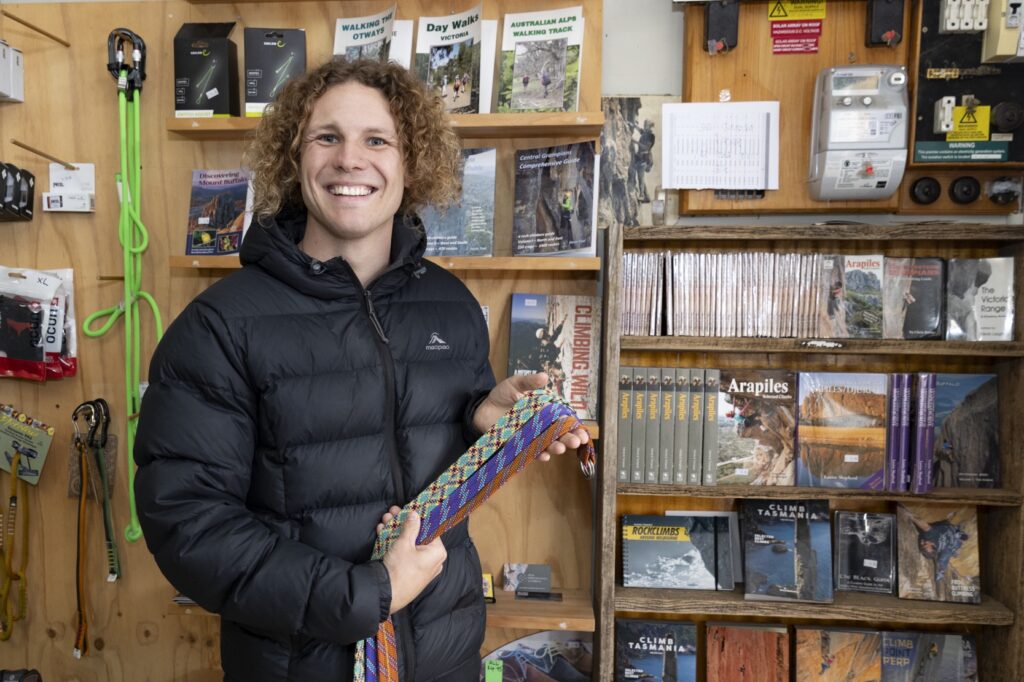
What began as a lockdown fix has evolved into a small business that transforms retired climbing ropes into dog leads, belts, keychains and more, upcycling the tools of adventure into everyday pieces with a story.
“I never planned any of this,” Sam admits. “I was just making something useful, then realised it was a great way to give old ropes another life instead of throwing them out.”
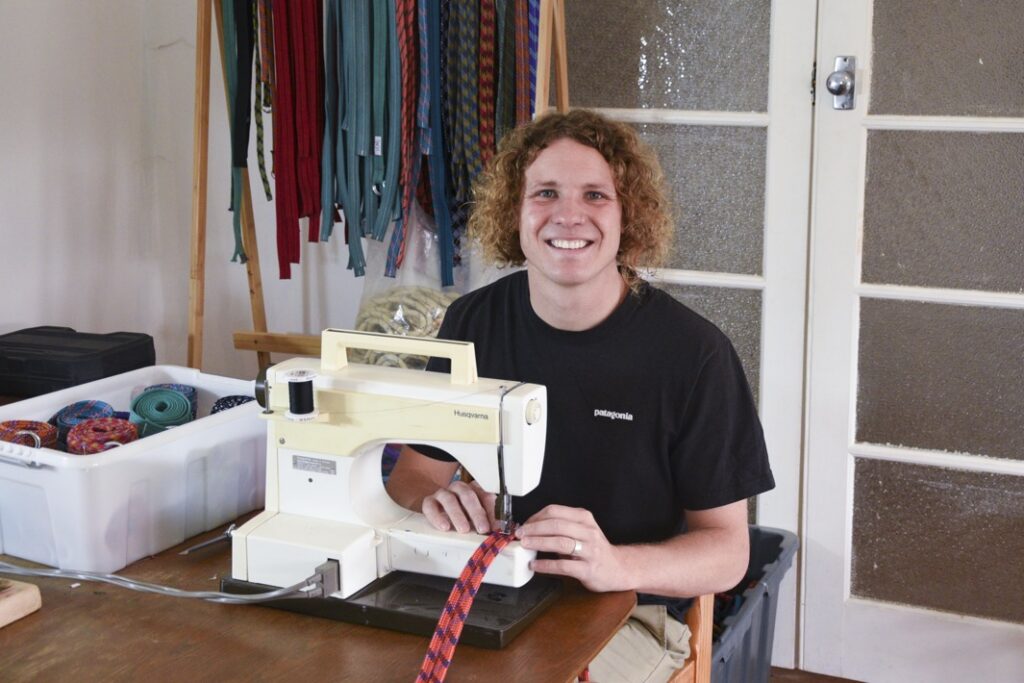
Handy by nature but with no background in sewing, Sam’s skills began on his grandmother’s old sewing machine. “I did a bit of Year 9 textiles,” he laughs. “When my grandma passed away, I got her machine and decided I was going to learn. That’s still the one I use today.”
Each product starts with a rope and a history. “I love knowing where a rope’s been,” Sam says. “Maybe it’s done thousands of metres of granite or caught someone’s first lead fall — those stories make it special. When people donate ropes, I always try to get a bit of the backstory.”
The process is simple but thoughtful: ropes are washed (not too perfectly), stripped of their cores, flattened, sewn, and reassembled into belts or leads. “I don’t scrub them till they’re pristine,” he explains. “The scuffs and marks are their perfect imperfections, part of their life on the wall.”
Some ropes arrive faded or frayed with age, but Sam leans into that. “They’re not meant to look new,” he says. “They’re meant to look loved.”
Ask him what his creations are, and he laughs. “Depends who you ask. My students call them fashion, they wear the belts hanging out of their jeans like cool kids. I think of them as a mix of all three: gear, fashion, and storytelling.”
And they’re not just for show. “They’re soft, they don’t dig in, and they sit perfectly under a harness or hiking pack. I forget I’m even wearing one half the time.”
Of course, working with old rope comes with trial and error. “I’ve had my fair share of belts explode mid-sew,” Sam admits. “Sometimes the thread wasn’t strong enough, or the stitch pattern didn’t hold. It’s been a lot of refining and learning on the go.”
He’s currently experimenting with sizing and waste reduction. “I can’t decide whether to make one-size belts people can trim down, or offer multiple sizes. Either way, I’m trying to keep waste to a minimum.”
As a teacher and environmental leader at his school, sustainability isn’t just part of Sam’s craft, it’s part of his life philosophy.
“I always tell my students, you don’t have to change the world — but you can make small choices that matter,” he says. “For me, this is one of those choices. It’s my way of doing something positive.”
When he started, he gave most of the belts away. “I just loved knowing they weren’t going to landfill. Making a bit of money now is a bonus, but that’s never been the motivation.”
Sourcing rope, however, remains a challenge. “There’ve been times when I’ve completely run out, no ropes, no product. But lately, more climbers have started donating their old lines. They love knowing their rope’s getting a second life.”
He laughs, “Don’t throw your ropes out! There’s so much more that can be done with them.”
His favourite colourway? No hesitation. “The Chameleon rope from Steve at Rock Hardwear in Bendigo, this wild blend of purples and blues. I made a belt from it with purple thread, and I wear it every day.”
And he’s not stopping there. “I’m experimenting with old slings and tapes — they’ve got amazing colours. I’ve also got piles of core material I’m testing for coasters or keychains. I’m just seeing where it goes.”
As part of a growing community of upcycling climbers, including Australian makers like Send On Upcycling— Sam sees collaboration, not competition.
“It’s not about who does it better,” he says. “The goal is to keep ropes out of landfill. If someone else is doing that beautifully — awesome. We’re all working toward the same thing.”
“If there’s one message I’d send to climbers,” Sam says, “it’s that ropes can live on long after their days on the wall. Don’t throw them out, find them a new purpose.”
To find out more and place an order, follow Sam on instagram @lead.vic
Katie McKinstry – Hyalite Designs
For Bozeman-based (Montana USA) climber and artist Katie McKinstry, the line between climbing and creativity has always been blurred.
“My love of climbing came first,” she says. “But I’ve always been a creative person. Before climbing, I was a professional horse trainer, I even designed the logo for the barn I worked at when I was about 14. So, creativity has always been part of me, but climbing became my true passion.”
That passion has taken her far. A self-confessed “horse girl” turned world-class ice climber, Katie has gone from managing barns in Washington to climbing volcanoes in the Pacific Northwest, scaling icy walls in New Zealand, and drytooling in Italy.
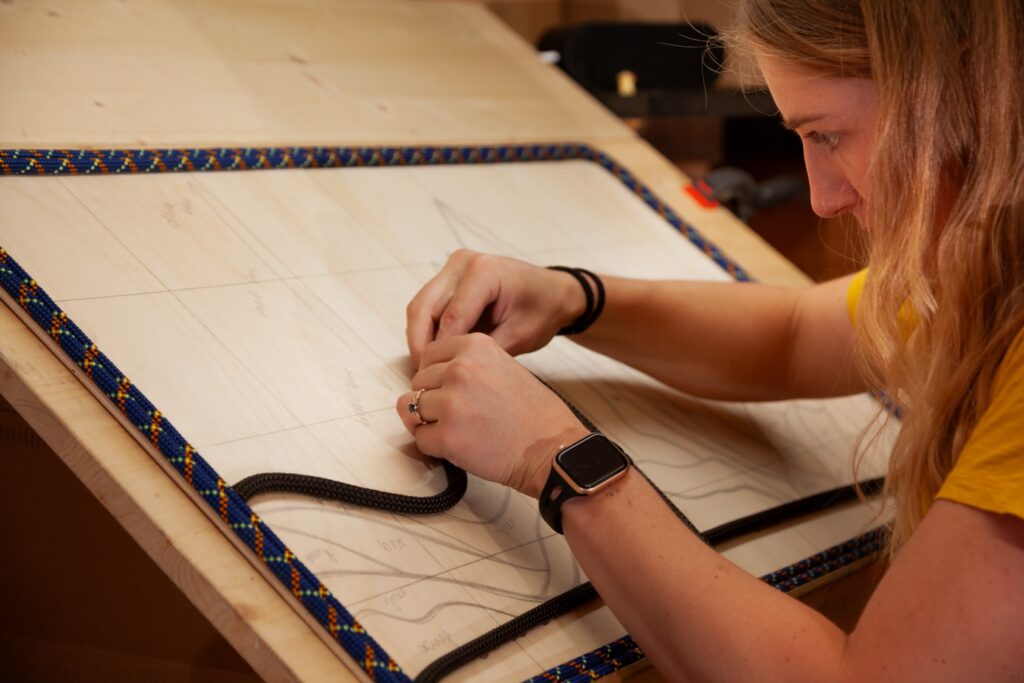
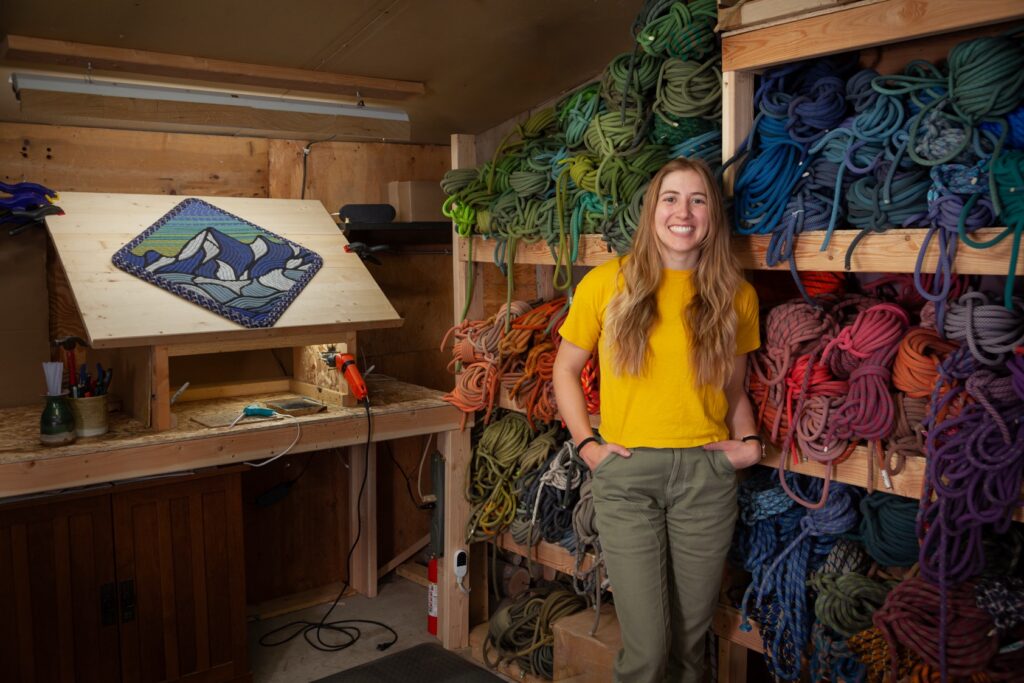
“We started in a small gym in Olympia, then got hooked on mountaineering — especially ice,” she says. “Now we live in Bozeman, which is one of the best places in the U.S. for ice and mountain sports.”
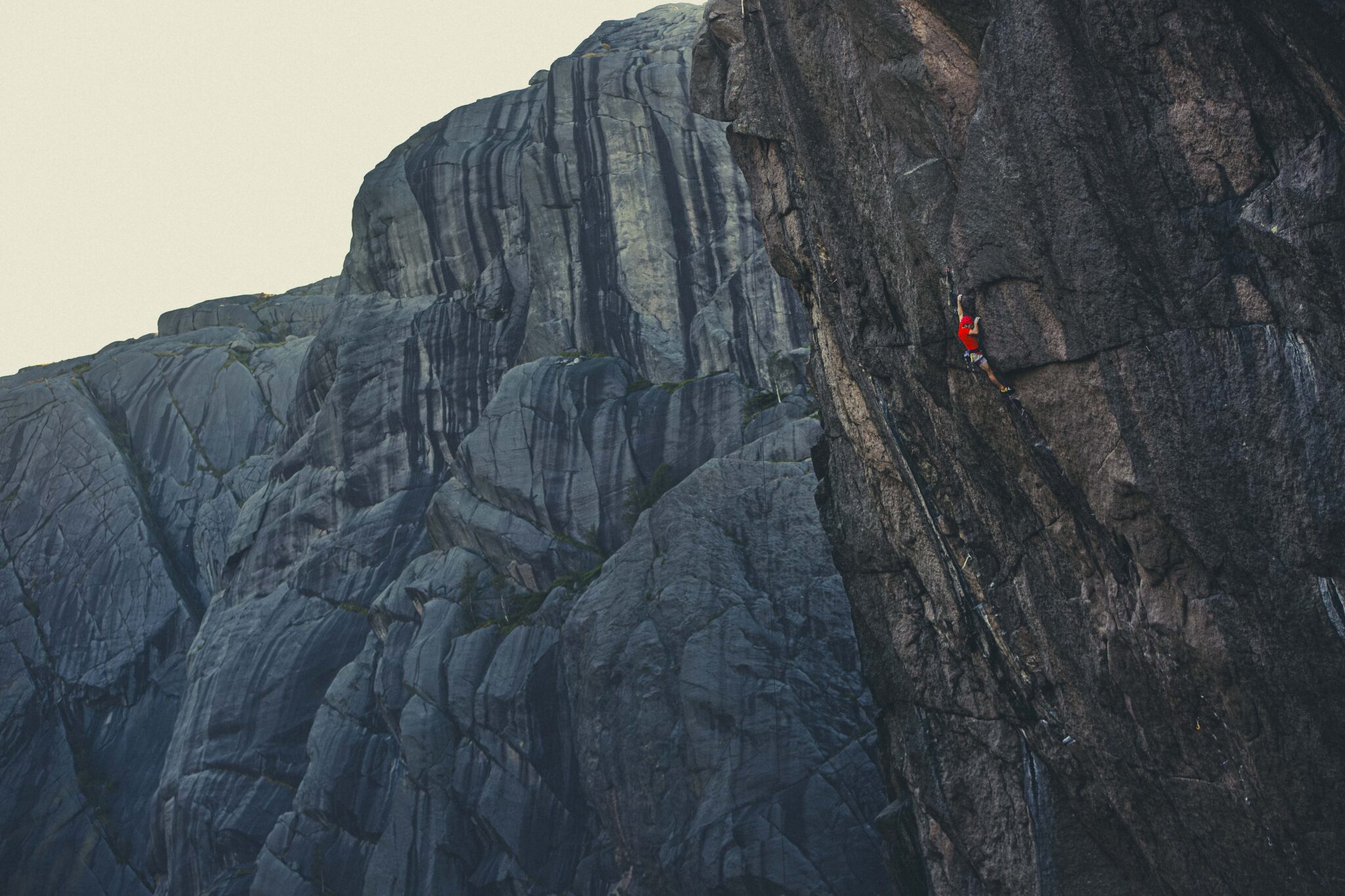
Her commitment to climbing runs deep. This past spring, Katie became the first woman in the world to climb Parallel World (D15+/D16–) in the Dolomites — one of the hardest drytooling routes on the planet. “It was the proudest I’ve ever been,” she says. “I’d never worked that hard for a climb before.”
When she’s not projecting on ice, she’s teaching others at ice festivals across the U.S. “I love climbing,” she adds, “but I also love sharing it.”
Katie’s rope art began, fittingly, in a climbing gym. “When I moved to Bozeman, I got a job at the local gym. There was a pile of old ropes, we couldn’t sell them, but we didn’t want to throw them out either.”
A coworker was experimenting with rope rugs and mentored her before eventually passing the torch and her supplies — to Katie.
“That gave me the drive to see where rope art could go,” she says. “Over time, it’s evolved into something of its own, almost a living, breathing form of creativity and expression.”
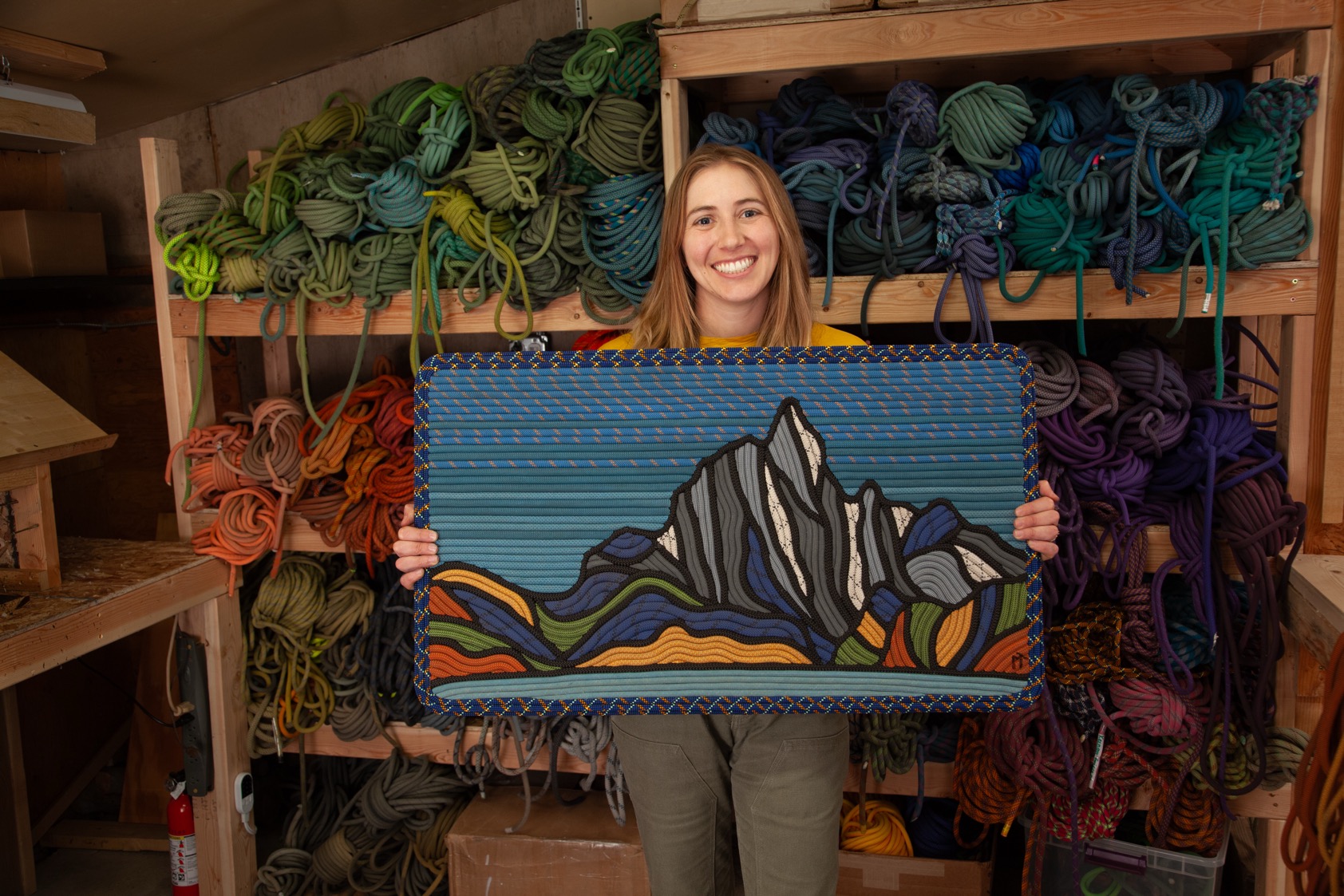
Today, her works range from intricate wall pieces depicting iconic peaks like Rainier and the Grand Teton, to abstract, colour-driven designs inspired by the ropes themselves. “I usually name them after the mountains they represent,” she says. “But sometimes I get more creative — Rainier at Dusk, Baker in Blush, The Great One. Maybe I’ll start naming them like routes one day!”
Katie’s studio is full of ropes and the memories that come with them. “I have a donation page on my website where people share their rope’s story, and it’s one of my favourite parts,” she says. “I’ve had ropes that were up Makalu, climbed Winter Dance in Hyalite Canyon, or blew a core shot on their very first pitch.”
Sometimes those stories come full circle. “I’ve made wedding gifts using ropes from a couple’s biggest climbs, and memorial pieces for families who’ve lost loved ones. I even made a piece for a friend using his rope, his mentor’s rope, and the one he sent his hardest project on. Those are the ones that really mean something,” she says
Ask Katie what ropes she prefers, and she doesn’t hesitate. “Soft ropes,” she laughs. “Gym ropes are crusty and stiff — a nightmare to shape. A nice soft rope with a thin diameter is a joy to work with.”
But she doesn’t just see rope as a material, she sees it as a record. “I love finding a stain, a core shot, or a worn patch. It’s like a physical memory of something that happened in the mountains. It makes me stop and wonder what story it carries.”
Even the smell, she admits, tells a tale. “They all have their scent, like the smell on your hands after belaying all day. It’s oddly nostalgic.”
Her approach to art mirrors her approach to climbing — patient, iterative, and full of problem-solving. “Sometimes I’ll rip up sections and redo them until they feel right,” she says. “But art is also where my projecting brain gets to rest. Climbing and art balance each other, one helps me recover from the other.”
That lesson, she says, comes from her early years with horses. “I learned there’s a kind of burnout you can’t come back from. So I protect my love for both climbing and art, because I want to keep doing them for a long time.”
For Katie, rope art isn’t just about aesthetics — it’s about perspective. “I want people to see how something built for a very specific purpose can become something completely new,” she says. “So many things in our world are made without thought for what happens after they’re used. We have a responsibility to think about the full life of what we make and use.”
Her work, she hopes, sparks that awareness, not just for climbers, but for everyone. “What’s surprised me is how much my art resonates with non-climbers too. It’s like the rope’s lived life speaks to people beyond the sport.”
And when asked which gives her a bigger rush — finishing a piece or topping out a climb — she smiles. “It depends,” she says. “Parallel World was a once-in-a-lifetime feeling. But some pieces in the studio… I step back, look at them, and just say ‘wow.’”
Check out more of Katie’s artwork on instagram @hyalite_designs
Tegan Luker — Send On Upcycling
When Tegan first picked up a harness, it wasn’t out of a lifelong obsession with climbing — it was because she needed one for her Certificate III in Outdoor Recreation.
“Completely backwards, I know!” she laughs.
After falling in love with hiking and the outdoors while living in London, she returned to Brisbane and signed up for the qualification thinking she’d become a bushwalking guide. But climbing was an elective, and she’d heard that having roped quals helped with employability. Prior to that, she’d only climbed indoors a handful of times and had never touched “real rock”.
That decision turned out to be a pivotal one. “Doing the guide training was so much fun,” she says. “When I started my work experience with Pinnacle Sports to get my logbook hours up, I just fell in love with the community.”
Eight years later, she’s still guiding for Pinnacle, running climbing and abseiling sessions at Kangaroo Point and the Glasshouse Mountains, and introducing countless newcomers to the sport. “Climbing attracts people who care deeply about the places we climb,” she says. “They’re endlessly supportive and encouraging. It’s such a special community.”
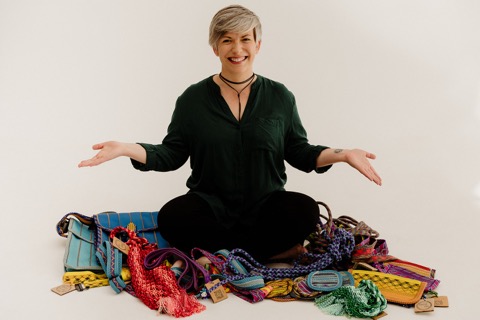
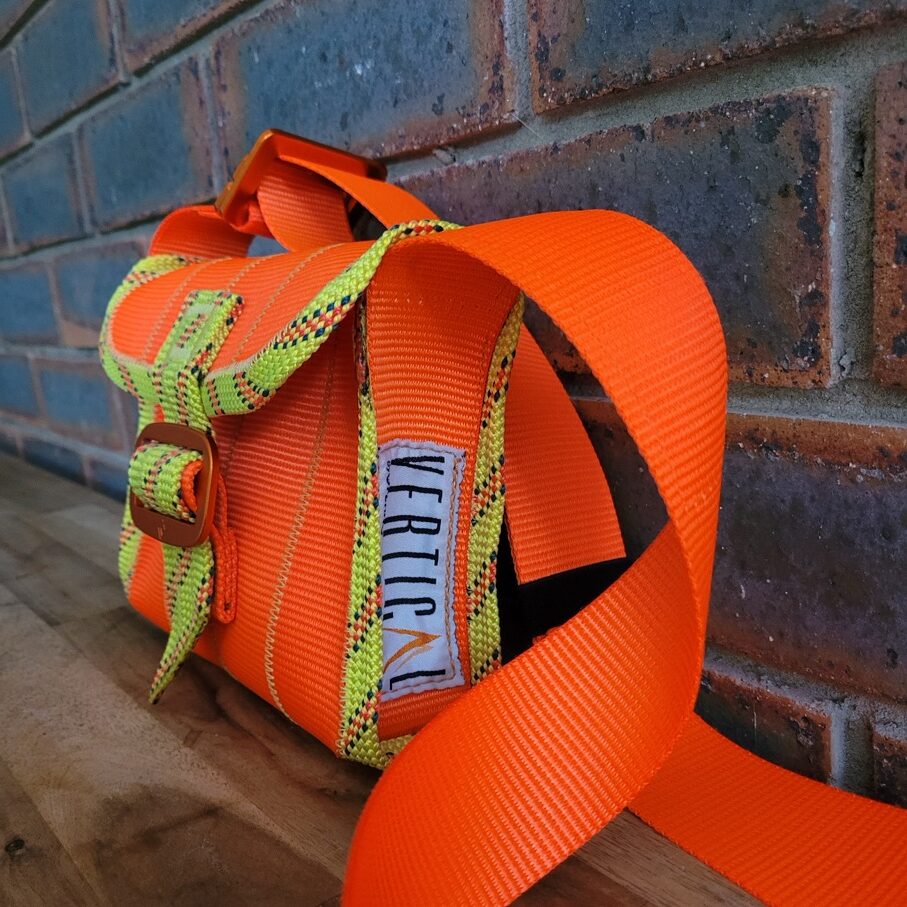
That sense of connection and care carries over into Tegan’s creative life, specifically, her project Send On, where she gives retired climbing gear a new life. Harnesses become satchels. Ropes become plant hangers, coasters, and macramé bags. Each piece is handmade, functional, and still carries a trace of its dirtbag past.
“I like leaving a little nod to what things used to be,” she says. “All the buckles on my satchels are taken directly from the harnesses themselves, and I’ll often leave the brand tag or even the warning labels visible.”
Tegan’s creative streak runs back to childhood. “I was a pretty creative kid, I loved writing stories and doing cross stitch,” she says. “But like a lot of people, I stopped during my teenage years and only picked it up again in my late twenties.”
In 2013, while living in the UK, she set herself a challenge: try something new every month for a year. “I did everything from white-water rafting to indoor ice climbing (yes that’s really a thing) to cross-country skiing,” she recalls. “My dad joked that I should slow down and learn to knit — so I did. And I loved it!”
That love for hands-on making stayed with her, eventually merging with her passion for sustainability. Having worked in outdoor recreation for years, she’d seen how much gear gets retired and thrown away. “It was being cut up and sent to landfill, purely because there was nothing else to do with it,” she says. “I knew there had to be a better solution.”
She began researching and found a growing community of makers overseas who were turning old ropes into functional art. “There wasn’t much happening locally,” she says, “so I figured, why not give it a go?”
There was one small problem: she didn’t know how to sew. “So I bought a machine and learned from YouTube,” she laughs. “We live in such an amazing age — the knowledge is right there if you want it. There’s no gatekeeping anymore.”
Her early experiments were clumsy, but curiosity drove her forward. Knife rolls from old harnesses took the most trial and error. “Harness webbing is not exactly forgiving material,” she says. “It’s thick and stiff, but once you get it right, it’s so satisfying.”
Now, Tegan’s creative process begins with what she has, not what she wants. “I only use upcycled or reclaimed parts,” she explains. “That limits me, but it’s a good kind of limitation. It makes me more inventive.” She scavenges Brisbane’s Reverse Garbage and The Nest for hardware and haberdashery, always looking for parts that can be reused.
Not every piece of gear comes with a backstory, but occasionally she receives something special. “I was once given a stack of Whillans Sit Harnesses — the first commercially available sit harness from the 1970s,” she says. “I just can’t bring myself to cut them up. They’re pieces of climbing history.”
Even the rope core — the part hidden inside the sheath — doesn’t go to waste. After realising how well nylon absorbs dye, Tegan began transforming the stained, grey inner strands into colourful macramé creations: plant hangers, bracelets, even crochet coasters. “I dye them on the stovetop,” she says. “The colours come out beautifully vibrant.” The only problem is space — “I’ve got boxes of braided core waiting for their moment,” she admits.
Between part-time guiding and raising two-and-a-half-year-old twins, Tegan’s time for Send On is limited, but her list of ideas is endless. “Turning an entire rope into a rug is high on the list,” she says. “It’s that classic climber dream — everyone swears they’ll make one, but who actually does?”
And to anyone still hanging onto a crusty harness in the back of the closet, she has one final message: “Nice one for not chucking it, but it’s time to let go, mate. Let me turn it into something new.”
To find out more, follow Tegan on instagram @sendonupcycling