JANNU: Climbing one of the hardest faces in the Himalayas
From the 2001 Rock Magazine archives, this gripping firsthand account follows an audacious push on Jannu’s formidable North Face—storms, spindrift, and near-disaster on one of the Himalaya’s most coveted unclimbed lines.
Words by Athol Whimp Images by Andrew Lindblade & Athol Whimp
In 1986 I read the Wall of Shadows, an account of the 1975 New Zealand expedition that first attempted to climb Jannu (7710 metres) from the north. The climbers tackled the ‘Wall of Shadows’ vast ice-fields of the North Face-but failed below the summit ridge when winter storms and a dwindling team effort forced them from the mountain. The next season the Japanese reached the summit after fixing thousands of metres of rope up the Wall of Shadows and following the precarious East Ridge to the summit.
Andrew Lindblade and I are drawn to the massive, unclimbed headwall of the North Face and decide to attempt the unclimbed North Face Direct. This direct route would present us with a myriad of logistical and technical challenges and would push us to the limit. Without doubt it is one of the most difficult and prized unclimbed routes of the Himalayas. From a base camp at 4500 metres on a terrace above the Jannu Glacier, the route crosses the glacier and climbs up steep cliffs to the névé at 5400 metres.
This is where the route really starts. A steep, icy couloir (gully) shoots 1500 metres diagonally up the face to a hanging glacier that clings precariously to the mountain at 7000 metres. There, in the thin air and freezing temperatures of a cold Himalayan north face, sits the sheer headwall, 700 metres of compact, vertical and overhanging rock leading to the airy summit.
After eight days’ walking we reach the site of our Base Camp, a beautiful, grassy terrace about 100 metres above the Jannu Glacier. Behind our camp, granite cliffs rise up a couple of hundred metres to vast scree slopes. Opposite Base Camp, on the other side of the glacier, massive cliffs rise 1000 metres up to the névé. An almost unbroken line of ice-cliffs tops the faces and huge avalanches thunder down into the valley throughout the day and night, the biggest ones sending a cloud of ice particles floating over our camp.
We spend the next three weeks establishing a route and packing the gear we will need for our climb up to the névé below the wall. We pick a line used by most expeditions who have attempted Jannu from the north, and first established by the 1975 New Zealand expedition. It takes a couloir from the glacier up to the cliffs and then a rising traverse across the cliffs to a broad snow-slope, where, at around 5100 metres, we establish an intermediate camp. From Camp 1 we climb up the snow-slope, a couple of small rock buttresses and finally to the edge of the névé at 5400 metres, where we set up Camp 2.
Relics from past expeditions indicate that this site has been well used. This is a period of acclimatisation and for getting in tune with the mountain. We also get an understanding of the weather, which proves to be unsettled and unpredictable.
On 6 April 2000 my girlfriend Panagiota and Andrew’s sister Katherine and her friend Dougal leave Base Camp to return to Australia. It is very sad to watch them disappear from view down the valley and we feel very alone. Now it’s just Andrew and I and our two Nepalese Base Camp staff. Without any distractions we are free to commit ourselves to the climb. The same day our friends leave, we take our last loads up to Camp 2 and prepare for the route.
Over the next few days we fix a couple of hundred metres of rope over the bergschrund (a major crevasse) at the base of the wall and up the bottom of the couloir that soars 1500 metres to the headwall. We haul the Porta-ledge and haul bag with 14 days’ supplies up to the top of the fixed rope. Hauling is extremely strenuous, harder than the climbing. Even with the haul bag on a two-to-one pulley system we have to throw our body weight against the rope to move the bag.
The first spindrift avalanches begin just as we finish setting up the Porta-ledge. At first, small avalanches slither past us, hissing down the couloir, but within minutes huge torrents of snow are thundering down, spilling over the tiny rock outcrop above us, crashing down on the Ledge, pummelling us as we hang on the belay. We finally manage to get inside the Ledge, crampons and all. There is snow everywhere, but at least we have some shelter. We lie there in the chaos, panting and swearing.
A couple of times each minute the Ledge gets battered and the roar from the continuous spindrift in the couloir- only a metre away-intensifies. Slowly we get ourselves organised. Working one at a time due to the confines of the Ledge, we remove our crampons, boots and wind suits and get into our sleeping bags. Every time the Ledge is hit, fine snow floats in through the vents, adding to the mess. We assemble the stove and soon get a brew going. Outside it is getting dark, but there isn’t any let-up in the snowfall. It is beginning to look like something more severe than just a typical afternoon storm.
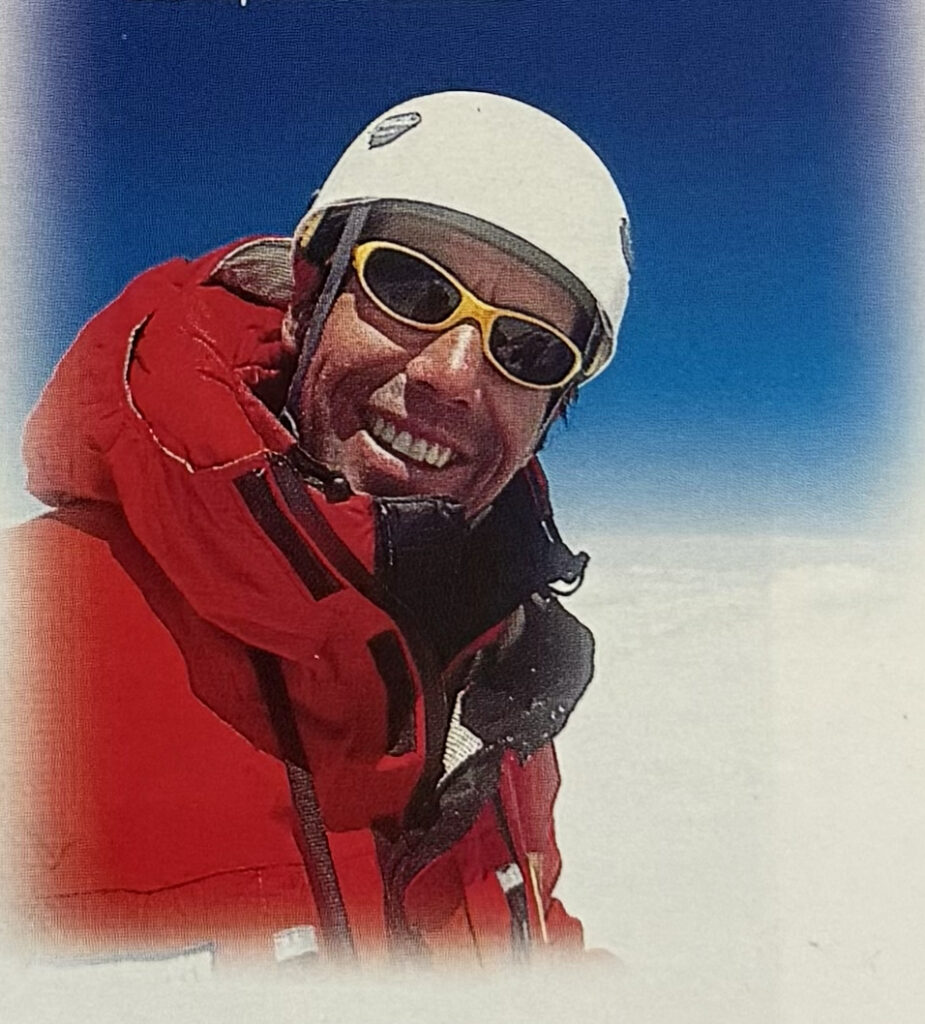
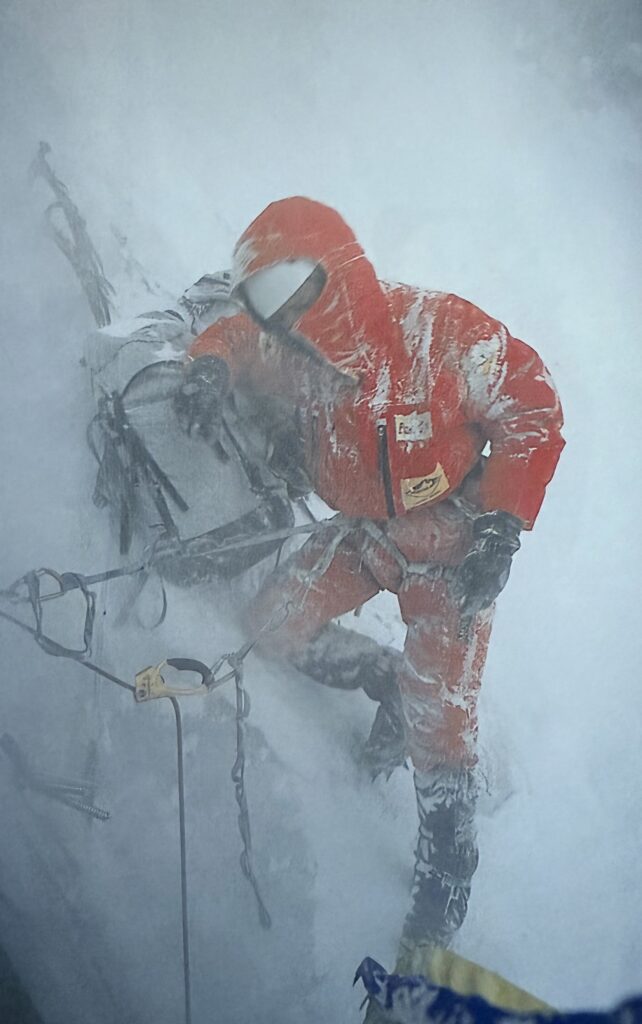
Left: Athol Whimp Right: Lindblade suffering the spindrift at about 6000 metres during the team’s first attempt on the North Face Direct. Rock Magazine 2001
Andrew and I are at 6000 metres on one of the hardest, unclimbed mountain faces in the world. Our tiny Porta-ledge, just one-and-a-half metres wide by two metres long, is hanging off three tied-off ice-screws on the edge of a steep, icy couloir 1500 metres above Base Camp and 1700 metres below the summit.
It is dark outside now and around us the storm continues to build. Flashes of lightning momentarily illuminate the interior of the Ledge. Snow covers everything. Thunder crashes around us, echoing off the huge walls of rock and ice, so loud and sudden that it makes us jump even though we’re expecting it.
Spindrift avalanches continue to pummel us, and the roar from the couloir does not cease. We are in the centre of a huge storm. We have to shout to hear each other. All night the storm continues unabated. Dawn slowly arrives and still the storm goes on. Snow has built up behind the Ledge, constricting the tiny space even more, and tilting the floor. Much of our gear is filled with snow and our sleeping-bags are damp. We realise that we cannot stay where we are; we must shift the Ledge or descend. I dress and climb I out into the storm. Spindrift cascades down on me, draining the heat from my body. I try to clear the snow from behind the Ledge but I cannot make any progress against the spindrift. We decide to pack up as best we can and descend.
We dismantle the Ledge, attach it and the haul bag to the anchor and abseil off. We try to keep to the edges of the couloir, but even so we are engulfed by spindrift many times. When we reach the névé in the early evening, the storm has all but finished; however, spindrift continues to cascade off the vast rock-and ice-faces surrounding us. Bathed in the beautiful glow of twilight, we plough wearily through half a metre of new snow back to Camp 2.
The next day we descend to Base Camp for a well-earned rest and to re- stock the depleted reserves of our bodies. At Base Camp we wash clothes, listen to music and read. A yak herder visits us and a keen trader from the village of Ghunsa arrives to sell us a couple of bottles of beer and some potatoes.
A week later we are once again at Camp 2 and ready for another attempt. After a 3 am start we cross the névé and Jumar up the couloir to the top of the ropes we fixed during our descent from the storm. We climb up to the Ledge and haul bag and manage to climb and haul another 100 metres by late afternoon. After our last experience we want a sheltered site for the Ledge, and find a small rock buttress we hope will give us some protection from the spindrift.
Anchors are hard to find and I have to climb up a further 20 metres and place a couple of pitons. We hang the Ledge from the rope and just manage to get inside as a snowstorm sends spindrift down the couloir. It stops snowing during the evening and when the spindrift ceases the mountain is eerily quiet. We sleep well but very early in the morning we are woken by a thunderous crash of rockfall down the couloir. We go back to sleep and wake up just before dawn.
We make a couple of hot drinks, eat some breakfast and prepare for the day’s climbing. Andrew dresses first and is just about to exit the Ledge when we hear a sickening crash above us. Suddenly the Ledge is smashed by a hail of rock and ice. Rocks tear through the fabric and we are surrounded by flying debris. We hunch against the wall as the Ledge kicks and shakes. As suddenly as it started, it is over. Small trickles of snow float down on us. The Ledge fly is shredded and the Ledge is full of rocks and ice. Miraculously we are unhurt.
For the next hour Andrew digs the haul bag out of the spindrift and packs our gear while I try to repair the Ledge. Slowly the gravity of the situation dawns on us. The Ledge is beyond repair, and without it we cannot continue. We discuss our options and both feel sick with disappointment as we realise that we must again descend. We look across to the Wall of Shadows and decide to make an alpine-style ascent of that route.
After another spell at Base Camp we are back at Camp 2 and ready to go. Two hours before dawn we quietly pack up Camp 2, leave a note among our gear should we not return, and head across the névé for what we hope will be the last time. We are fit and acclimatised and make good time to the base of the wall. We Jumar 200 metres of rope that was fixed the day before up the steep, mixed buttress at the base of the wall and emerge into sunlight at the start of the ice-fields.
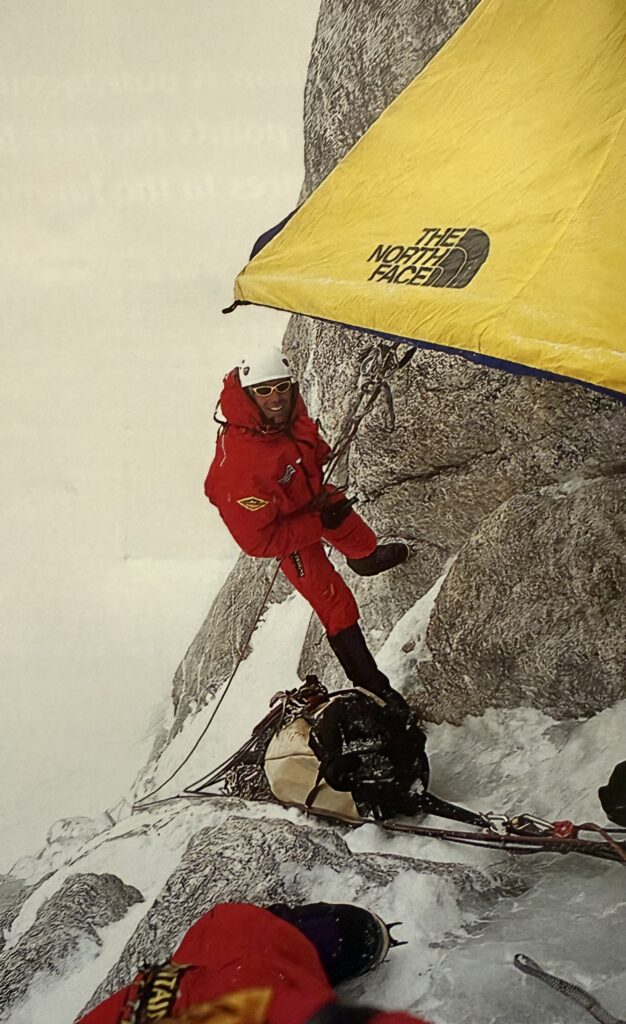
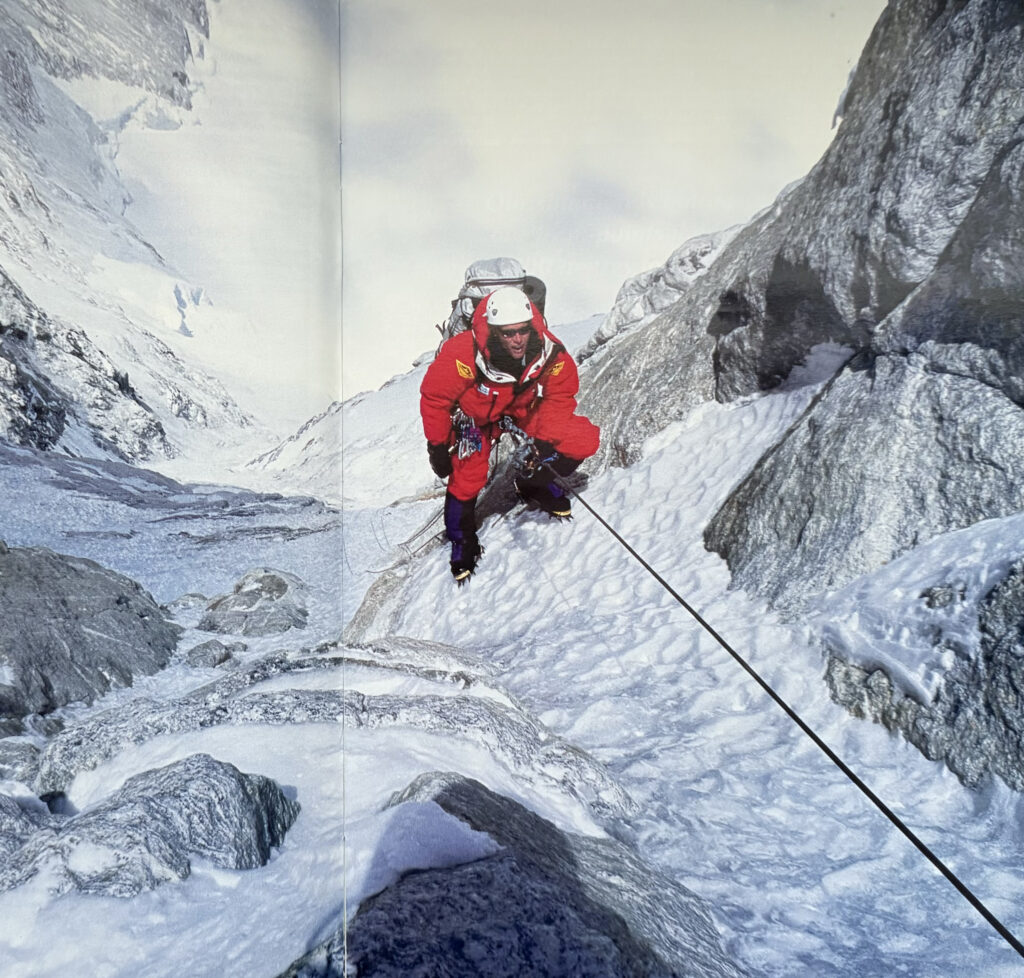
Left: Home Is where the Ice-screw is Whimp setting up the Porta-ledge at about 6100 metres. Image by Lindblade Right: Andrew Lindblade in the couloir at about 6000 metres during the pair’s second attempt on the North Face direct. Rock magazine 2001
A thousand metres above us-seeming to hang out over our heads-massive, leaning seracs (ice-towers) challenge our very existence, daring us to cross the exposed ice-slopes ahead. For the past week we have been mentally conditioning ourselves for this ‘Russian roulette’. For the next hour or so we are in the firing line. With the rope packed away we climb up and across the steep, polished ice-slopes, constantly casting nervous glances above us. There is nowhere to run, nowhere to hide.
Without incident we make it to the relative safety of the lower of two hanging glaciers that are the dominant features of the Wall of Shadows. We traverse underneath the hanging glacier and emerge into a broad, steep couloir that winds up the side. By midday the oven-like heat from the sun is starting to sap our strength. A few hours later we are near the top of the hanging glacier at 6400 metres. In the shelter of a small ice-wall we chop a platform for our tiny tent. Just as we finish pitching it an afternoon snow-shower sends waves of spindrift hissing down the face.
In the morning we climb to the top of the hanging glacier and then up a steep ice-rib for 100 metres. Above us the face steepens, broken by several rock-bands. We get the rope out, wind in a couple of ice-screws and start to climb, pitch by pitch. The hard ice and heavy packs make for strenuous climbing. The second Jumars the rope and we make steady progress. We get stunning, close-up views of the stupendous headwall of the North Face Direct-our original objective and speculate on the line, and how we would have gone. The sheer enormity and complexity of the head-wall almost leaves us speechless.
By mid-afternoon we have climbed seven hard, steep pitches and, with the build-up of cloud and signs of snow, we decide to traverse to the second hanging glacier and look for a tent-site. Even before I start the pitch it is snowing and torrents of spindrift are hurtling down the couloir we have to cross. I traverse steep, bulletproof ice into the couloir. It’s strenuous climbing and I struggle to wind in an ice-screw to protect me when I launch into the river of spindrift. I fight to maintain my footing, my crampons scratching at the ice under the torrent. Finally, exhausted, I reach the shelter of an open-ended crevasse and belay Andrew across. Like me, he battles the spindrift and arrives frozen and exhausted. We have a great tent-site, a natural ice cave with a roof to keep out the spindrift.
The next day we climb only a couple of hundred metres-up to the ‘schrund at the top of the second hanging glacier. Here, at around 7000 metres, we pitch the tent under the huge, overhanging, upper wall of the ‘schrund. We spend the rest of the day eating, drinking and sleeping in the sun. It is a magnificent site; the face drops away dramatically and the headwall looks close enough to touch. The Himalayas stretch away to the horizon and to the north the mountains fade into the brown plains of the Tibetan Plateau. The sunset is phenomenal; the headwall turns red, and the sun slowly sinks among the monsoon clouds, silhouetting the giants of the Everest group.
It’s 1.30 am, very cold and very dark. We pack only a little food, the stove, the rope and a couple of pitons and ice-screws. With our head torches on we climb out of the ‘schrund and on to the sweeping ice-fields that lead up to the East Ridge. There isn’t any moonlight but we can vaguely make out the huge, striped rock buttress above us, round which we have to climb. Front-pointing up the ice we make good progress, concentrating on the circle of ice illuminated by our headtorches. I pause for a rest and turn off my head torch. I look across at Andrew as he climbs towards me, a small circle of light playing over the glistening ice. He stops next to me and turns off his torch. As our eyes become accustomed to the dark we try to make out the route above.
The cold quickly invades our clothing and we continue upwards, carefully climbing a thin ice-ribbon through a small, steep rock-band. The buttress looms above us and we traverse underneath it and up towards the ridge. Dawn comes slowly as we near the top of the ice-fields. The sky brightens and light invades the valley below.
Our situation is outrageous. Beneath our front-points the face falls away 3000 metres to the Jannu Glacier; the towering rock buttress to our right is striped with horizontal bands of black shale that are tinged red in the morning light. We continue upwards towards the ridge, heading for a weakness in the rock-band that guards the ridge. On the way I collect a piton and karabiner from the edge of the buttress for a souvenir.
Below the rock-band we get out the rope. Andrew belays me as I climb up the steep rock step and on to the ridge at about 7400 metres. I sit in the snow, dig my heels in and call for Andrew to follow. Our view to the summit is blocked by a step in the ridge. We climb over a small ‘schrund and up steep, soft snow to the top of the step.
The view along the ridge to the summit fills us with despair. The ridge is long and intricate. Huge cornices hang off the southern side and the northern side drops away steeply to the North Face. Several steep steps finally lead to the precarious summit. It is obvious that we can’t make the summit and return to our camp in one day. We haven’t any bivvy gear with us but we have the stove. We decide to climb on and bivvy on the descent.
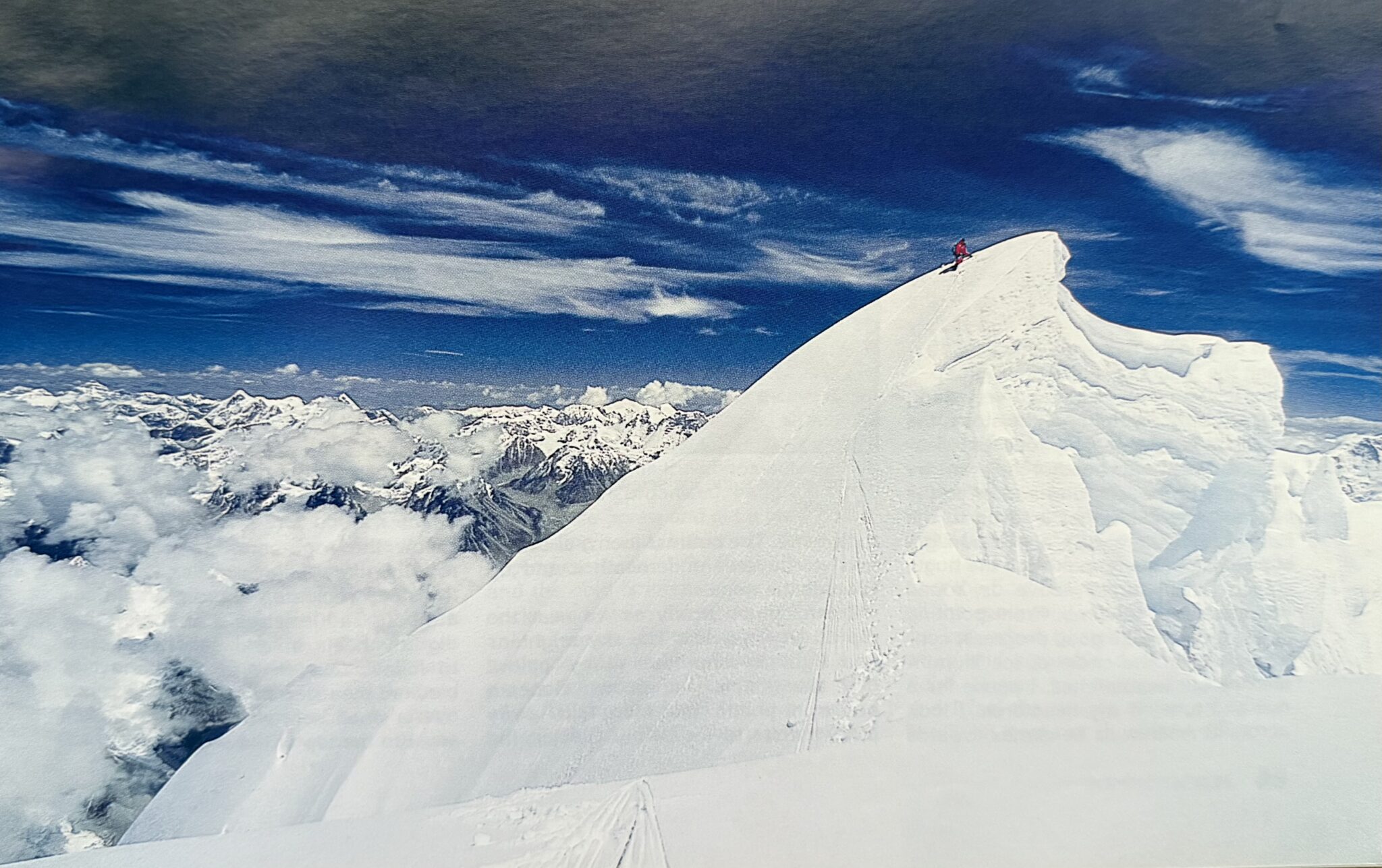
Like two very old men bent over their walking-sticks, we hunch over our ice-axes, breathing deeply. I turn to look at Andrew, a few metres away. His red suit stands out brightly against the white snow and the deep-blue, almost black. sky. Our meandering tracks in the knee-deep snow, like those of a small beetle foraging for food, trace our route back along the ridge. Behind Andrew the steep, fluted flanks of the East Peak of Jannu glisten in the sun while further away the mighty South Face of the five-summited Kangchenjunga massif completely dominates the view.
I straighten up and focus my camera on Andrew, framing the shot to catch the wisps of high cloud that could warn of the approach of the hurricane-like winds that batter this part of the Himalayas. The shot captures the essence of why we are here; the physical struggle, the awesome beauty, and our detachment from civilisation. The deliberate, mechanical sound of the shutter causes Andrew to look up. ‘Awesome shot, Andy’, I say. He straightens up, I put my camera away and once again we turn to the task at hand, climbing the last several hundred metres to the summit of Jannu.
I sit astride a small snow-ridge and dig my heels into the snow. ‘OK’, I shout into the wind and swirling snow as I pull the rope tight. Eventually Andrew arrives. ‘Across this gully and up the side of that rock buttress’, I say. It’s 5 pm and we are only about 100 metres from the top. Andrew heads off, traversing the steep gully. I can hear a buzzing, crackling noise-like an electrical appliance about to short out. The noise intensifies, and I realise that it is coming from me, from my helmet. Static electricity surrounds me and shocks start to shoot through my body. Fuck, I feel as though I’m about to explode. ‘Andy’, I scream, pulling at the rope, ‘come back, come back!’ He understands what is happening and hurries back to me. He can hear the buzzing noise and it begins to affect him too. ‘Quick, there’s a small ice-cave about ten metres down there. Go.’ I shout.
The sudden tranquillity of the ice-cave is as shocking as the chaos outside. We get ourselves organised, hang the stove from an ice-screw and get a brew going. A freezing wind blasts up through a gaping crevasse in the floor of the cave and the cold is intense. We change our socks and make ourselves as comfortable as we can for the long night ahead.
It is soon dark and for the next 12 hours we concentrate on keeping our feet alive. During the night the temperature plummets to -20°C. We put chemical toe warmers in our socks and massage our feet to keep the circulation going. The night passes painfully slowly but the task of avoiding frostbite keeps us occupied. At 6 am we make another hot brew and leave the cave for the summit.
A rising traverse on the south side of the ridge leads me to the airy summit. I stand just below the top and dig my tools into the snow. Andrew arrives and we stand together, looking out over the Himalayas, choked up with emotion. We spend about half an hour on the summit before starting the long descent.
We slowly climb back along the summit ridge, the sun and soft snow sapping what little energy we have left. Darkness catches us just after we abseil the rock-band to the top of the ice-fields. For the next four hours we carefully down-climb the steep ice-slopes to our tent in the ‘schrund. We arrive at 10 pm, exhausted and dehydrated. The next day we rest, sitting and dozing in the sun, and the following day we down-climb and abseil the face to the névé and Camp 2.
I linger on a grassy moraine ridge and cast a final glance up at the mountain; Andrew and the porters have gone on ahead. I look up at the face and slowly shake my head as I recall our incredible journey into the unknown. The hours of endless front-pointing up and down the vast ice-fields, our dance along the precarious summit ridge, the freezing night in the ice-cave. Powerful memories to last a lifetime. A gust of cold wind brings me back to the present. Cloud drifts over the East Ridge and slowly obscures all the mountain except for the summit ice-cap, which glistens in the sun. I turn away and scramble down the moraine ridge. Before me the valley opens up. and I feel the weight of the expedition finally lift from my shoulders.
Bio: Athol Whimp is a New Zealander who spent his childhood among the mountains of the Southern Alps, where he developed his passion for mountaineering. At present (2001) he lives and works in Melbourne managing his own property development business.