Type-Two Cotopaxi Adventure
In this extract from The Gap Years, Tom French returns to Ecuador, a country he first discovered through mountaineering in his youth. Now in his 60s and several years into a personal journey of rediscovering adventure, he joins climbing partner Mark Pattison for an ascent of Cotopaxi, Ecuador’s iconic 19,300-foot volcano. What begins as a relaxed acclimatisation trip quickly becomes a race against deteriorating weather and time. From torrential storms and flooded mountain roads to a freezing ascent through the darkness, French captures both the exhilaration and suffering of high-altitude climbing, culminating in a spectacular sunrise summit and a hard-earned lesson in the meaning of Type 2 fun.
At the end of 2019, Tom French retired from a four-decade career in business, determined to return to interests that had defined his youth and see what meaning they still held. One of these interests was mountaineering. Another was adventure travel, with a particular focus on Nepal. A third was cross-country ski racing. Over the following three years, he rebuilt his athletic strength, competed in cross-country ski marathons, and climbed some of the world’s highest mountains, including two expeditions to Everest. On the first Everest climb, a cyclone forced him to turn around high on the mountain and descend the treacherous Lhotse Face in a blizzard. On the second, he approached the mountain through the remote Makalu Barun region, the first Everest climber ever to do so, and climbed to the summit on a moon-lit night. In his book, The Gap Years, Tom finds beauty and joy found in wild places, about cross-country ski racing and mountaineering more broadly, and—most of all—about a journey to find meaning in life and reconnect with the passions of youth.
We’re privileged to share an extract from one chapter of Tom French’s inspiring story.
Enjoy!
Cotopaxi – Chapter Extract
In December of 2021, I joined a climbing friend for an ascent of Cotopaxi, a 19,300-foot volcano in Ecuador. Mark Pattison and I had climbed together in Antarctica in 2019 and remained friends. He had also been on Everest when I was. Mark had an interesting life story: one that had lot to do with the power of goals. After playing football in the NFL, he had a hard time finding structure and meaning in retirement. Experiencing some deep personal lows, he found salvation in the mountains and set a personal goal of climbing all of the Seven Summits. Everest had been his seventh, and he was now sorting out what came next.
I welcomed an excuse to return to Ecuador, where I hadn’t been since the climbing days of my youth. I recalled with fondness its mix of Andean mountain towns, tropical valleys, and snow-covered volcanoes. Before climbing Cotopaxi, we would spend a week climbing smaller volcanoes to get our bodies ready for higher altitude. Mark’s girlfriend Darci Hanson would join us for the lower elevation hikes. I could do it all in nine days, door to door from Boston. Jill dropped me at the airport early one morning, and by late that night I was checking into my hotel in Quito.
The next morning, Mark and Darci arrived, and we met up with the guide we had engaged. David Garcia was a talented climber in his late twenties; experienced beyond his years in leading people on the peaks of Ecuador. He embodied an endearing mix of technical competence, exuberance at being in the mountains, and younger generation hipness. His small blue Chevrolet with South American techno and salsa music pulsing from its speakers became our team’s transport vehicle. We spent the first couple of days doing hikes in the mountains above Quito. Then we moved up to the highlands, where we stayed in a series of charming mountain lodges and acclimatized with a progression of ever higher hikes and climbs.
Among practitioners of endurance sports, there is the concept of “Type 1” and “Type 2” fun. Type 1 is the kind of fun you experience in the moment, doing things that are immediately pleasurable. Powder ski runs and picnic lunches on top of sunny mountains are examples. Type 2 fun is the kind of activity where, at the time you are doing it, you are physically miserable and just want it to end. However, after you are done and reflect on it, it becomes deeply satisfying. Mountain climbing generally involves a mix of both types of fun, with the amount of Type 2 increasing with the steepness and height of the mountain. Climbing Everest had been almost entirely Type 2. This Ecuador trip was almost entirely Type 1. In our acclimatization hikes, we moved at a measured pace, stopped to enjoy the views, and returned to hot showers and delicious meals.
The weather in the Ecuadorian highlands was highly variable, alternating between sun, clouds, rain, and thunderstorms. It was not unusual to experience all four in a single day. One day, we rolled out of bed to clear skies and bright sun, with a stunning view of Cotopaxi rising above verdant, open hills. After breakfast, we drove to the trailhead for our day’s hike. As David’s car bounced along the rutted dirt road with samba music blasting at high volume, I looked out the rolled-down window at tropical greenery and had an intense feeling of being exactly where I wanted to be. Stopping at a small cottage, David banged on the door and exchanged some cash for a gate key. We drove through the gate, up a steep track, and parked in a small turnout on the lower flanks of a 15,000-foot volcano named Ruminahui. After several hours of hiking, we were about three quarters of the way up. Clouds began drifting in, and we could see a front approaching. Darci decided to wait beneath a large boulder while David, Mark, and I continued to the top. The storm would soon be upon us. Approaching the narrow summit, we sprinted to the top, then dropped back down to Darci. The four of us descended together in heavy rain and hail, with lightning strikes all around.
Back at the car, we pulled on dry clothes and began driving through desolate upland hills to our night’s lodging, which was located on plateau a thousand vertical feet above us. The dirt road grew narrower and rockier as it ascended a steep ravine. We began encountering rivers of water flowing down the road, runoff from the storm. The rivers grew deeper, and David’s car increasingly had trouble making progress. We rounded a turn and were brought to a stop by a motionless line of trucks and cars. The one-way track was covered by a raging torrent. No one could proceed, and there was no room to turn around. A short hike around a corner confirmed that we would not be moving anytime soon. The road disappeared into a deep pool of water, and a medium sized truck carrying gasoline was unable to get through. It had made several attempts and was now partly stuck, perched precariously on a rock rib in the water. We returned to David’s car, pulled on jackets to keep warm, and settled in to see how things would play out. We considered trying to hike to the lodge, but it was too far. Also, David didn’t feel he should leave his vehicle with all of our climbing gear unattended overnight. We would have to wait for the waters to recede. In front of us, a group of lightly dressed laborers and their families were crowded into the open back of a pickup truck, shivering in the rain.
The rain lightened, but the volume of water cascading down the narrow track did not. It would be at least several hours before the runoff abated. Then, a wonderful thing happened. Country people, men and women, appeared from nearby cottages with picks and shovels. They waded into the deepest pools in the road and began moving boulders to create a passage. While they worked, the passengers of the pickup lit a bonfire in an adjacent field and huddled around it for warmth. It began to get dark. Eventually, it was decided that the first truck should try to push through. Gears grinding, it made several attempts, shimmying dangerously close to deep ditches. Finally, just barely, it succeeded. The other vehicles began moving forward. The group around the bonfire climbed back into to the pickup. David was worried that his car lacked sufficient power. To lighten the load, Mark, Darci, and I ran ahead and joined the group in the pickup. They squeezed together to make room for us. We wedged ourselves between the cargo area and the cab, holding onto the roof as the truck bounced and jolted its way successfully through the deep pool. Then we jumped down and stood on a large boulder on the side of the track while David gunned the Chevy’s small engine. Swerving wildly, he reached the other side. Cheering, we climbed back in and drove the remaining distance to our lodge.
That night, as light from a kerosene lantern flickered on the walls of my simple room, I settled under a heavy woolen blanket and replayed the day’s events. I had loved every bit. The part that would endure longest in memory was the narrow track filled with torrents of water, the villagers emerging out of nowhere with shovels and picks, the laborers and their families gathered around the bonfire in the field, and crowding into the back of the pickup as it jostled its way to the other side of the deep pool. Years ago, that kind of vibrancy had been an integral part of daily life. It was nice to be returning to it, if only for a while.
Now it was time for the main event: climbing Cotopaxi. Rising to an altitude of 19,300 feet, Cotopaxi is arguably Ecuador’s most iconic volcano. Its heavily glaciated upper reaches rise steeply above the surrounding plains and are riddled with deep crevasses. Climbers must navigate steep snow couloirs and looming ice blocks. Variable weather and high winds frequently repel access to its summit. It is a coveted climb among mountaineers worldwide, and a popular peak for people seeking their first exposure to high altitude mountaineering.
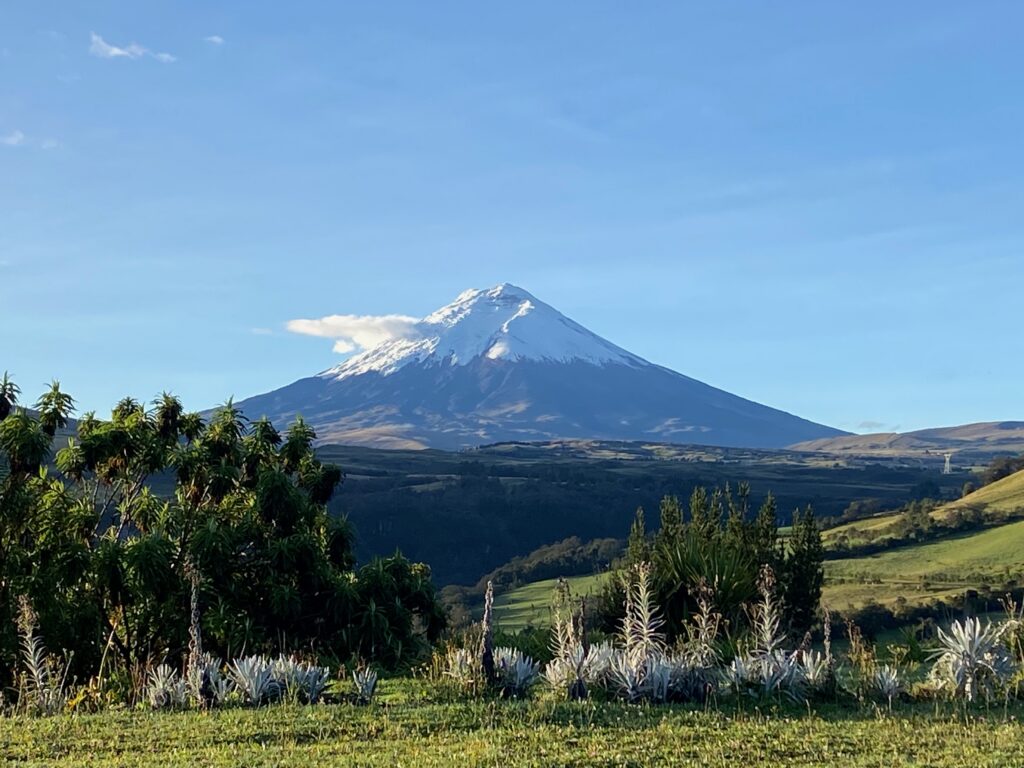
Cotopaxi, 2021
We drove across a windswept plateau and settled into a small lodge at the base of the mountain. The next morning, it was raining steadily, but we knew that the weather could change at any time. That afternoon, Mark, David, and I said goodbye to Darcy, drove up the mountain’s flanks to a desolate parking area, and hiked up a steep, scree-filled trail to a climbers’ hut at 15,700 feet. The rain had stopped, at least temporarily. The hut was located on a rocky shoulder, several hundred feet below the glacier where the steep climbing began. Ecuador required the use of guides on all climbs above 5,000 meters, (16,400 feet), and the hut that night contained several guided groups. The caretaker prepared a simple dinner of soup and bread. We planned to leave for the summit that night, and everyone up there had similar plans. People typically take between six and seven hours to climb from the hut to the summit. It was important to reach the top early in the morning, in order to descend before the sun warmed the slopes and created significant avalanche risk. For this reason, most of the climbers were planning to depart the hut between 11:00pm and midnight. Thinking that our climbing pace would be faster than most, David suggested we leave at 1:00am, targeting a 6:00am arrival at the summit. We ate an early dinner and settled into a communal bunk room for a few hours of sleep.
The scene in the bunk room was like mountain huts everywhere: people curled up in sleeping bags with nervous anticipation, mostly not sleeping, trying to ignore the snoring from those that were. We could hear wind and sleet hitting the roof but hoped it would lighten as the night went on. I managed to sleep a couple of hours, interrupted by successive waves of climbers getting out of their sleeping bags to get ready to leave. At 12:15am my alarm went off and it was our turn. I pulled on my clothes and climbing harness, ate a few handfuls of goldfish crackers, double checked my gear, and was out in the main room as planned shortly before 1:00am. The hut was largely empty, as all the other climbers had started up the mountain. David was waiting and explained that our plan needed to change.
The wind had let up somewhat, but the sleet and freezing rain hadn’t. Monitoring the radio, David heard that the climbing teams who had left the hut earlier were struggling. Many were turning around. As we stood there, teams started re-appearing in the hut. Their climbing clothes were encrusted in ice. Beneath the ice they were drenched. Collectively, they were cold, miserable, and defeated. All of them confirmed that continuing to ascend in those conditions had been out of the question. Hearing this, David pushed our start time to 2:00am, in hopes that conditions improved. When 2:00am came, things remained the same. The freezing rain hadn’t let up, and no one had climbed high enough to find out if it eventually stopped or turned over to snow. The hut was now full of teams that had turned around. David, Mark, and I huddled in a corner and reviewed the situation. Even if the conditions eventually improved, we needed to reach the summit by 7:00am to assure a safe descent. “We have one final shot,” David said, “we will wait until 3:00am and give it a try. You guys are strong enough that, if the weather improves, I think we can get up in time.” I asked: “what do you think the chances are that the weather improves?” “Less than 50 percent,” he answered.
I headed back to the bunk room and lay on my sleeping bag, fully clothed, with my climbing gear still on. Sleep was out of the question. As I lay there waiting for 3:00am, I started building mental constructs that would let me feel good about returning home not having reached the top. As much as getting to the top meant to me, it meant more to Mark. He had carefully planned this trip around standing on the summit on his 60th birthday. A few days earlier, he had given me some additional context: “Ten years ago, on my 50th birthday, I was alone. My life was in a really bad place. The mountains gave me a way to put things back together. This climb is to celebrate how far I have come, and all the good things that have happened to me since.” In typical Mark fashion, he hoped to do 60 push-ups on the summit.
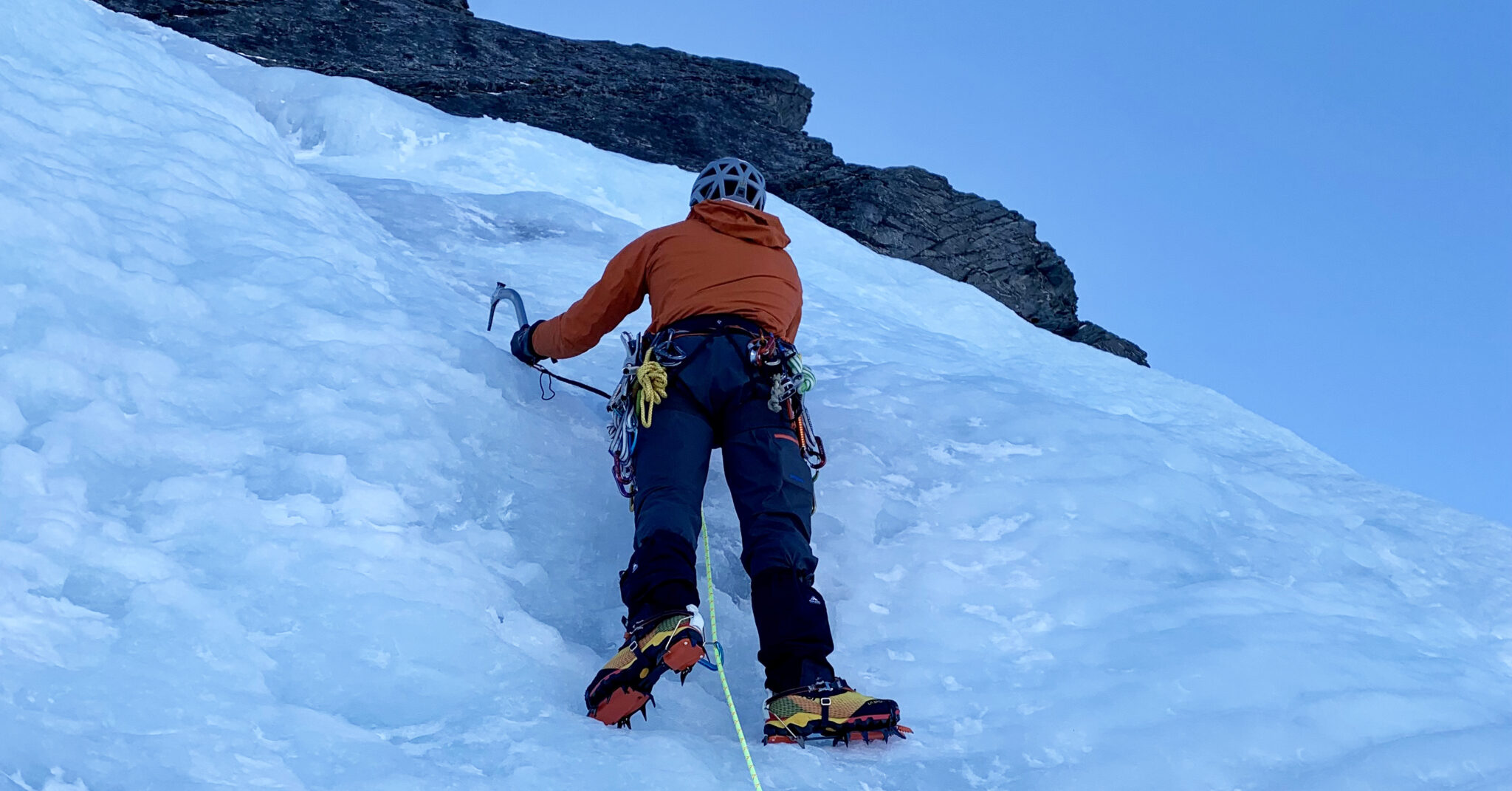
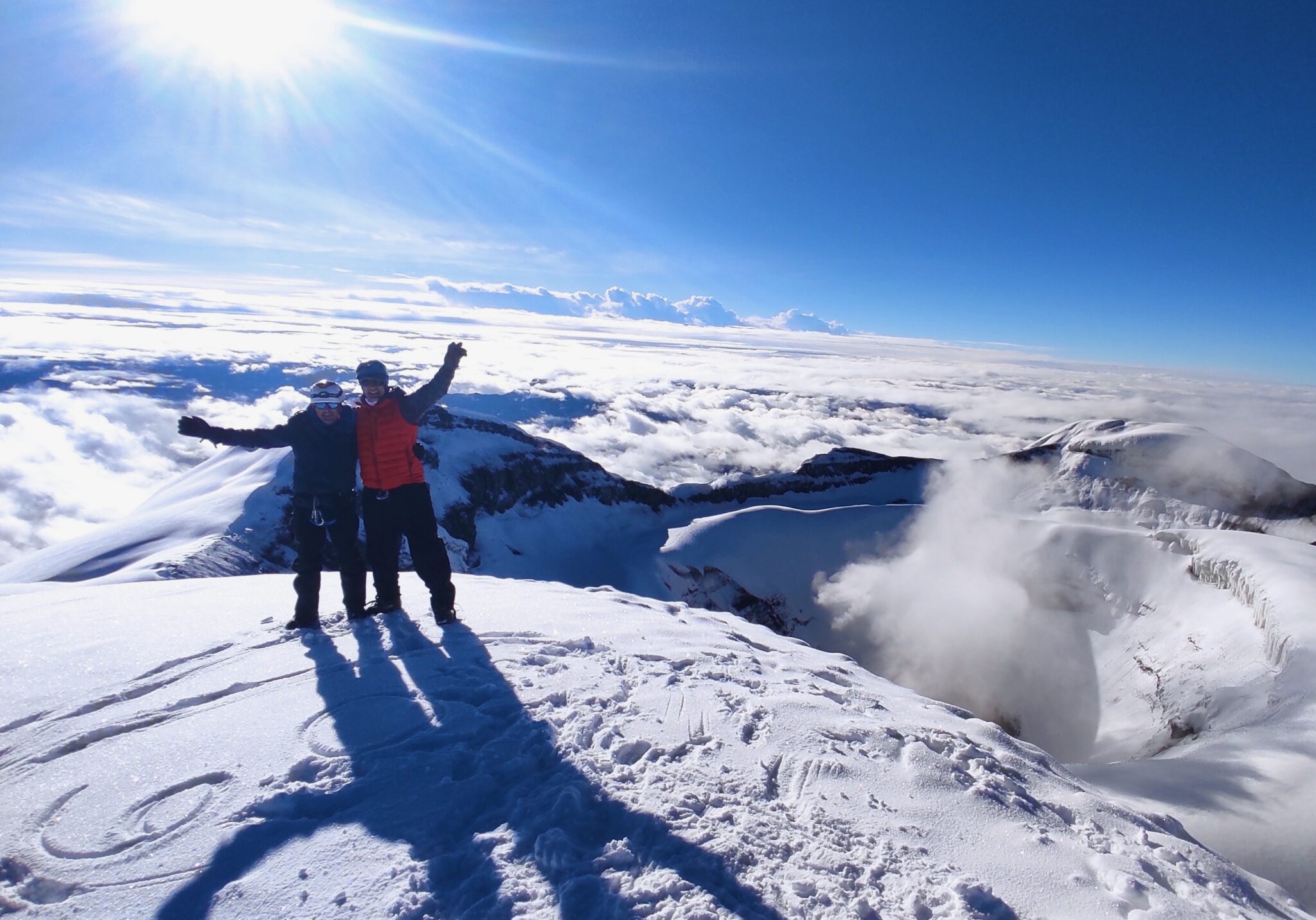
3:00 came. Freezing rain was still beating down on the hut roof. David said we should give it a try. We zipped Gortex outer layers over warm inner layers, switched on headlamps, headed out the door, and started climbing. After an hour of ascending mixed rock and snow, we reached the glacier and stopped to put on our crampons and rope up. Cotopaxi’s volcanic shape meant that, from there, we would be climbing steadily upward, at angles of 40-50 degrees. The rain froze on our outer layers but felt manageable. We continued to ascend, moving quickly. Then Mark looked up and yelled: “stars!” We were breaking through the rain clouds into the clear, but we had to keep moving to reach the summit by 7:00am. David set an aggressive pace, with Mark and I doing all we could to match him. As we ascended steep snow couloirs between towering ice blocks, our legs burned and we struggled to fill our lungs. Out of necessity, we were climbing far more rapidly than we would have if we had left the hut at our originally planned time. I kept looking up to see if the terrain was leveling out, but it wasn’t. I just wanted it to be over. Type 2 fun. The sun rose and we stopped briefly to put on our glacier glasses. Then we rounded a cornice, looked up, and saw a single ridge with nothing but sky behind it. We smelled sulfur and knew we were near the volcanic crater at the top. Shortly after 7:00, we were standing on the summit of Cotopaxi in brilliant sunshine. We had it to ourselves. The summit was a broad flat area, covered in snow, looking down over the deep crater. The views extended for miles in all directions, including the summits of all of Ecuador’s largest volcanoes, Chimborazo, Antisana, Cayambe, and the Illinizas. We dropped our packs in the snow and wandered around the flat area, soaking it all in. Mark cranked off sixty pushups, while David filmed him with his phone. The three of us hugged and whooped. Then we started down. The sun was starting to warm the snowfields and avalanche risk was increasing.
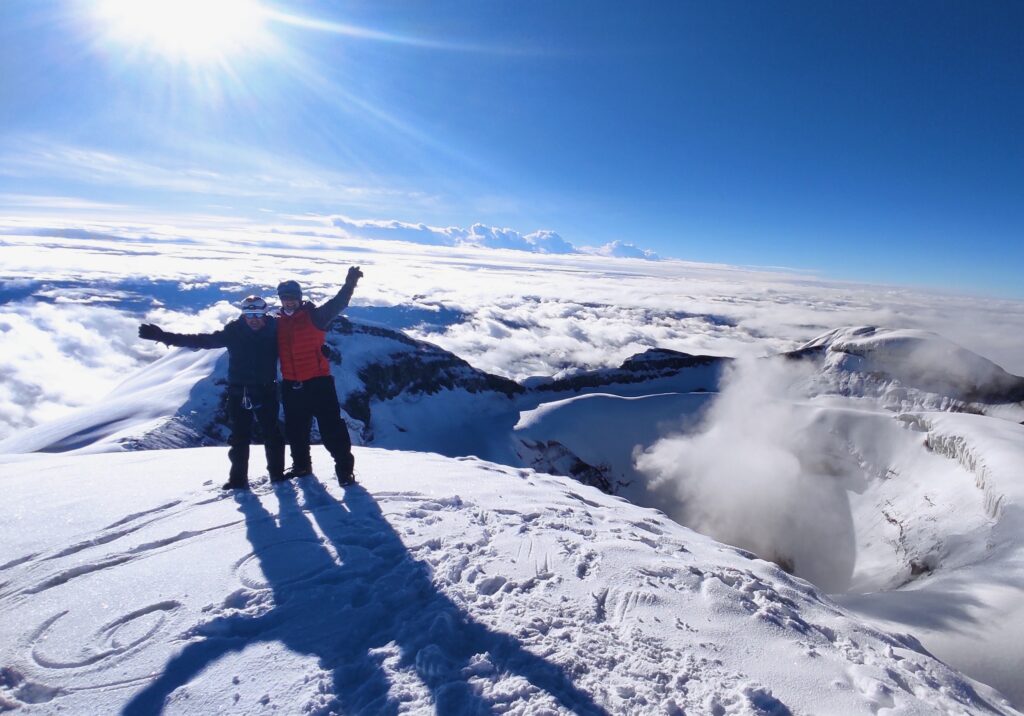
Tom French with Mark Pattison on the summit of Cotopaxi, 2021
We descended non-stop. My legs began to shake. Eventually, the hut came into view, still some way below us. Reaching the snow line, we paused to take off our crampons. The final twenty minutes to the hut took every last ounce of energy. We stopped briefly in the hut to collect the rest of our gear, having climbed round trip to the summit and back in six hours: the time most people take just to get to the top. It was difficult to summon the energy needed to fill my pack. Then we hiked the remaining half hour down to the car and drove back to the lodge where Darci was waiting. After a celebratory breakfast, Mark and Darci drove south to the tropical town of Banos, where they would relax for a couple of days. David drove me back to Quito. I checked into a hotel, showered, slept a few hours, and caught an early morning flight to Miami and Boston. Jill picked me up at the airport. Thirty-six hours after Mark and I were standing on the summit, I was home, deeply satisfied. Type 2 fun indeed.
Tom French is a lifelong mountaineer, cross-country skier, and lover of the outdoors. A senior partner emeritus of McKinsey & Company, he is currently chairman of the Trustees of Reservations, a director of Corning Incorporated, and a member of several other nonprofit boards. Tom has written widely on business issues. The Gap Years is his first non-business book. He lives outside of Boston with his wife Jill.
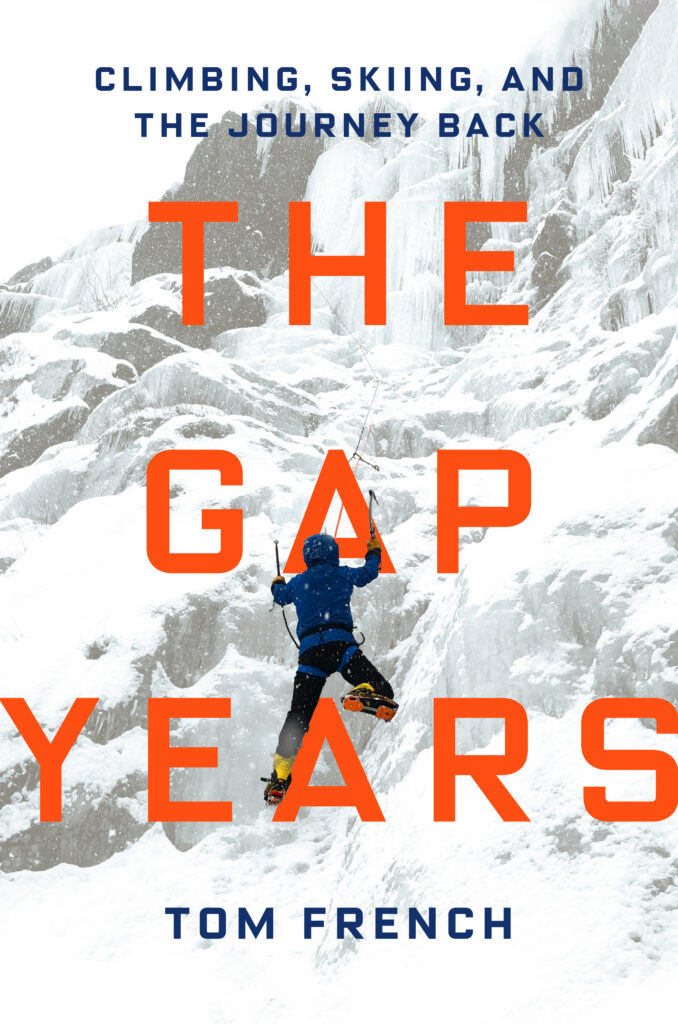
The Gap Years by Tom French can be purchased here.
Other Mountaineering Stories:
Getting to know mountaineering adventurer William Skea
Bill McLeod in His Own Words: A Rare Look Inside a Solo Alpinist’s Mind