Steve McClure & Molly Thompson Smith's Deep Cave Climbing Ascent
Deep beneath Yorkshire’s limestone, Gee Gee Rider climbs 140 metres from the floor of Gaping Gill to daylight above. In May, Steve McClure and Molly Thompson-Smith completed the fourth ascent of the notoriously wet and committing E3 5c. Here, filmmaker Jack Homan takes us behind the scenes of the project and into one of Britain’s strangest climbs.
Words & Images by Jack Homan. Edited by Claire Williams
Back in the Winter issue, filmmaker Jack Homan took us behind the scenes of Steve McClure and Molly Thompson-Smith’s attempt on Gee Gee Rider (E3 5c), a deep cave climb in the UK.
On May 18, the pair completed the fourth ascent of the notoriously wet and wild route. In an interview with UKClimbing Molly Thompson-Smith described the experience. “It’s such an overwhelming and overstimulating place down in the main chamber.”
Read Jack’s original account of the project below.
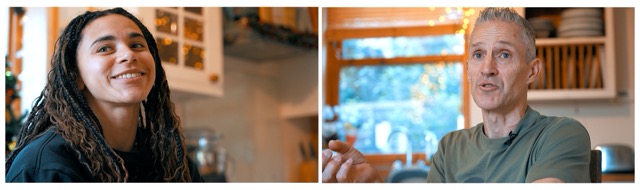
Left: Molly Thompson-Smith Right: Steve McClure
You’re two metres into a 140-metre climb and you’re already soaked through. Water pours through cracks and fissures in the limestone, down your hands and in through your sleeves. Tapered seams won’t keep you dry here. Nothing really will.
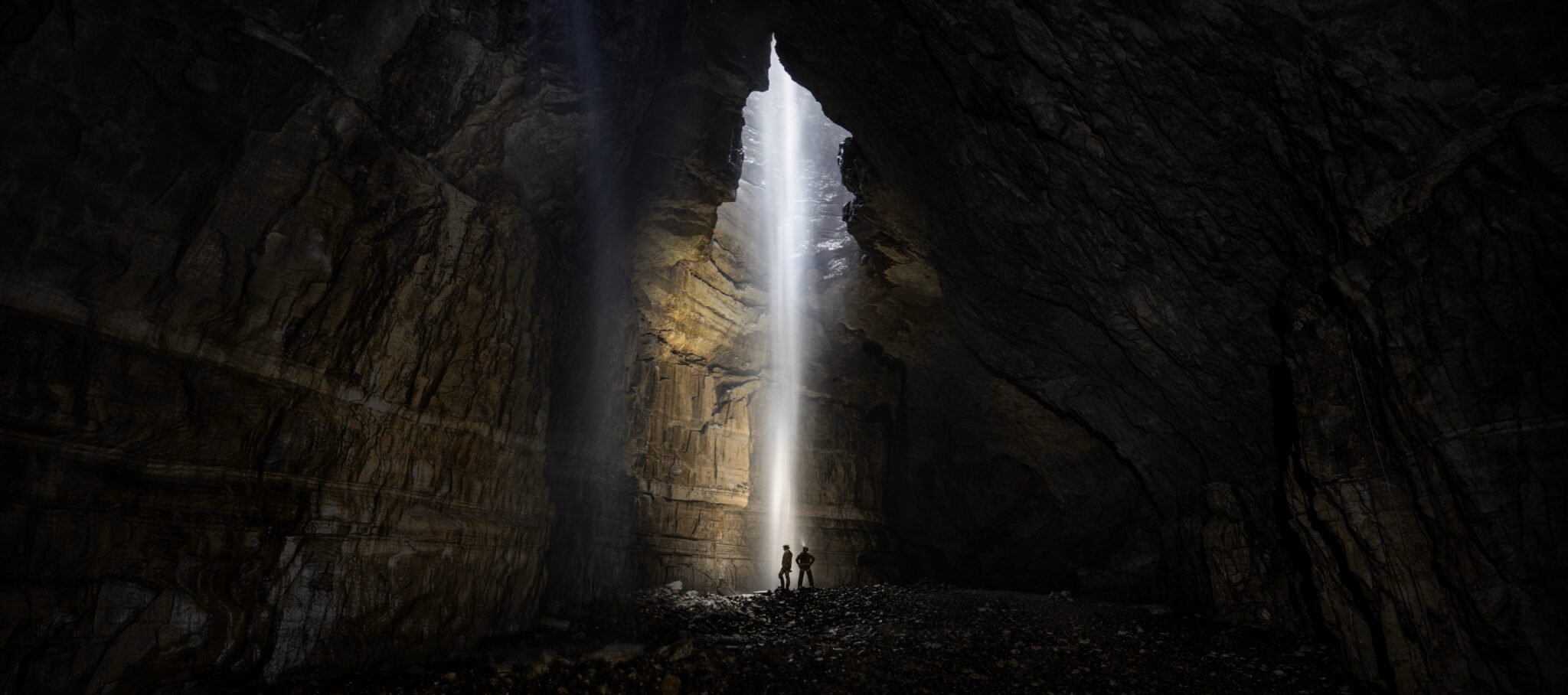
This water arrives as spray, swirling through the air, kicked up by Britain’s highest unbroken waterfall thundering down just metres away. It’s the same water that has shaped the rock you’re holding, over thousands of years, carving it into bizarre forms, razor-sharp spikes, pitted slopers, scalloped walls that look less like rock and more like something that belongs in a museum. Wet limestone is usually a no go, but this is different. Every hold has the texture of sandpaper, coated in grit blasted up from the falls. It’s almost pitch black. The only illumination, other than the beam from your headtorch, comes from a thin slip of daylight far above your head, spilling weakly down from above. The noise is constant. The wind is blowing. You are cold already. This is one of Yorkshire’s longest trad climbs and it’s not on a sea cliff, it’s not on a mountain… it’s inside one.
At 140 metres, with the much of the opening 40 metres steeply overhanging, it is one of the longest and least-travelled trad routes in the country.
Beneath Ingleborough, the Gaping Gill cave system sprawls across more than 20 kilometres of tunnels
and chambers. At its heart lies the main chamber: a cathedral-sized void, comparable in scale to York Minster, opened to the surface by a 100-metre-deep shaft cut through the limestone by the water of Fell Beck. It is the water, and all that it has carved away, that makes a climb like Gee Gee Rider possible.
The route rises from the chamber floor, following weaknesses in the rock all the way to the surface above. At 140 metres, with the much of the opening 40 metres steeply overhanging, it is one of the longest and least-travelled trad routes in the country. It is also one of the strangest, a climb that starts in darkness, in a cold underground void, beneath a thundering waterfall, we might be used to some easy approach climbing in the dark, but this isn’t that.
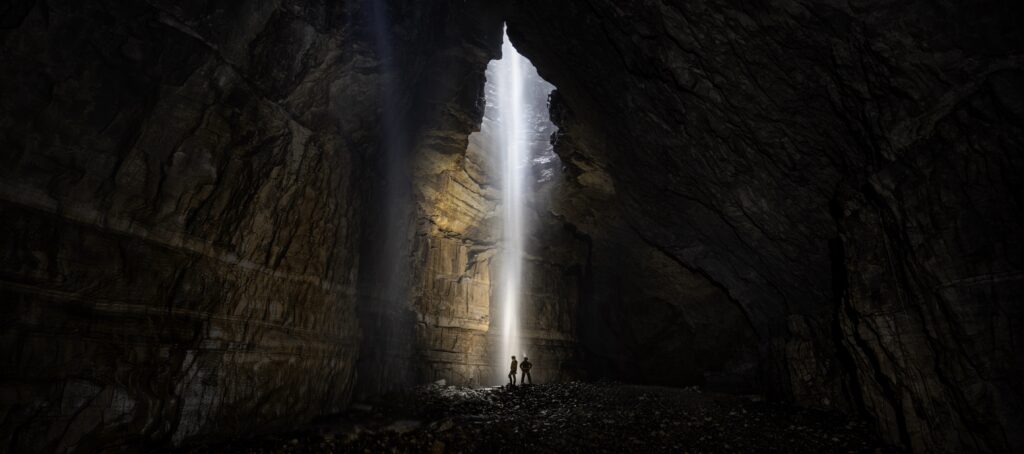
In 1972, Robert Baxter-Jones and John Moore were the first to climb the line, using aid (ten points of it), to work their way up through the hardest sections. Sixteen years later, in June 1988, Paul Eastwood and David Hetherington climbed the route free. As far as anyone can tell me, they are still the only people to have done so. In over fifty years, just four men have climber this rock from the chamber floor to the daylight above.
Others have tried. Most recently, in 2021, two climbers attempting the route were rescued from the cave after becoming stuck. Gee Gee Rider is not technically outrageous by modern standards (Paul and David gave the route E3 5C), but to the unprepared it is a dangerous undertaking. The temperature at the bottom of Gaping Gill hovers around 7 degrees, even at the height of summer. Despite being underground, a wind funnels through the chamber, whipping spray off the falls and turning it into a fine mist that soaks you in seconds. Hypothermia is not unthinkable in an environment like this.
Retreat is difficult. With the lower section steeply overhanging, downclimbing the route is effectively impossible, and without very long ropes an abseil might leave you dangling above your anchors in the void. Once you are committed, you are committed. Higher up, things get even more exciting. The top pitch is described as the hardest. Where sunlight penetrates the cave, plant life thrives. The grippy, blasted limestone of the lower pitches gives way to a slimy jungle of vegetation. By this point you are almost 100 metres above the chamber floor, you might be out of the darkness, feeling like you’re on the home stretch but you’re greeted here by a different challenge entirely.
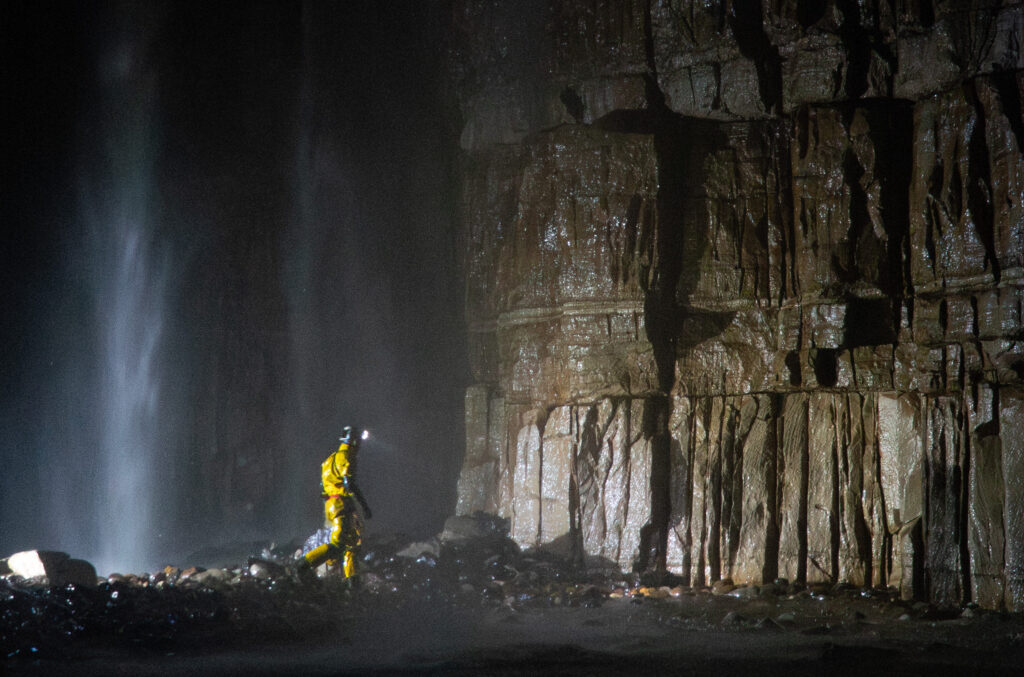
Andy Wilson recces the start of Gee Gee Rider ahead of filming. Image by Jack Homan
Paul Eastwood talks of the ascent in simple terms “I don’t think Dave or I thought that it was a particularly big deal” And it’s remarkable how casually it all began “we didn’t plan, weeks or months in advance. I think it was kind of spur of the moment, to think about doing it and then discovering that actually it wasn’t a bad time of the year to do it, because it was coming up to a winch meet and so we knew it was fairly dry… we kind of felt confident that we could give it a go”. There was no extended campaign, no months of preparation. The weather lined up. The water was manageable. A local caving club had built a dam at the surface which would hold back the worst of the flow, and a friend rigged a rope so they could get into the chamber. And then, more or less, they went for it.
That lack of ceremony is perhaps the most remarkable thing about the ascent. Gee Gee Rider is a route that requires perfect conditions, coordination between climbers underground and helpers on the surface, and a willingness to climb for hours in the cold and dark with no easy way out. It seems almost unthinkable that so little planning went into such a serious undertaking. But, thankfully, for Paul & David, it all worked out.
There was no extended campaign, no months of preparation. The weather lined up. The water was manageable.
Paul and David’s interest in this route didn’t happen by chance, both were keen climbers and cavers and Gaping Gill was a proving ground for them before what would become many impressive, international caving expeditions. For a long time, before indoor walls became the default winter training ground, bad weather didn’t stop people climbing, it just pushed them underground. Caving wasn’t a niche pursuit so much as a seasonal one, a winter option that sharpened skills and tolerance rather than being treated as two isolated disciplines. Gee Gee Rider sits squarely in that tradition, blurring lines between climbing and caving.
All of this is the subject of a film I’m working on, originally a short film focusing on the historic climb which has turned into something bigger, after a conversation with Steve McClure. I had approached Petzl to see if they might support the film in some way, given their caving and climbing history, they felt a perfect fit and after some positive conversations, they suggested I speak to Steve, who seemed to be planning a repeat before we’d even had a chance to talk on the phone “I think with these sorts of things… you just have to grab them. You know that’s what climbing is all about for me, it’s the unknown”
For Steve, after decades at the top of the game, it’s the unusual, the awkward ‘type-2’ challenge of this project that he says has grabbed his attention.
Steve needed a partner and he suggested that we speak to Olympian Molly Thompson-Smith, another climber on Petzl’s roster. Molly was in almost straight away, almost “had you asked me about this project a year ago” she said “it would have been hard no. I wouldn’t have even stopped to think about whether it interested me or not. I was just so locked in on climbing inside comps, I liked doing things that were difficult, but in my normal range of difficult. Whereas this year I’ve let myself stop to think about what actually interests me outside of that”
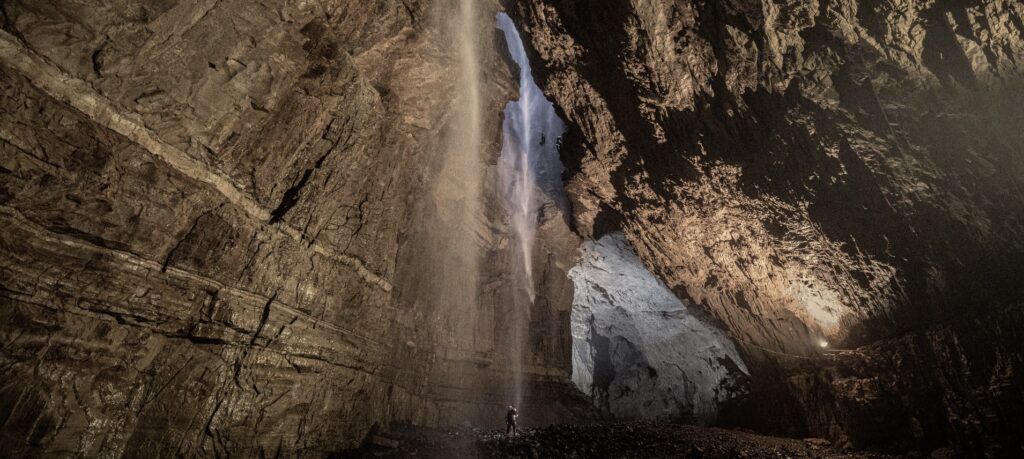
Gaping Gill main chamber illuminated at a caving club ‘winch meet’. Image by Jack Homan
For Molly, the route arrives at a moment of transition. After years in competition climbing, she’s increasingly focused on what comes next. She sees her contemporaries head off on far-flung expeditions, she still wants to go in for competition climbing, but on her own terms and so finds herself more interested in adventures a little closer to home. Doing that alongside someone she trusts matters and the pair have known each other for a long time. For Steve, after decades at the top of the game, it’s the unusual, the awkward ‘type-2’ challenge of this project that he says has grabbed his attention.
With the repeat planned in the coming months and with the help and advice of local clubs and organisations (NPC, Gritstone Club, Yorkshire Dales Guides and both the Bradford and Craven pothole clubs), as well as the valuable assistance of volunteers too numerous to mention here, the film is shaping up to be something really special but, the exciting thing is, despite the incredible talents of these two climbers, due to the nature of the climb, success on the day is far from guaranteed.
If you liked this piece, you should subscribe to the print mag. Only a fraction of the great stories we run in the mag make it to our website; if you want to read them, head to verticallifemag.com
Articles on Climbing Films:
Connor Herson Takes on Norway’s Hardest Trad in New Black Diamond Film
Who does it better? Connor Herson & Jacopo Larcher on Bon Voyage (5.14D/9A)
Connor Herson Takes on Norway’s The Recovery Drink in new Black Diamond Series