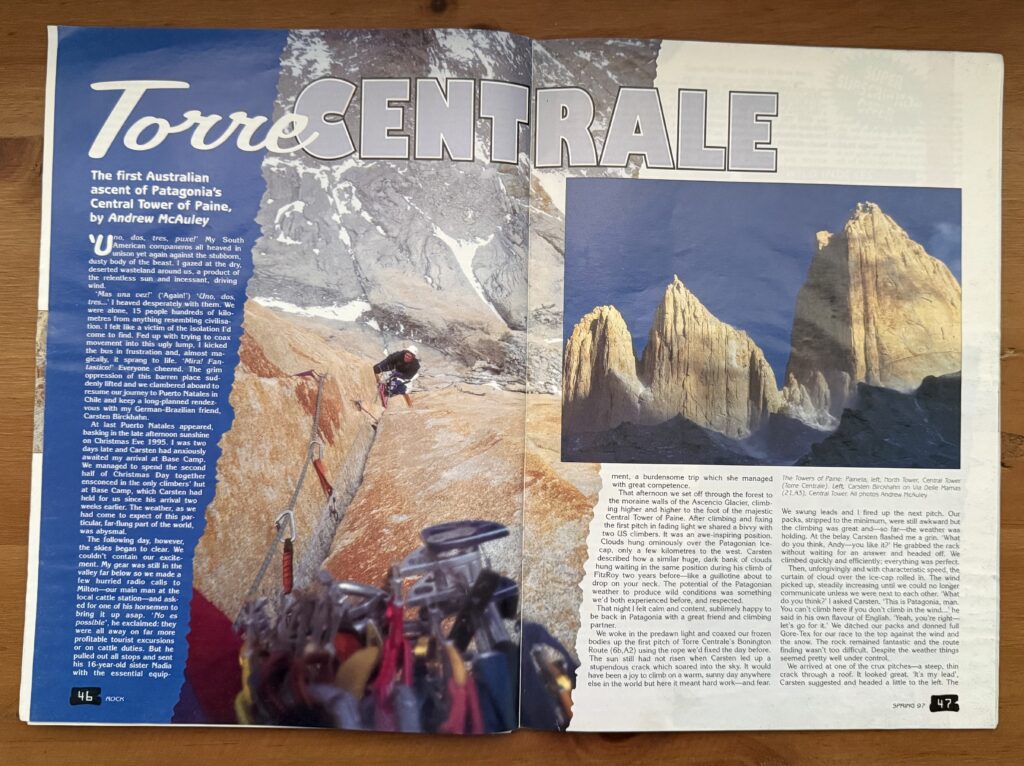
The first Australian ascent of Patagonia's Central Tower of Paine
Words and images by Andrew McAuley
Originally published in Rock Magazine 1997.
‘no, dos, tres, puxe!’ My South American companeros all heaved in unison yet again against the stubborn, dusty body of the beast. I gazed at the dry, deserted wasteland around us, a product of the relentless sun and incessant, driving wind.
‘Mas una vez!’ (‘Again!’) ‘Uno, dos, tres…’ I heaved desperately with them. We were alone, 15 people hundreds of kilometres from anything resembling civilisation. I felt like a victim of the isolation I’d come to find. Fed up with trying to coax movement into this ugly lump, I kicked the bus in frustration and, almost magically, it sprang to life. ‘Mira! Fantastico!’ Everyone cheered. The grim oppression of this barren place suddenly lifted and we clambered aboard to resume our journey to Puerto Natales in Chile and keep a long-planned rendezvous with my German-Brazilian friend, Carsten Birckhahn.
At last Puerto Natales appeared, basking in the late afternoon sunshine on Christmas Eve 1995. I was two days late and Carsten had anxiously awaited my arrival at Base Camp. We managed to spend the second half of Christmas Day together ensconced in the only climbers’ hut at Base Camp, which Carsten had held for us since his arrival two weeks earlier. The weather, as we had come to expect of this particular, far-flung part of the world, was abysmal.
The following day, however, the skies began to clear. We couldn’t contain our excitement. My gear was still in the valley far below so we made a few hurried radio calls to Milton our main man at the local cattle station-and asked for one of his horsemen to bring it up asap. ‘No es possible’, he exclaimed: they were all away on far more profitable tourist excursions or on cattle duties. But he pulled out all stops and sent
his 16-year-old sister Nadia with the essential equipment, a burdensome trip which she managed with great competence.
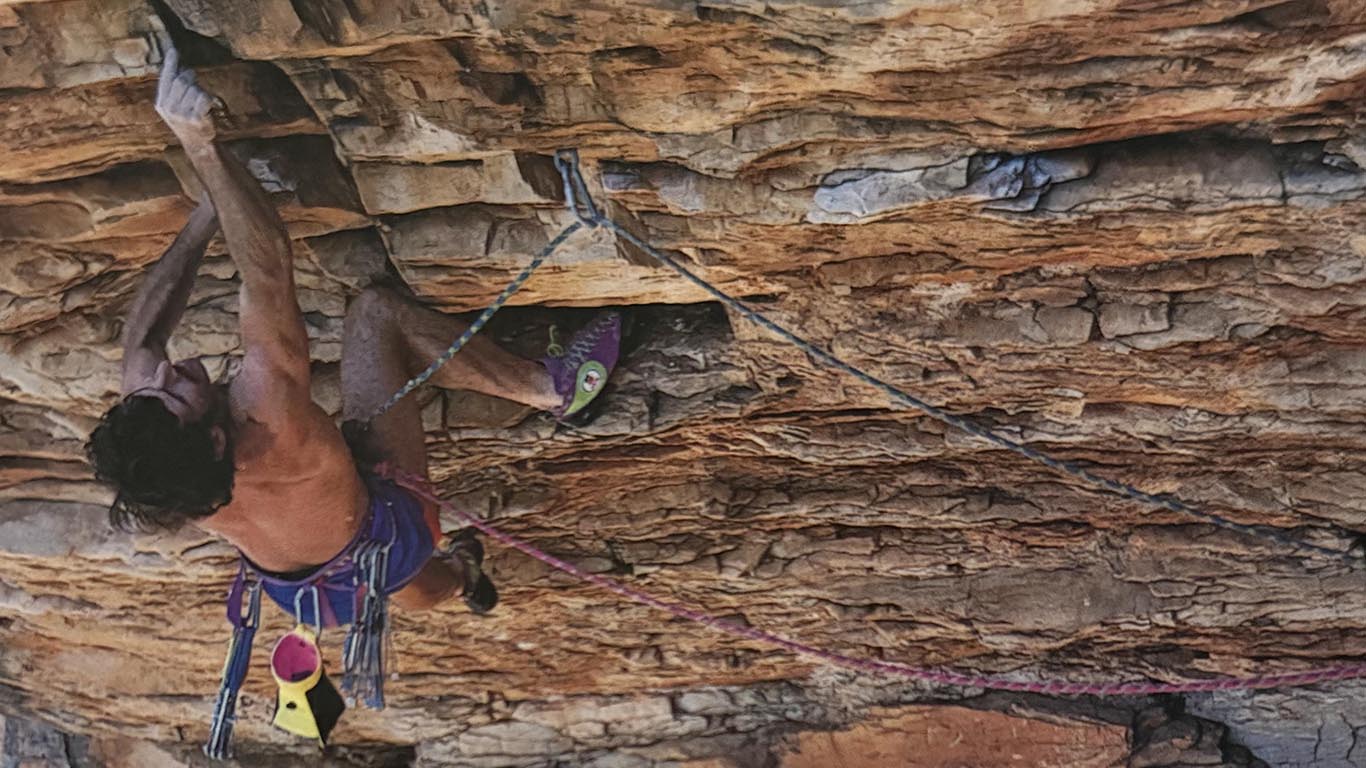
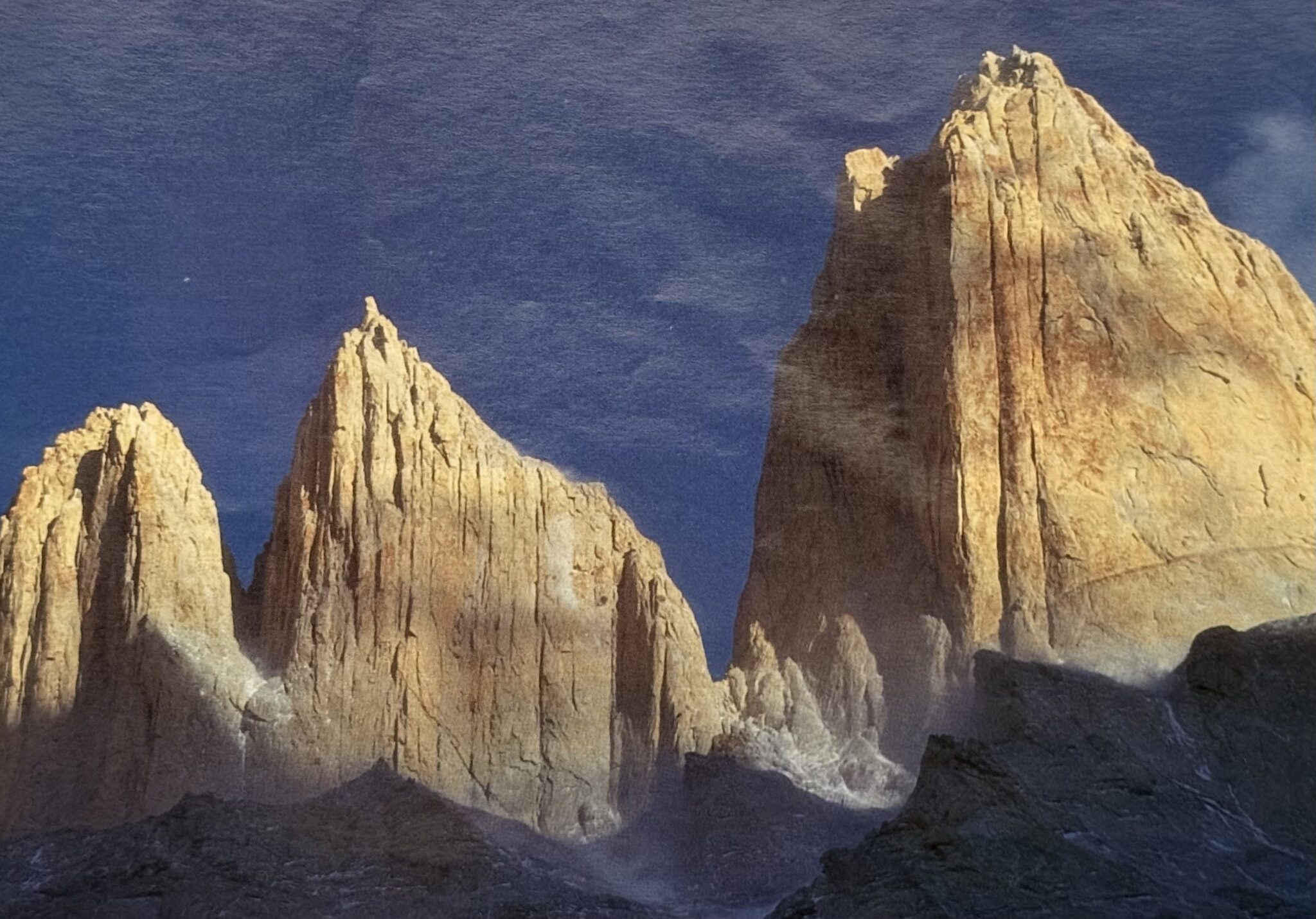
The Towers of Paine: Paineta, left, North Tower, Central Tower (Torre Centrale). Left, Carsten Birckhahn, on Via Delle Mamas (21,A3), Central Tower. All photos Andrew McAuley
That afternoon we set off through the forest to the moraine walls of the Ascencio Glacier, climbing higher and higher to the foot of the majestic Central Tower of Paine. After climbing and fixing the first pitch in fading light we shared a bivvy with two US climbers. It was an awe-inspiring position. Clouds hung ominously over the Patagonian Icecap, only a few kilometres to the west. Carsten described how a similar huge, dark bank of clouds hung waiting in the same position during his climb of FitzRoy two years before-like a guillotine about to drop on your neck. The potential of the Patagonian weather to produce wild conditions was something we’d both experienced before, and respected. That night I felt calm and content, sublimely happy to be back in Patagonia with a great friend and climbing partner.
We woke in the predawn light and coaxed our frozen bodies up the first pitch of Torre Centrale’s Bonington Route (6b,A2) using the rope we’d fixed the day before. The sun still had not risen when Carsten led up a stupendous crack which soared into the sky. It would have been a joy to climb on a warm, sunny day anywhere else in the world but here it meant hard work-and fear.
We swung leads and I fired up the next pitch. Our packs, stripped to the minimum, were still awkward but the climbing was great and-so far-the weather was holding. At the belay Carsten flashed me a grin. ‘What do you think, Andy-you like it?’ He grabbed the rack without waiting for an answer and headed off. We climbed quickly and efficiently; everything was perfect.
Then, unforgivingly and with characteristic speed, the curtain of cloud over the ice-cap rolled in. The wind picked up, steadily increasing until we could no longer communicate unless we were next to each other. ‘What do you think?’ I asked Carsten. ‘This is Patagonia, man. You can’t climb here if you don’t climb in the wind…’ he said in his own flavour of English. ‘Yeah, you’re right-let’s go for it.’ We ditched our packs and donned full Gore-Tex for our race to the top against the wind and the snow. The rock remained fantastic and the route finding wasn’t too difficult. Despite the weather things seemed pretty well under control.
We arrived at one of the crux pitches-a steep, thin crack through a roof. It looked great. ‘It’s my lead’, Carsten suggested and headed a little to the left. The crack was full, of pitons and the odd wooden chock threaded with fencing wire dating from the first ascent 30 years before. Carsten led another pitch
up the steep dihedral, finding an easier, though unprotected, variant to the left. My pitch again; this time stuck unavoidably in the corner-crack. Things began to get strenuous and before long ice in the crack forced me to aid climb for the last few metres to the belay.
Now the route began to spiral round to the eastern side of the mountain and soon we were sheltered from the incessant, howling wind. It was strangely calm on this side of the mountain – an eerie, almost supernatural feeling akin to scuba-diving deep in the ocean below the wildest seas imaginable.
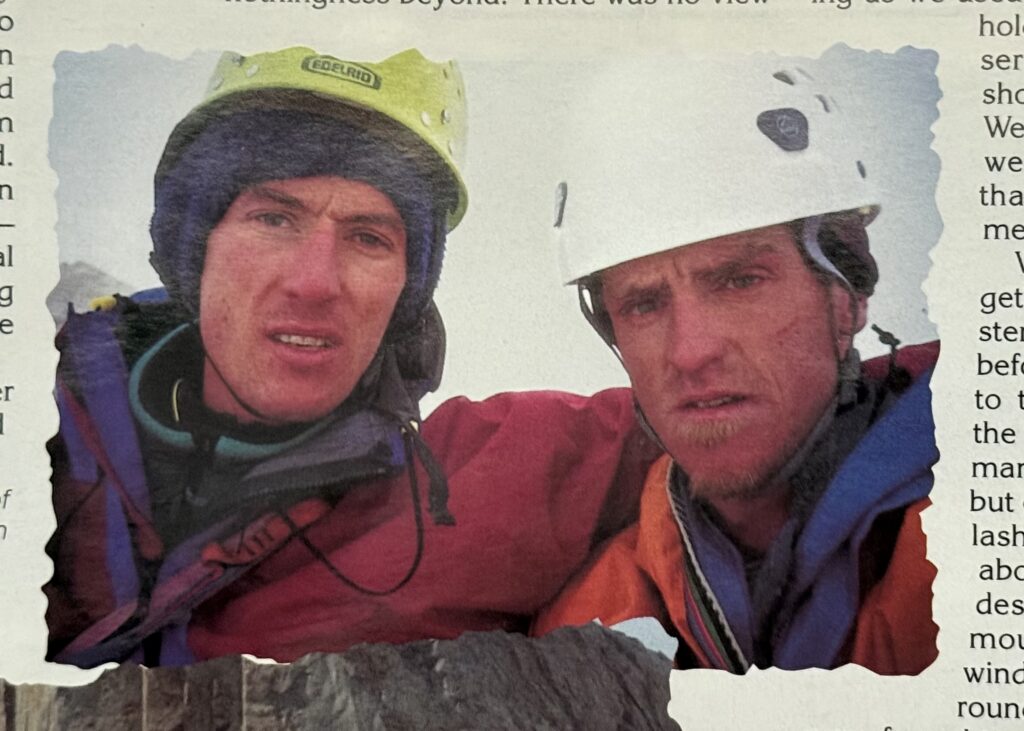
The strain shows on the faces of McAuley, left, and Birckhahn on the summit of Torre Centrale.
The climbing was easier and more broken now and we moved together through the clouds until the occasional steep section forced us to belay. We gained the summit ridge, a rock prow exposed to the full force of the wind. The noise was incredible. It sounded as though we were dangling from the underbelly of a jumbo jet. The wind seemed to vibrate across the whole mountain, accelerating over the summit and screaming off into the nothingness beyond. There was no view but we didn’t care. Struggling up the last
couple of pitches, we clung desperately to the rock on what would normally have been easy ground.
Our time at the summit was a rushed affair, a few quick photos and: ‘We’re outta here!’ Then followed a seemingly endless series of abseils down the pitches below us: 18 pitches of climbing turned into nearly 36 pitches of abseiling as we used only one rope to retreat holding the second in reserve in case something should happen to the first. We came to a point where we had no other option than to make a full 50 metre abseil.
We joined the ropes together and I watched Carsten disappear into the void before I followed him down to the belay. Sure enough, the ropes became stuck. We managed to retrieve the first but our second 50 metre line lashed and writhed in the air above us like a mad thing desperate to escape this mountain and follow the wind. It latched itself firmly round a flake of rock and we were forced to cut it loose and continue with just one rope.
Our meeting with the Americans at the bivvy site was a sobering affair. They had retreated after five pitches of climbing and had lost both ropes on their descent; they’d also lost a 20 kilogram pack, watching in disbelief as the wind plucked it from the mountain and whipped it a hundred metres away before dropping it more than 800 metres to the glacier below.
We withdrew from the mountain together, Carsten and I deliriously happy to have summited Torre Centrale after only two days together in the park. Mine I was the first Australian ascent of this storm-lashed and sought-after peak and Carsten was the first Brazilian to reach its summit.
The weather during the next six weeks was less than tropical although we did manage a few routes between the storms. We climbed the North Tower (‘Torre Norte’) of Paine by way of the Monzino Route (19/20) but were turned back from attempts on the same peak by way of The Cornwall (about 22), Via
Giorgio Giannacinni (about 21,A2) and Capuchin Tortola (about 20,A2). Another stab at Torre Centrale by way of Via Delle Mamas (21,A3) also ended in frustration.
These routes provided days of challenge in spectacular locations; however, nothing quite matched the aura of perfection which surrounded that first climb of Torre Centrale.
Andrew McAuley (1968–2007) was an acclaimed Australian adventurer, sea kayaker and mountaineer known for pushing the boundaries of human endurance. In January 2007, he attempted to become the first person to kayak solo and unassisted across the Tasman Sea from Australia to New Zealand. After more than 30 days at sea and just 80 kilometres from his destination, he radioed that he was in trouble and activated his emergency beacon. A search was launched, but McAuley was never found. His empty kayak was later recovered off the coast of New Zealand, and he is believed to have died at sea. His remarkable journey remains one of Australia’s most extraordinary and tragic adventure stories.
Disclaimer: This article was originally published in 1997. The information, route descriptions, and access details reflect the conditions and ethics of that time. Climbing areas and their access arrangements may have changed significantly since then. Please consult up-to-date local sources, land managers, or climbing access organisations before visiting any of the locations mentioned.
Other Rock Magazine Articles:
JANNU: Climbing one of the hardest faces in the Himalayas