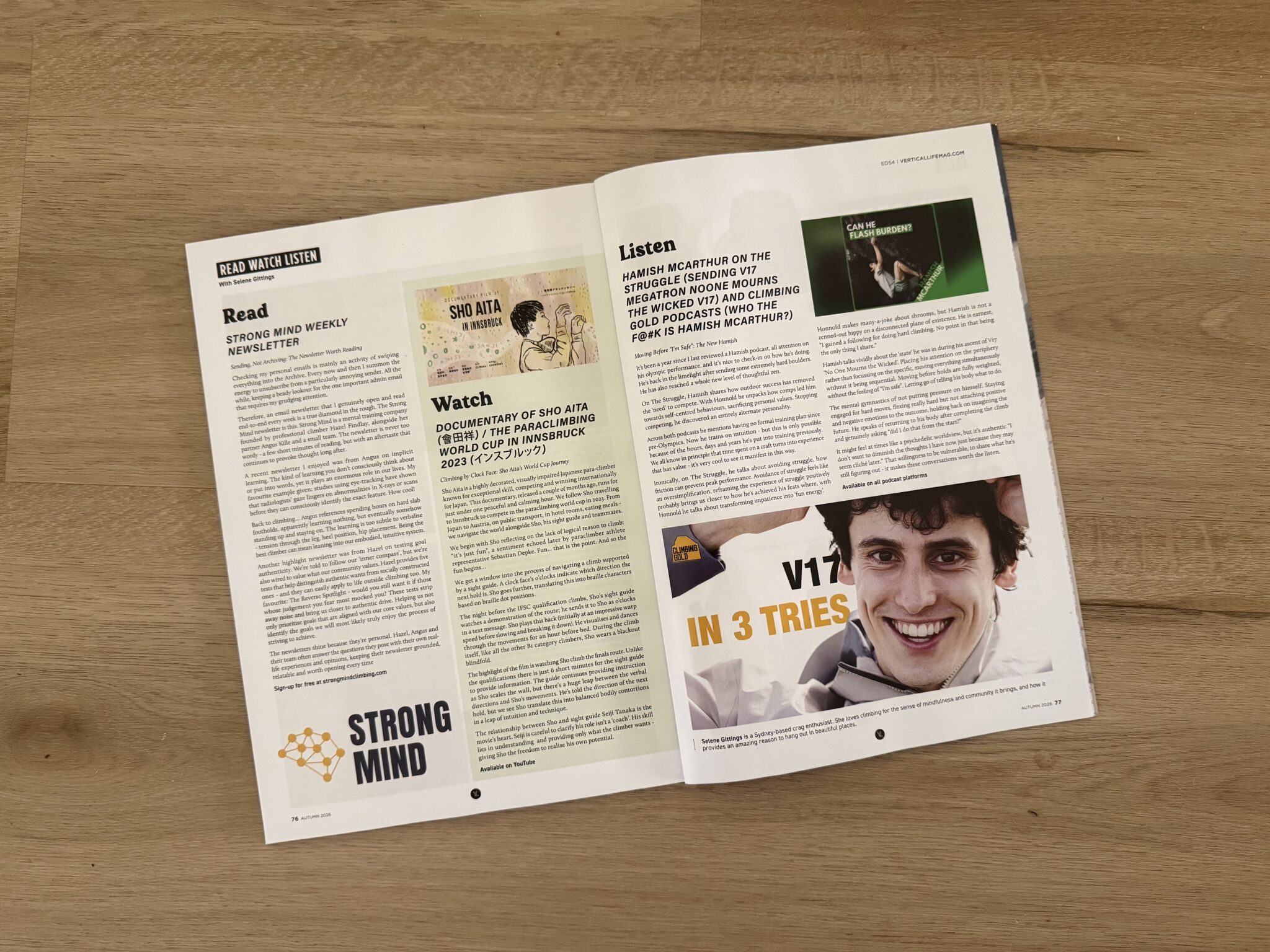
Read, Watch, Listen - Autumn 2026
As the days cool and the light softens, we’ve curated the season’s best reads, films, and listens—stories to sink into, soundtracks for the road, and inspiration for slower autumn moments.
Words by Selene Gittings
READ
Read – Strong Mind Weekly Newsletter
Sign-up for free at strongmindclimbing.com
Sending, Not Archiving: The Newsletter Worth Reading
Checking my personal emails is mainly an activity of swiping everything into the Archive. Every now and then I summon the energy to unsubscribe from a particularly annoying sender. All the while, keeping a beady lookout for the one important admin email that requires my grudging attention.
Therefore, an email newsletter that I genuinely open and read end-to-end every week is a true diamond in the rough. The Strong Mind newsletter is this. Strong Mind is a mental training company founded by professional climber Hazel Findlay, alongside her partner Angus Kille and a small team. The newsletter is never too wordy – a few short minutes of reading, but with an aftertaste that continues to provoke thought long after.
A recent newsletter I enjoyed was from Angus on implicit learning. The kind of learning you don’t consciously think about or put into words, yet it plays an enormous role in our lives. My favourite example given: studies using eye-tracking have shown that radiologists’ gaze lingers on abnormalities in X-rays or scans before they can consciously identify the exact feature. How cool!
Back to climbing… Angus references spending hours on hard slab footholds, apparently learning nothing, but eventually somehow standing up and staying on. The learning is too subtle to verbalise – tension through the leg, heel position, hip placement. Being the best climber can mean leaning into our embodied, intuitive system.
Another highlight newsletter was from Hazel on testing goal authenticity. We’re told to follow our ‘inner compass’, but we’re also wired to value what our community values. Hazel provides five tests that help distinguish authentic wants from socially constructed ones – and they can easily apply to life outside climbing too. My favourite: The Reverse Spotlight – would you still want it if those whose judgement you fear most mocked you? These tests strip away noise and bring us closer to authentic drive. Helping us not only prioritise goals that are aligned with our core values, but also identify the goals we will most likely truly enjoy the process of striving to achieve.
The newsletters shine because they’re personal. Hazel, Angus and their team often answer the questions they pose with their own real-life experiences and opinions, keeping their newsletter grounded, relatable and worth opening every time
WATCH
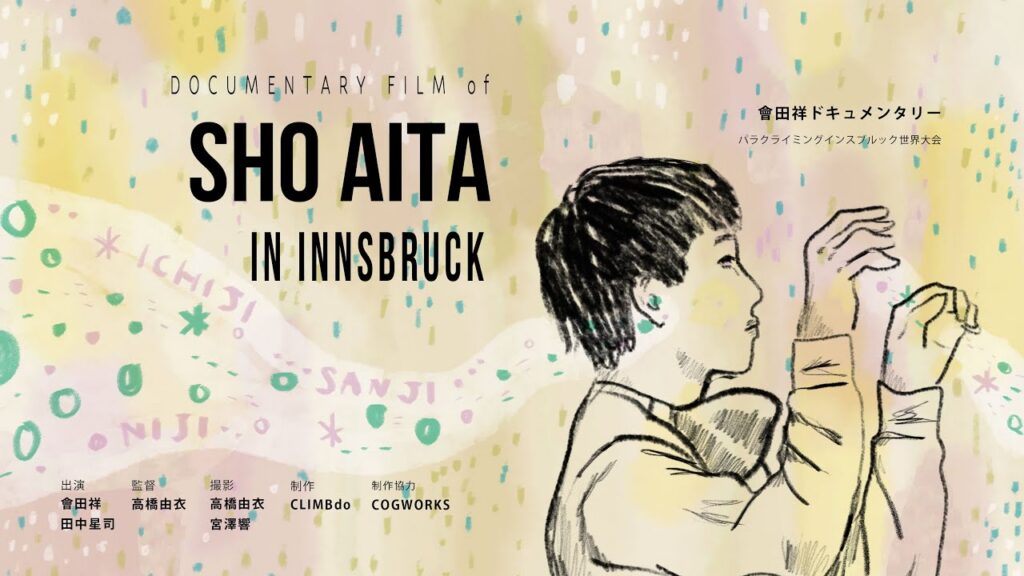
Watch – DOCUMENTARY of SHO AITA(會田祥) / The Paraclimbing World Cup in INNSBRUCK 2023 (インスブルック)
Available on YouTube
Climbing by Clock Face: Sho Aita’s World Cup Journey
Sho Aita is a highly decorated, visually impaired Japanese para-climber known for exceptional skill, competing and winning internationally for Japan. This documentary, released a couple of months ago, runs for just under one peaceful and calming hour. We follow Sho travelling to Innsbruck to compete in the paraclimbing world cup in 2023. From Japan to Austria, on public transport, in hotel rooms, eating meals – we navigate the world alongside Sho, his sight guide and teammates.
We begin with Sho reflecting on the lack of logical reason to climb: “it’s just fun”, a sentiment echoed later by paraclimber athlete representative Sebastian Depke. Fun… that is the point. And so the fun begins…
We get a window into the process of navigating a climb supported by a sight guide. A clock face’s o’clocks indicate which direction the next hold is. Sho goes further, translating this into braille characters based on braille dot positions.
The night before the IFSC qualification climbs, Sho’s sight guide watches a demonstration of the route; he sends it to Sho as o’clocks in a text message. Sho plays this back (initially at an impressive warp speed before slowing and breaking it down). He visualises and dances through the movements for an hour before bed. During the climb itself, like all the other B1 category climbers, Sho wears a blackout blindfold.
The highlight of the film is watching Sho climb the finals route. Unlike the qualifications there is just 6 short minutes for the sight guide to provide information. The guide continues providing instruction as Sho scales the wall, but there’s a huge leap between the verbal directions and Sho’s movements. He’s told the direction of the next hold, but we see Sho translate this into balanced bodily contortions in a leap of intuition and technique.
The relationship between Sho and sight guide Seiji Tanaka is the movie’s heart. Seiji is careful to clarify his role isn’t a ‘coach’. His skill lies in understanding and providing only what the climber wants – giving Sho the freedom to realise his own potential.
LISTEN
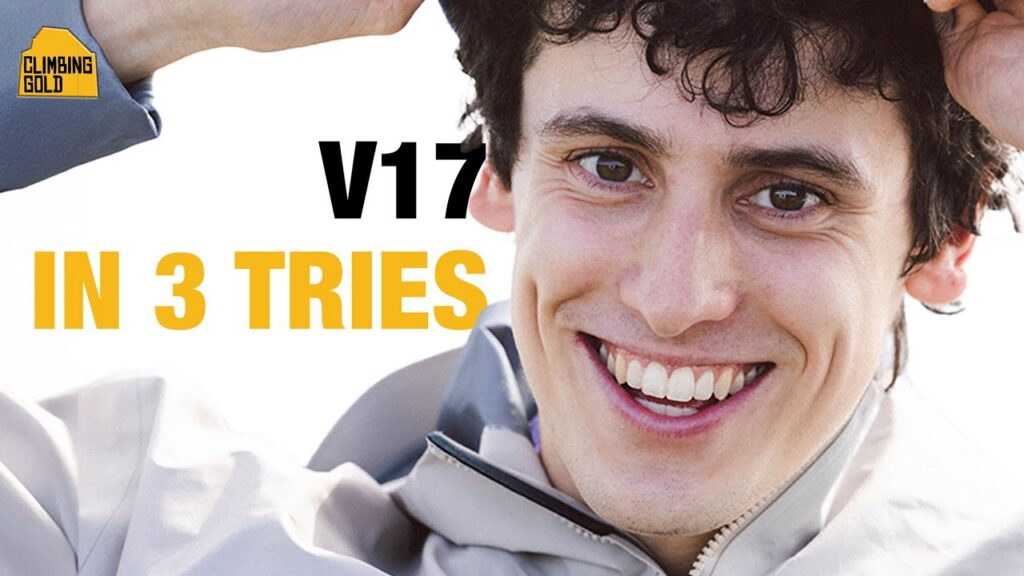
Listen – Hamish McArthur on the Struggle (Sending v17 Megatron
Noone mourns the wicked v17) and Climbing Gold Podcasts (Who The F@#k is Hamish McArthur?)
Available on all podcast platforms
Moving Before “I’m Safe”: The New Hamish
It’s been a year since I last reviewed a Hamish podcast, all attention on his olympic performance, and it’s nice to check-in on how he’s doing. He’s back in the limelight after sending some extremely hard boulders. He has also reached a whole new level of thoughtful zen.
On The Struggle, Hamish shares how outdoor success has removed the ‘need’ to compete. With Honnold he unpacks how comps led him towards self-centred behaviours, sacrificing personal values. Stopping competing, he discovered an entirely alternate personality.
Across both podcasts he mentions having no formal training plan since pre-Olympics. Now he trains on intuition – but this is only possible because of the hours, days and years he’s put into training previously. We all know in principle that time spent on a craft turns into experience that has value – it’s very cool to see it manifest in this way.
Ironically, on The Struggle, he talks about avoiding struggle, how friction can prevent peak performance. Avoidance of struggle feels like an oversimplification, reframing the experience of struggle positively probably brings us closer to how he’s achieved his feats where, with Honnold he talks about transforming impatience into ‘fun energy’.
Honnold makes many-a-joke about shrooms, but Hamish is not a zenned-out hippy on a disconnected plane of existence. He is earnest, “I gained a following for doing hard climbing. No point in that being the only thing I share.”
Hamish talks vividly about the ‘state’ he was in during his ascent of V17 ‘No One Mourns the Wicked’. Placing his attention on the periphery rather than focussing on the specific, moving everything simultaneously without it being sequential. Moving before holds are fully weighted, without the feeling of “I’m safe”. Letting go of telling his body what to do.
The mental gymnastics of not putting pressure on himself. Staying engaged for hard moves, flexing really hard but not attaching positive and negative emotions to the outcome, holding back on imagining the future. He speaks of returning to his body after completing the climb and genuinely asking “did I do that from the start?”
It might feel at times like a psychedelic worldview, but it’s authentic “I don’t want to diminish the thoughts I have now just because they may seem cliché later.” That willingness to be vulnerable, to share what he’s still figuring out – it makes these conversations worth the listen.
BIO: Selene Gittings is a Sydney-based crag enthusiast. She loves climbing for the sense of mindfulness and community it brings, and how it provides an amazing reason to hang out in beautiful places.