ARAPILES' HARDEST CLIMBS
First Published in Rock Magazine 1979
Written by Kim Carrigan
This article was originally published in Rock Magazine in 1979. The information, route descriptions, and access details reflect the conditions and ethics of that time. Climbing areas and their access arrangements may have changed significantly since then. Please consult up-to-date local sources, land managers, or climbing access organisations before visiting any of the locations mentioned.
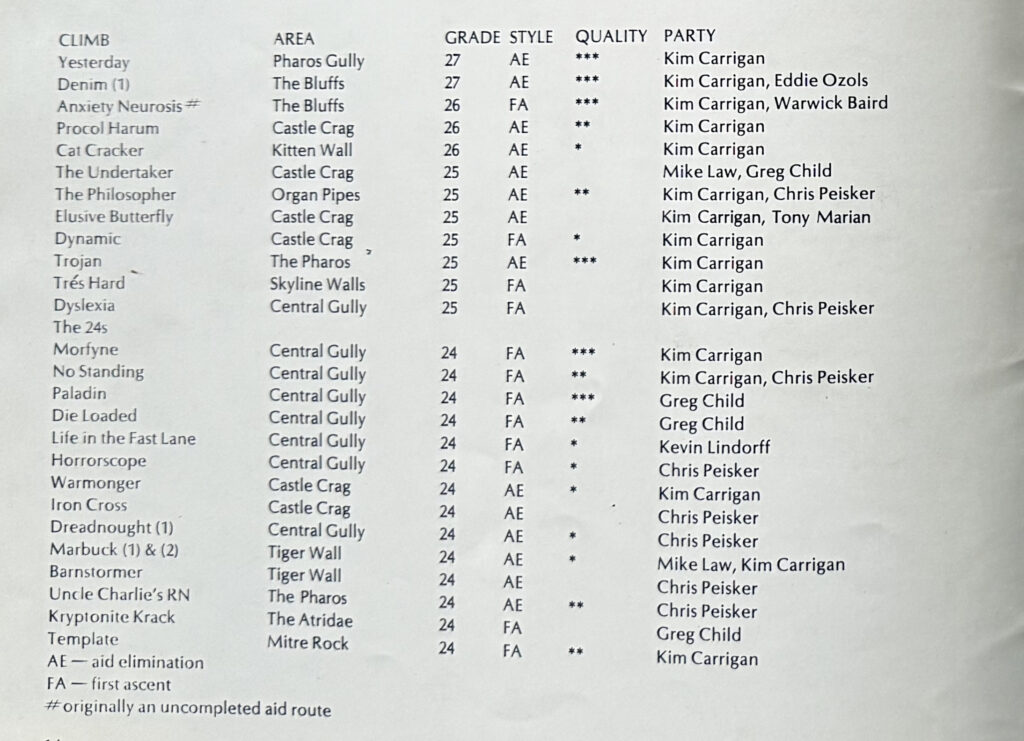
Mt Arapiles has the hardest routes in Australia. There is one person qualified to discuss them. In this article Kim Carrigan describes the 12 climbs graded 25 and above and ranks the 14 24’s in a graded list for the energetic to plummet their way through.
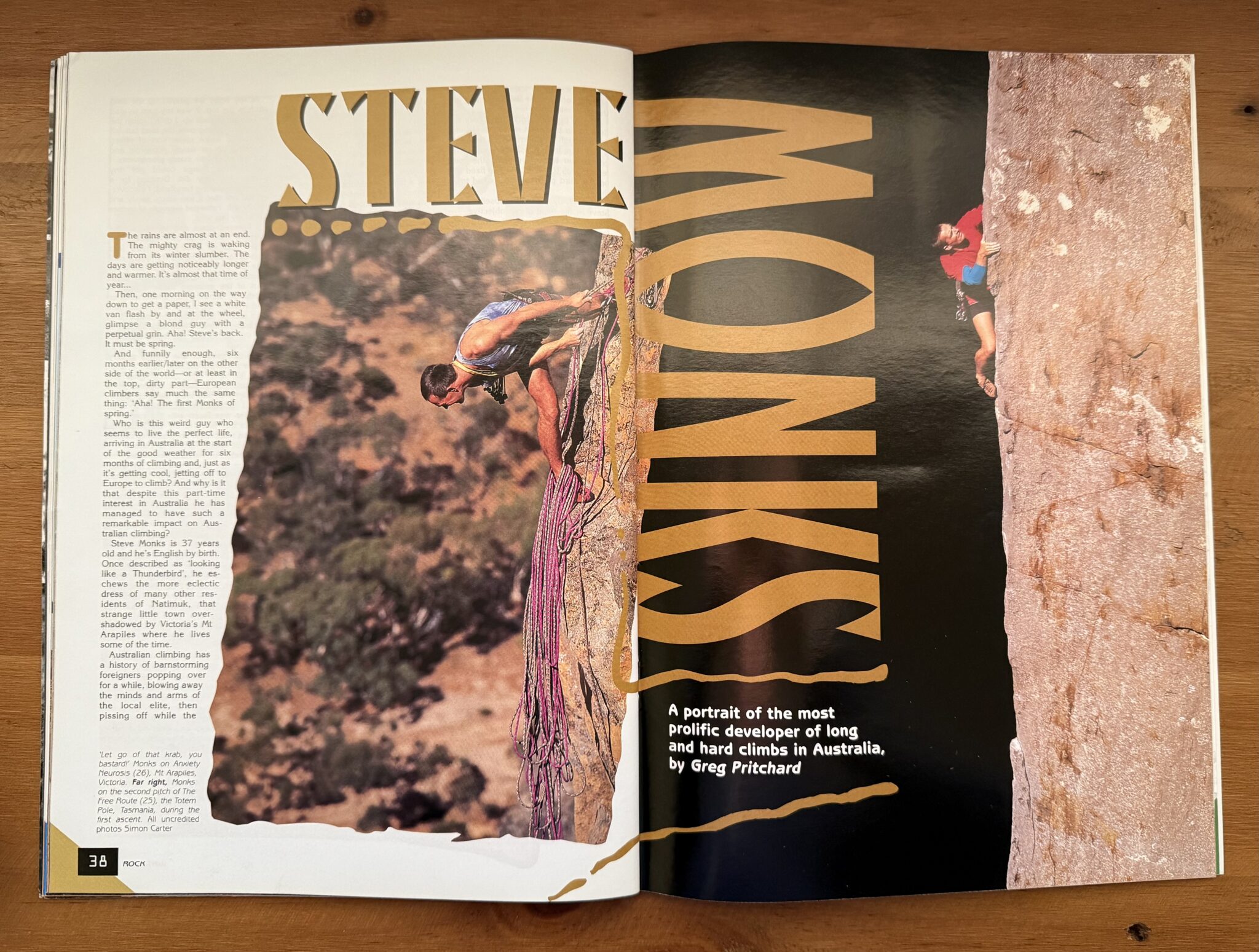
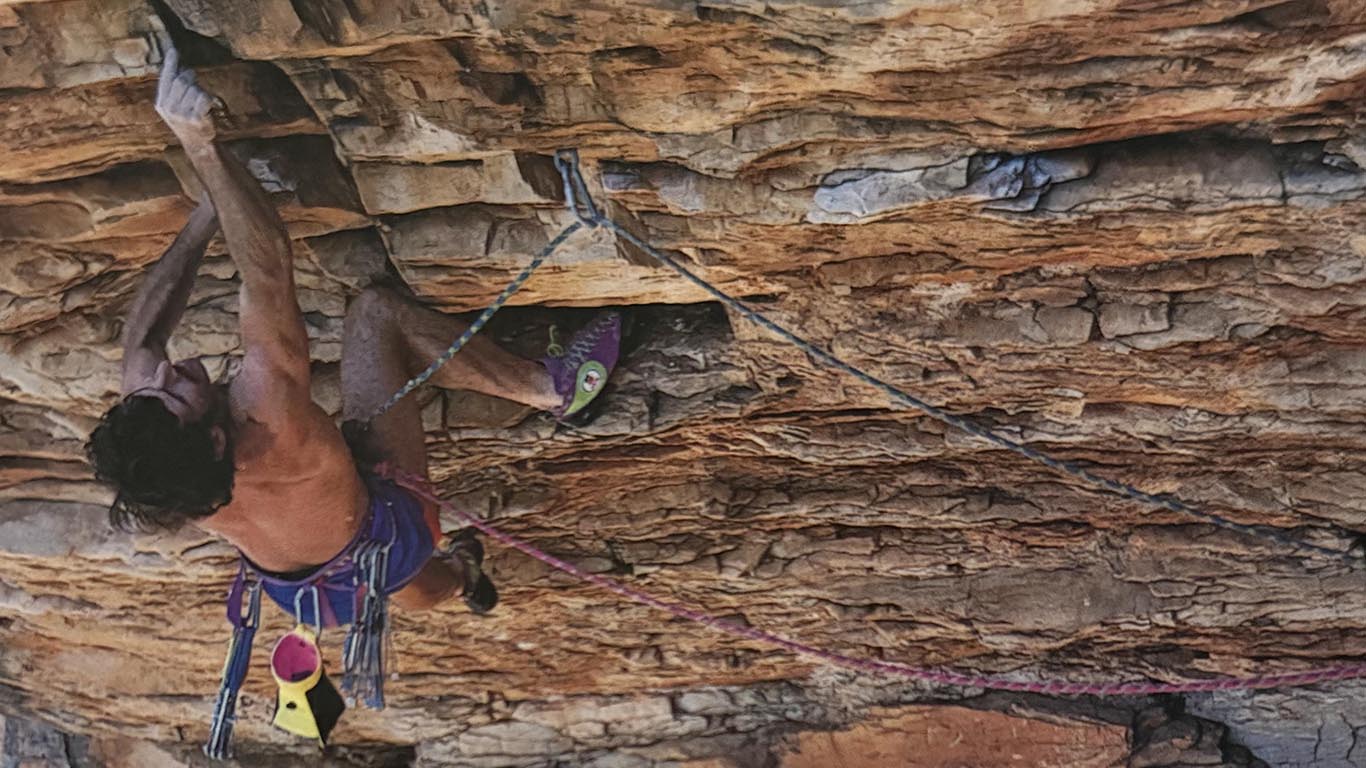
TOWERING MAJESTICALLY above all stand the Bluffs, where Anxiety Neurosis, a roof that makes Procol Harum look like a slab, lies. Almost exactly following the old unfinished aid line, the first pitch now goes at 26, after three days of working. After reaching the lip on the second day, the end was thought to be in sight, but it still took seven attempts to gain the next two metres. The second pitch, a steep arete, which turns arms to putty, also saw several falls and eventually succumbed at 23. Definitely one of the great routes of Arapiles, as well as being one of the hardest
Tucked away in one of the coldest nooks of the Bluffs, just above Ali’s, lies one of Arapiles’ arch nasties. Denim now goes totally free with pitches of 27 and 22. The first pitch, the one that only a year ago ‘would laugh at attempts to free it’, now emits loud guffaws at those very stupid few who fling themselves at and off its continuous steepness. A long sequence of poor locks and face holds is the key to a pitch that overhangs about 20º. Only at one place in 25m does the climbing ease below 23.
In a fairly obscure area lies the other real hardie of the Arapiles continuum of top routes. Yesterday Gully is a narrow, ravine-like gully off the Pharos Gully, so named because of the old aid route Yesterday. Like so many of the old climbs it is now an ex-aid route. At 27, also, it contains one of the longest hard sequences to be found anywhere. Grade 22 climbing leads to a vague rest at eight metres, from which a long, sustained set of moves containing two grotesque, dynamic sequences separated by merely hard climbing shows the way up the overhung and diagonal ‘crack’. After about 20m of this sort of thing the face really lies back to just on vertical.
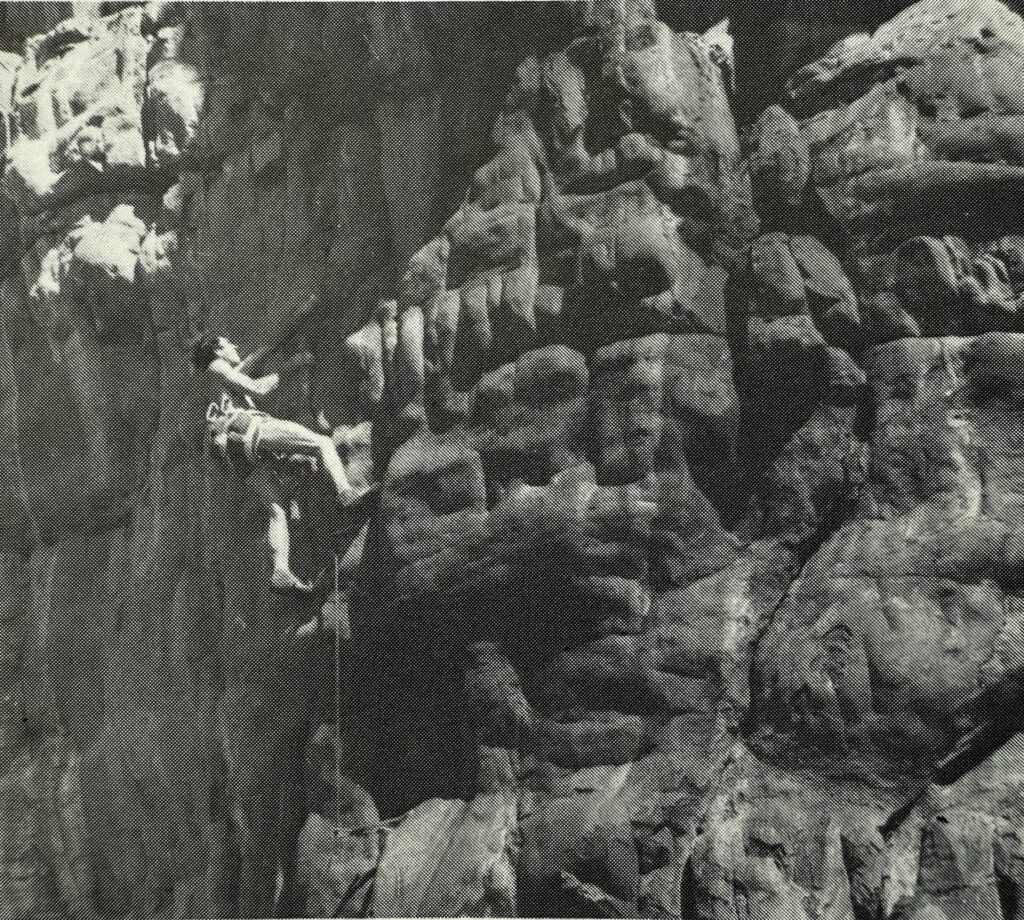

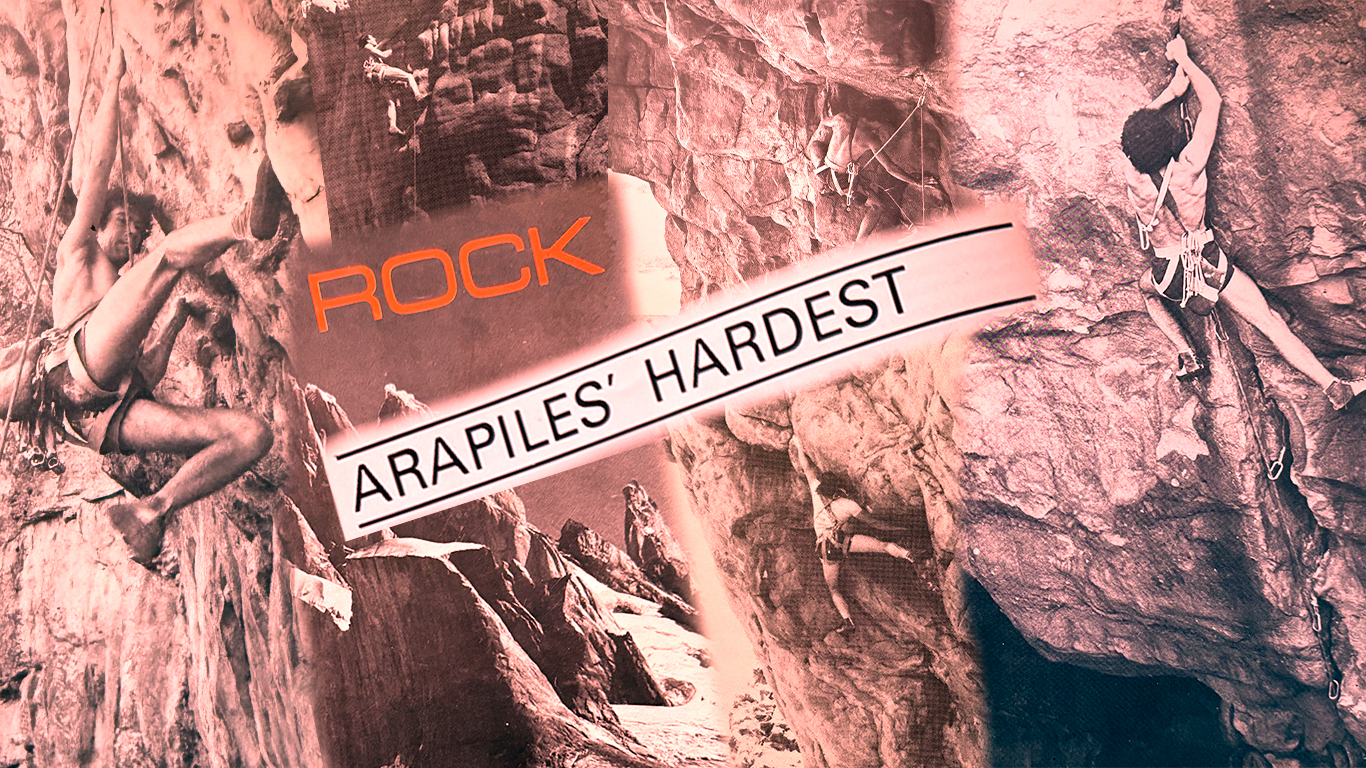
Left: Carrigan, first ascent Dynamic, 25/ Greg Child Right: Child, second free ascent Procol Harum, 26 / Carrigan
Dyslexia, though to some only a toy climb, will certainly amuse the children for hours on end. It amused us for a day. In only eight metres it overhangs two, making for quite a problematical little overhang. A bone-crunching finger-lock leads to severe barn-door laybacking – somewhat testing in fact.
Castle Crag is a rather large boulder with correspondingly large boulder problems. Once the aid climbing area of Arapiles, it now has more hard routes per square foot than any other area at Arapiles. Most of the hard climbs on this crag are ‘merely’ problems; a convenient categorisation used often by certain cynics to belittle them as actual climbs, with two rather notable exceptions.
The first, Procol Harum, would probably have been quite a pleasant doddle had it not been subjected to a 90° rotation which rather radically altered the required techniques. A long sequence of liebacks, underclings, foot-locks and face holds enable the roof to be turned after about 12m. The other is The Undertaker. This sustained, overhung thin crack problem was eventually forced free after two days of work by Mike Law and Greg Child (among others). The many fixed pins are quite useful (for runners of course!), even if they do move a bit.
Of the other climbs, Dynamic and Elusive Butterfly, are the most problematical. Short, but well protected, they are at times hideous in the extreme. On Dynamic crux protection was pre-fixed from rappel and still remains fixed.
Not bad for such a tiny piece of rock. Rather amazingly to some, the potential remains for at least another six routes of barely conceivable difficulty. Staggering perhaps – not really. The potential for difficulty is infinite, merely the increment of increase becomes smaller with respect to time. Hard climbing is a function of prevailing social conditions.
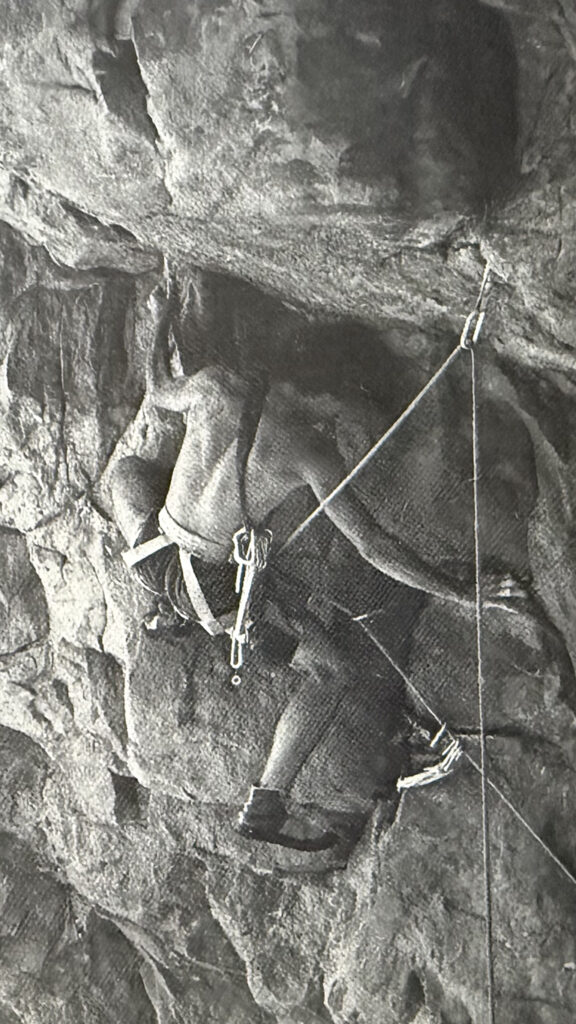
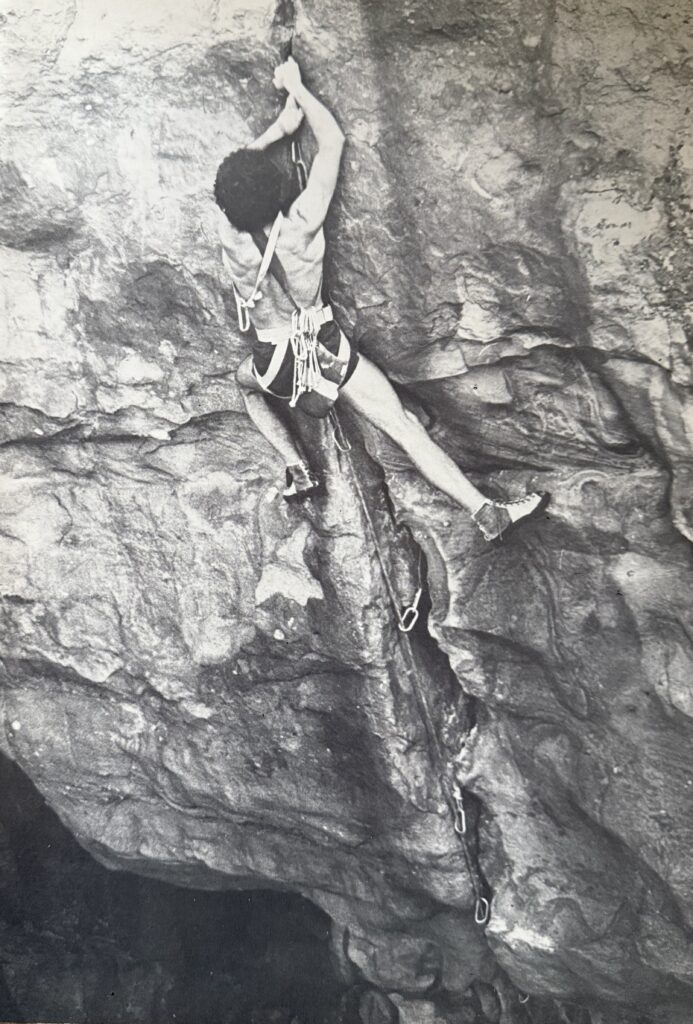
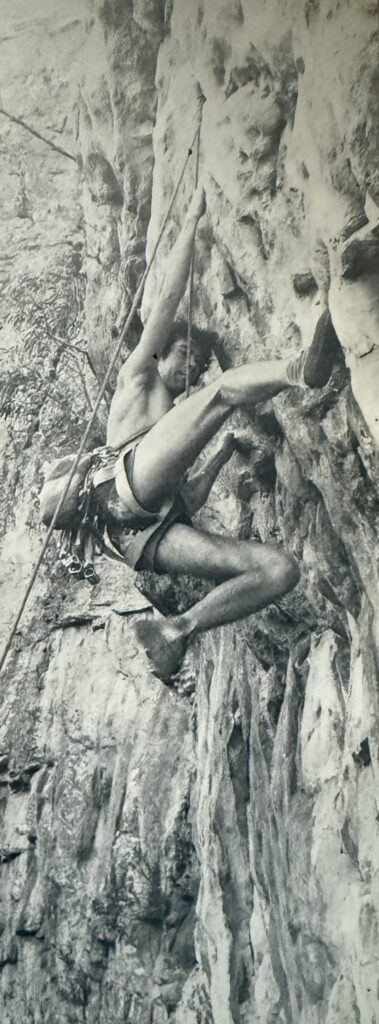
Left: Kim Carrigan, first ascent, Anxiety Neurosis, 26 / Barry Young Centre: Carrigan, first free ascent, Denim, 27/ Simon Kenny Right: Carrigan, first free ascent, Tres Hard, 25 / Rod Young
Trojan, yet another of the really great Arapiles routes is on the steep back wall of that ancient sea stack, the Pharos. For a long time it was an aid route; it is easy to see why. For almost 25m this climb remains constantly overhung at about an average angle of 20°. To complete the route, the second pitch goes at the relatively modest grade of 21.
High on Skyline Walls, lies the nasty problem Trés Hard, which overhangs some four metres in 15. Classic, subversive style being the order of the day, a fixed pin was placed with the aid of a five-metre branch. A series of hideous slopes, liebacks and pinches eventually lead to easier climbing.
Kitten Wall, too, has its resident nastie. One of the most recent of the hard routes, it is also the most insignificant, being most definitely a boulder problem, although unfortunately removed from the ground by about 20m. The grade it carries, 26, is not a good indication of its difficulty: far better to see it as a problem at BI+ or B2, the crux being a long dynamic from mean slopes on an overhung wall to a small hold above a roof. What fun!
Nearer camp lies the D Minor pinnacle on the back of which yet another rather unlikely coup was made as this article was being submitted to the printer. Philospher, though not steep for an aid climb, is certainly steep for a free one. There is little for more than fingertips, and it is a very thin sequence indeed that leads to the final dyno into Cadenza. The finishing pitch, of Cadenza Direct, remains to be freed.
Being a rather vague account of all routes of grade 25 and above at Mt Arapiles, up until May 1979.
Want to learn more about Arapiles? Check out some of our recent stories:
6 Climbing Areas at Risk if the Arapiles Bans Proceed
Arapiles Update: Climbers Rally at Shared Not Shut Vigil
Historical Photo Gallery from Arapiles Climbing Museum in Natimuk
Rest Day Views from Dyuritte/Arapiles
Climbers Reflect on Life, Community, and the Future of Arapiles.
Rock Climbing Rescue on Tiger Wall, Arapiles and Near Miss on Balls Pyramid