Updates from Altitude: Shattered Stones and Shattered Nerves
Alessandra (Allie) Pepper is currently aiming to summit the world’s 14 highest peaks without supplemental oxygen. Her most recent ascent saw her become the first Australian woman to stand atop Pakistan’s second highest peak, Nanga Parbat (8,126m)… but became a journey that had her questioning her entire mission.
WORDS BY ALESSANDRA PEPPER
IMAGES BY MIKEL SHERPA AND DAWA SHERPA
We were in the middle of the Diamir Face on our first rotation to Camp 2. The sun had just hit the face when we heard it—an almighty crack from high above. I looked up and saw a car-sized boulder hurtling down toward us. Time seemed to slow. I had enough of it to understand we probably weren’t going to survive.
I kept my eyes locked on the boulder. It smashed into the cliff 50 metres above us and exploded into pieces. I crouched low under my helmet and prayed. My partner Mikel stayed upright, dodging sideways as shards of rock flew past. One rock the size of my hand hit my arm, but we were both okay. Just… okay. There was silence. I looked down at Mikel. Unscathed. I started crying and shaking. We’d survived, but barely.
Now we had a choice: go up or down. Heading back meant spending even more time in the sun-exposed rockfall zone. Climbing up wasn’t safe either but we were closer to Camp 2 than Camp 1. So, we pushed on, terrified but committed.
Neither Mikel nor I had climbed Nanga Parbat before. When we reached the Kinshofer Wall, the falling rocks had finally stopped but the climbing was harder than I expected. The second-last pitch had around 10 vertical metres with no holds. I prusiked with my leg loop, inching my way up. The final pitch was a slab, crampons scraping over bare rock. No snow, no ice. Just friction, fear, and front points. Ten hours and forty-five minutes after leaving Camp 1, we reached Camp 2. It was only the beginning.
My partner Mikel stayed upright, dodging sideways as shards of rock flew past.
Nanga Parbat challenged me on every level, physically, mentally, emotionally, spiritually. Even the trek in was confronting. I’d heard stories about women being assaulted in the area. And I couldn’t forget what happened at Base Camp in 2013, when climbers were murdered in their tents. It haunted me. We were escorted by community police, one of them carried a gun and armed officers were stationed at Base Camp the entire time. It offered some sense of protection, but I never truly felt safe.
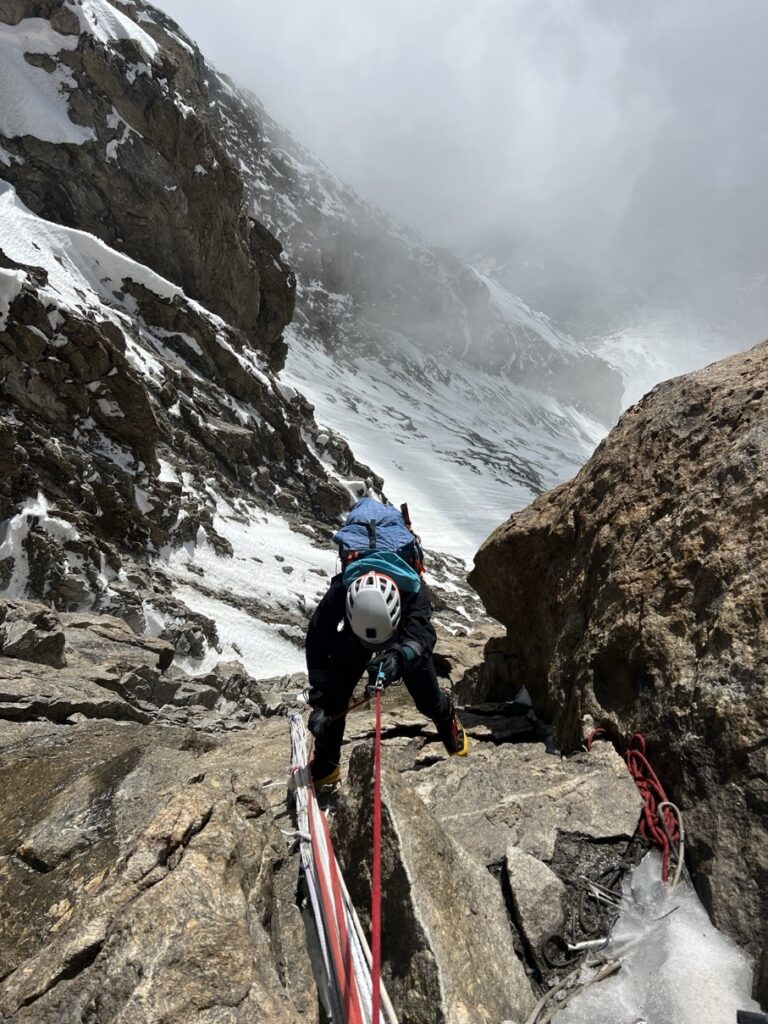
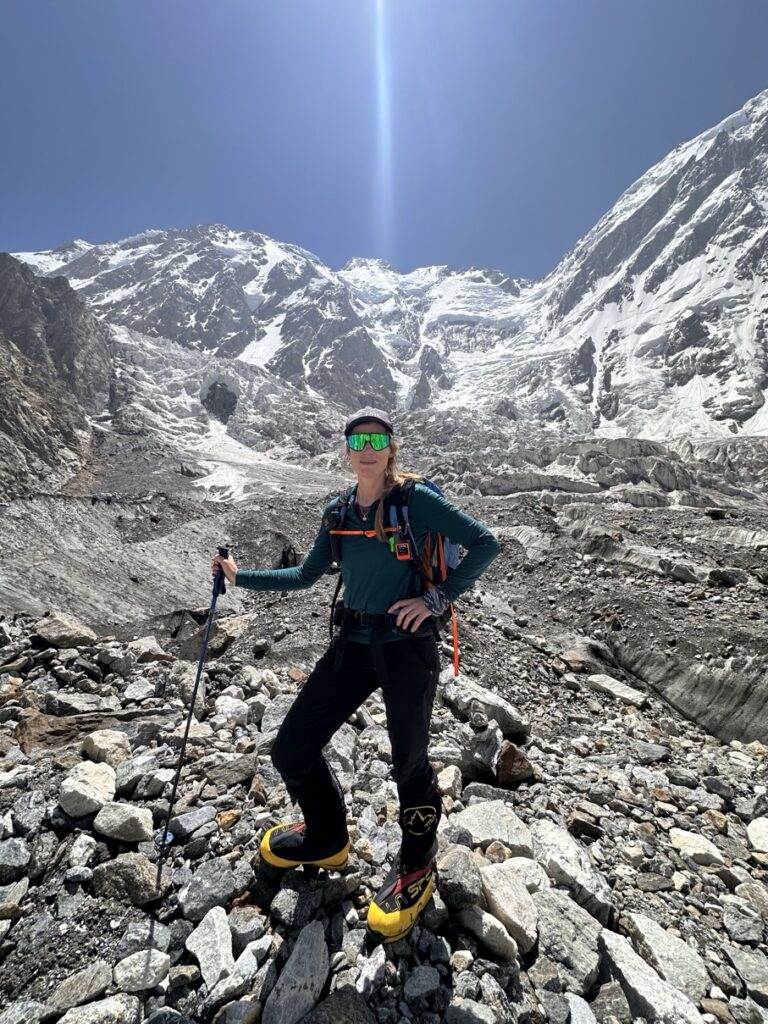
LEFT: AT THE TOP OF THE SECOND LAST PITCH ON KINSHOFER WALL. RIGHT: VIEW OF THE DIAMIR FACE IN THE DISTANCE
And then, the usual gastro. I was sick for almost the entire time I was at Base Camp from the food or the water. I actually recovered better on the mountain when I was eating from a packet and melting snow.
We had only taken three weeks between Kanchenjunga (8,586m) and Nanga Parbat to recover. My legs were still tired when we arrived. Kanchenjunga had beaten me down. I hadn’t summited without oxygen and I’d climbed with the flu. The weather on the summit push was horrific. I used supplemental oxygen because I knew I wouldn’t survive the summit without it. That decision stayed with me.
So, I set my mind on achieving Nanga Parbat without bottled O2. But the mountain wasn’t in good condition. There’d been little spring snowfall. Everything was dry, a lot of rock, ice, and danger. We quickly realised we had to climb in the shade or the dark between Camp 1 and Camp 2. The sun would trigger rockfall. Timing was everything.
After our first rotation where I reached 6,300m and we spent two nights at Camp 2, we waited a week for a summit window. I was sick again at Base Camp, knocked down by gastro. I needed strong meds to recover in time. The forecast gave us a window: July 3-4. We left Camp 1 at midnight and reached Camp 2 by 9am, climbing mostly in the dark. Dawa, a Sherpa whose client had gone home, joined us. He helped carry some of my gear, and with a lighter pack I moved faster up the Kinshofer.
The climb to Camp 3 was harder this time. Conditions had changed, more hard ice and falling rock. We pushed through it, relieved when we finally reached snow in the last few hundred metres. We decided to make a Camp 4 for me to have a better chance at a no-O2 summit. That night, everyone else at Camp 3 left for the summit with oxygen. My friend Klara went too. She hadn’t slept well and was tired, but she wanted to try. In the night, she returned. I didn’t know it at the time, but she’d decided to descend to Camp 2 in the dark so she could get to Base Camp the next morning.
Then we got the call on the radio. Klara had fallen. A long way. She hadn’t survived.
I was in shock. There was nothing we could do; there was no chance of a rescue. A helicopter would later be sent to try and locate the body. With heavy hearts, we continued.
We reached Camp 4 (7,260m) and pitched our tent mid-afternoon. We planned to leave around 10pm for the summit. But the wind picked up, and I doubted whether I could do it without oxygen. Still, we left at 10:30pm.
In the dark, my legs started giving out. My quads were burning from climbing the hundreds of meters of ice on the mountain. After three hours of climbing, at 7,500 metres, I knew I wouldn’t make the summit without help. I made the call to use our emergency O2. Within 30 minutes, the pain eased. I could move again. It still wasn’t easy, but it was possible.
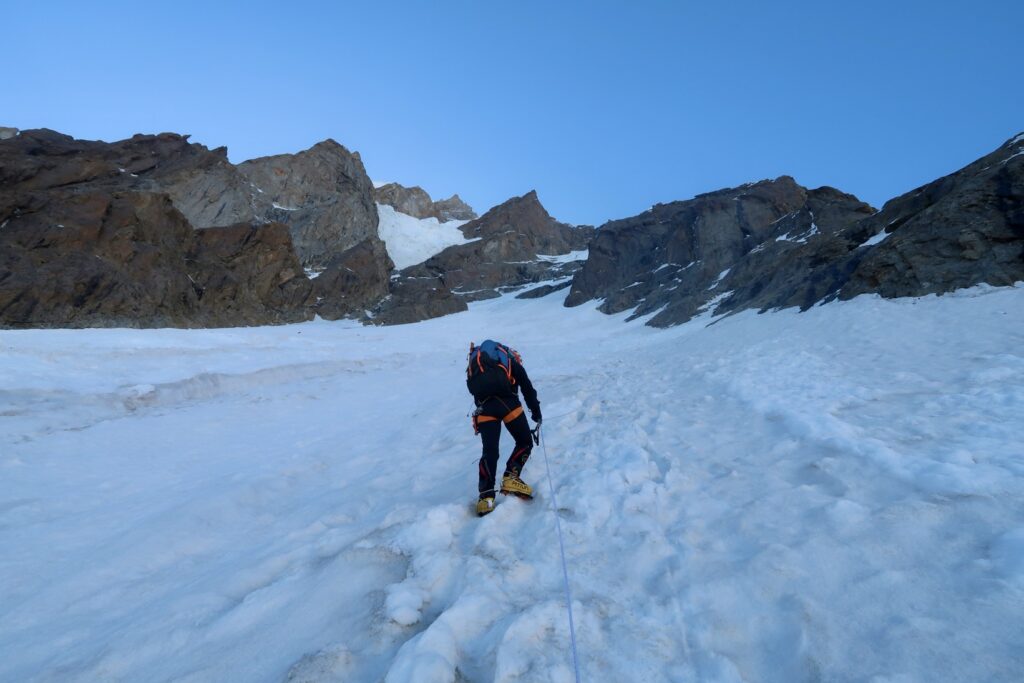
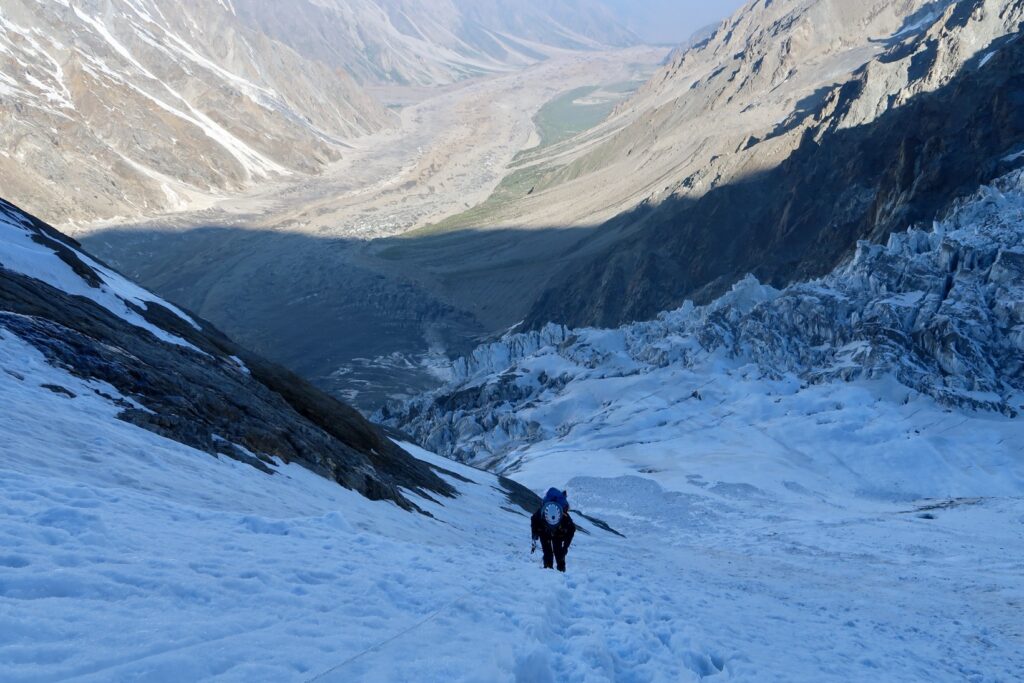
LEFT: HEADING UP THE KINSHOFER COULOIR TOWARDS THE KINSHOFER WALL TO CAMP 2. RIGHT: HEADING BACK TO BASE CAMP ALONG THE DIAMIR GLACIER
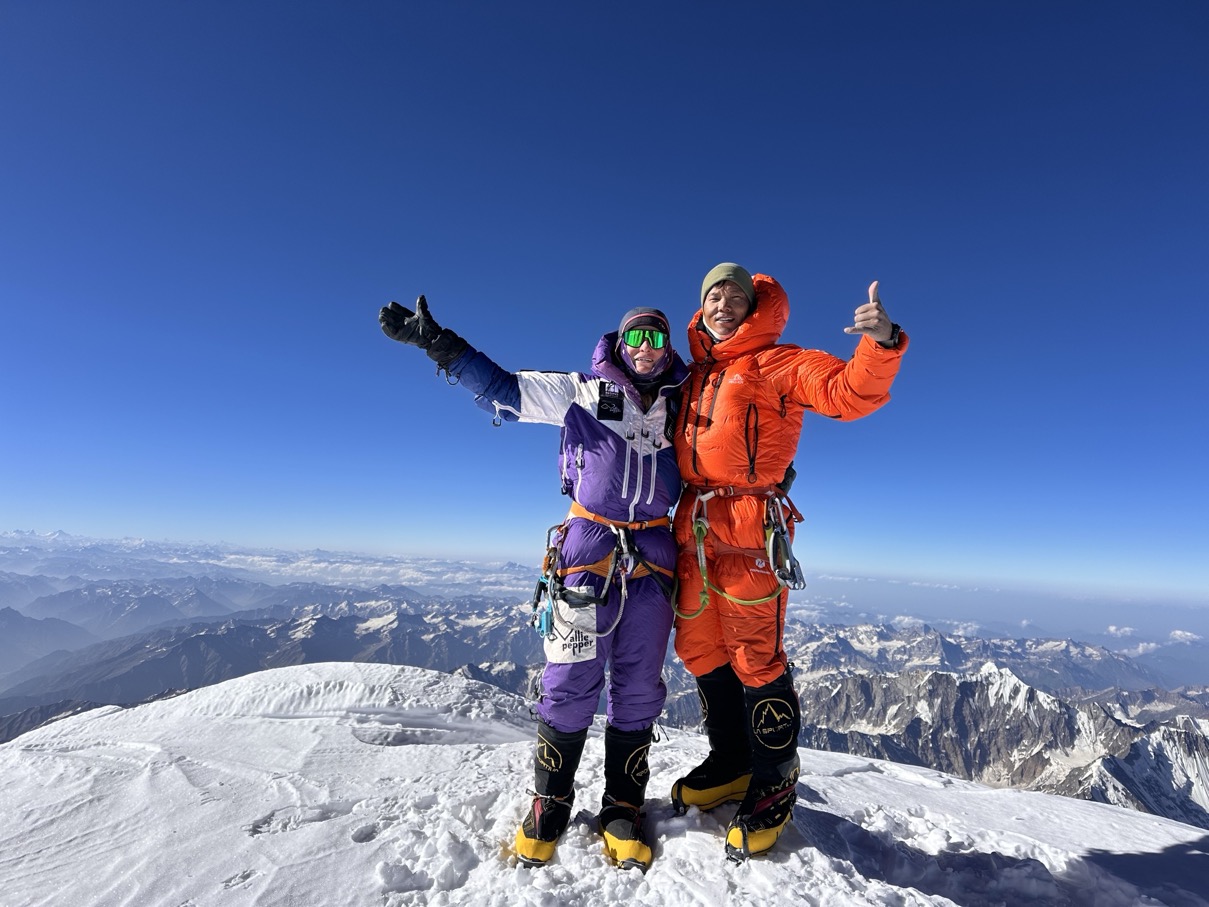
We reached the end of the fixed ropes. The summit was still a few hundred metres away. What was left was loose rock and boulders. Carefully, we climbed. The final stretch was a small snow slope which brought us to a perfect summit. No wind. No clouds. Blue sky in every direction. A 360° view of the Karakoram. It was surreal. For the first time in a long time, I wasn’t scared. There were no falling rocks. We were safe, at least for now. We spent an hour on the summit, filming and soaking it in.
For the first time in a long time, I wasn’t scared. There were no falling rocks. We were safe, at least for now.
But the summit is only halfway. The downclimb through the rocky section was easier than I expected. We packed up Camp 4 and descended to Camp 3. A few hours of rest, then we left at 1am to continue to Base Camp. At 4am we reached Camp 1, and that’s when things started to get really bad.
The Diamir face was now dry—just rock, dirt, and patches of black bulletproof ice. Most of the snow was gone. Anchors had ripped out. Ropes were twisted, tight and full of knots. Some were so tight we couldn’t abseil them. Others ran across sketchy traverses where the only option was to hang on tight and pray. It was terrifying. And then, the sun came out and so did the rocks.
That mountain changed me. It stripped my ego raw. I swore I’d never go back.
We were frayed, arguing with each other, nerves shredded. When we finally stepped into Camp 1, I began shaking and I cried. I was shaking from the adrenaline that had kept me alive. I could finally let out my emotions that I had bottles up inside me to just get the job done.
Walking into Base Camp was like stepping into a dream. We were alive. We’d survived Nanga Parbat. We were the lucky ones.
That mountain changed me. It stripped my ego raw. I swore I’d never go back. No part of me wanted to step foot on that mountain ever again. I needed time to mentally process what happened.
But now, as I recover, I’ve made a decision: I’ll continue my 14 peaks no-O2 journey. And that means one day, I’ll return to Nanga Parbat. I know it sounds crazy. But every climb is a new climb. That was true of Annapurna for me. The first time was an absolute nightmare, second time I reached the summit safely without oxygen.
So, the journey continues.
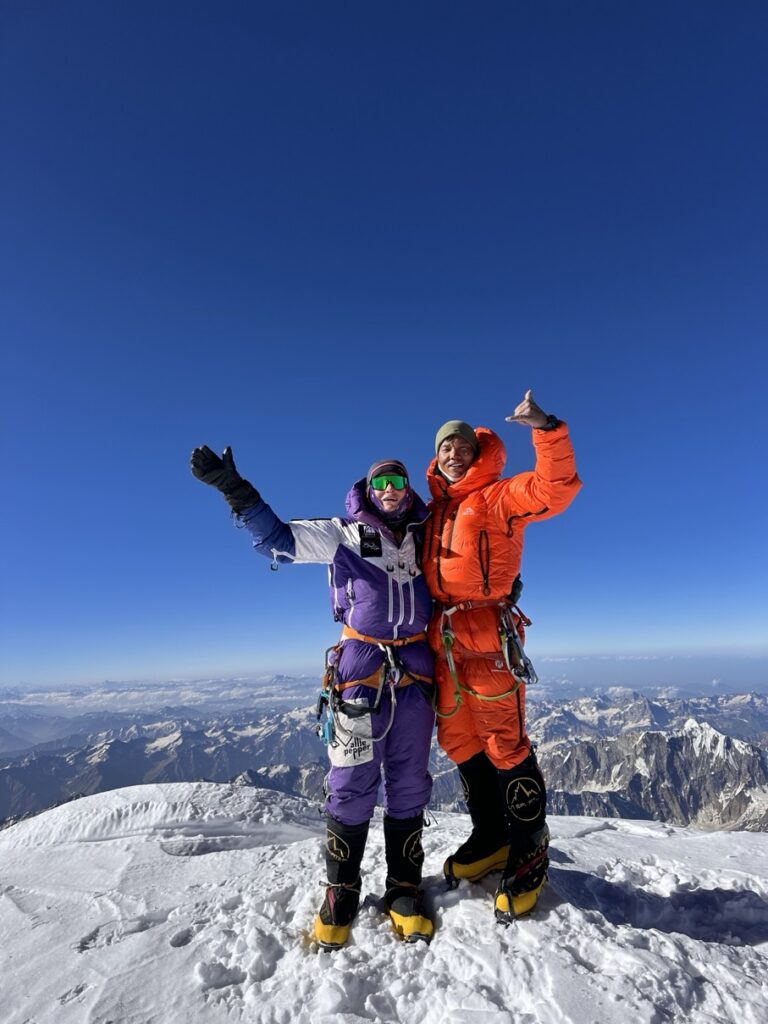
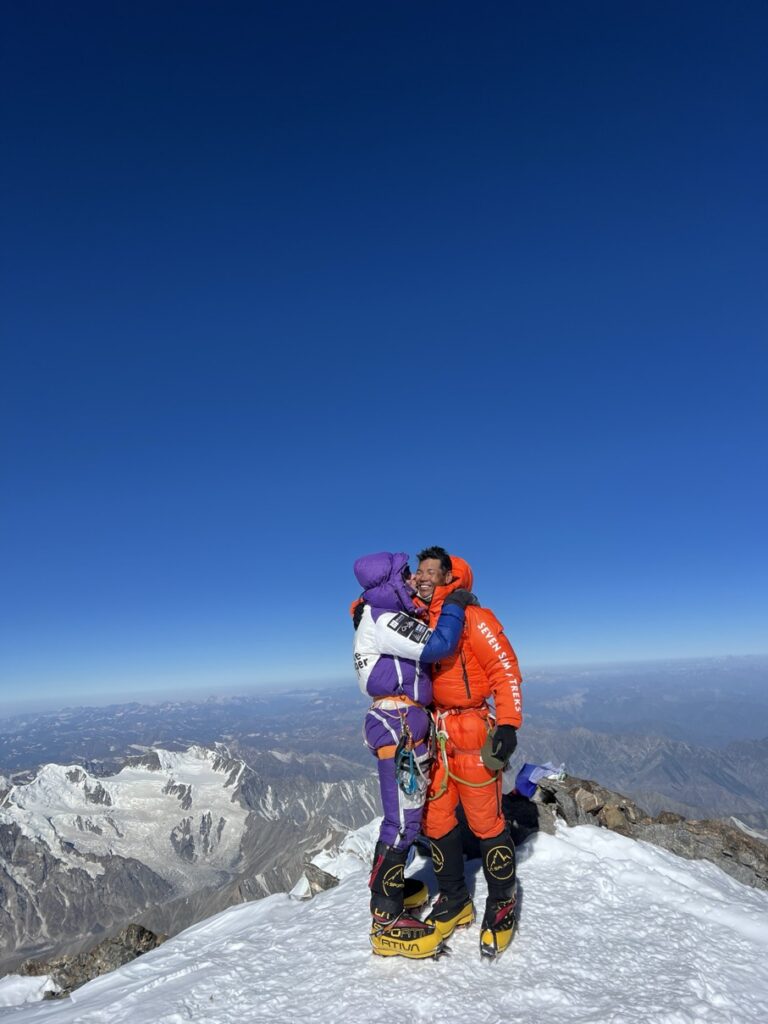
BOTH IMAGES: MIKEL AND ALESSANDRA ON THE SUMMIT WITH FANTASTIC WEATHER AND CONDITIONS
Bio: Alessandra (Allie) Pepper is Australia’s most accomplished female high-altitude mountaineer. She is the first Australian woman to summit Nanga Parbat. With over 25 years of climbing experience, she is on a mission to summit all 14 of the world’s 8000m peaks without supplemental oxygen.

Follow Allie on her journey!
Other articles of interest:
Will Allie Pepper be the fastest person to summit 14 of the 8000m peaks without supplemental oxygen?
Limitless Above the Clouds: Allie Pepper’s Mission to Summit Without Oxygen
Updates from Altitude: Allie Pepper and The Turquoise Goddess