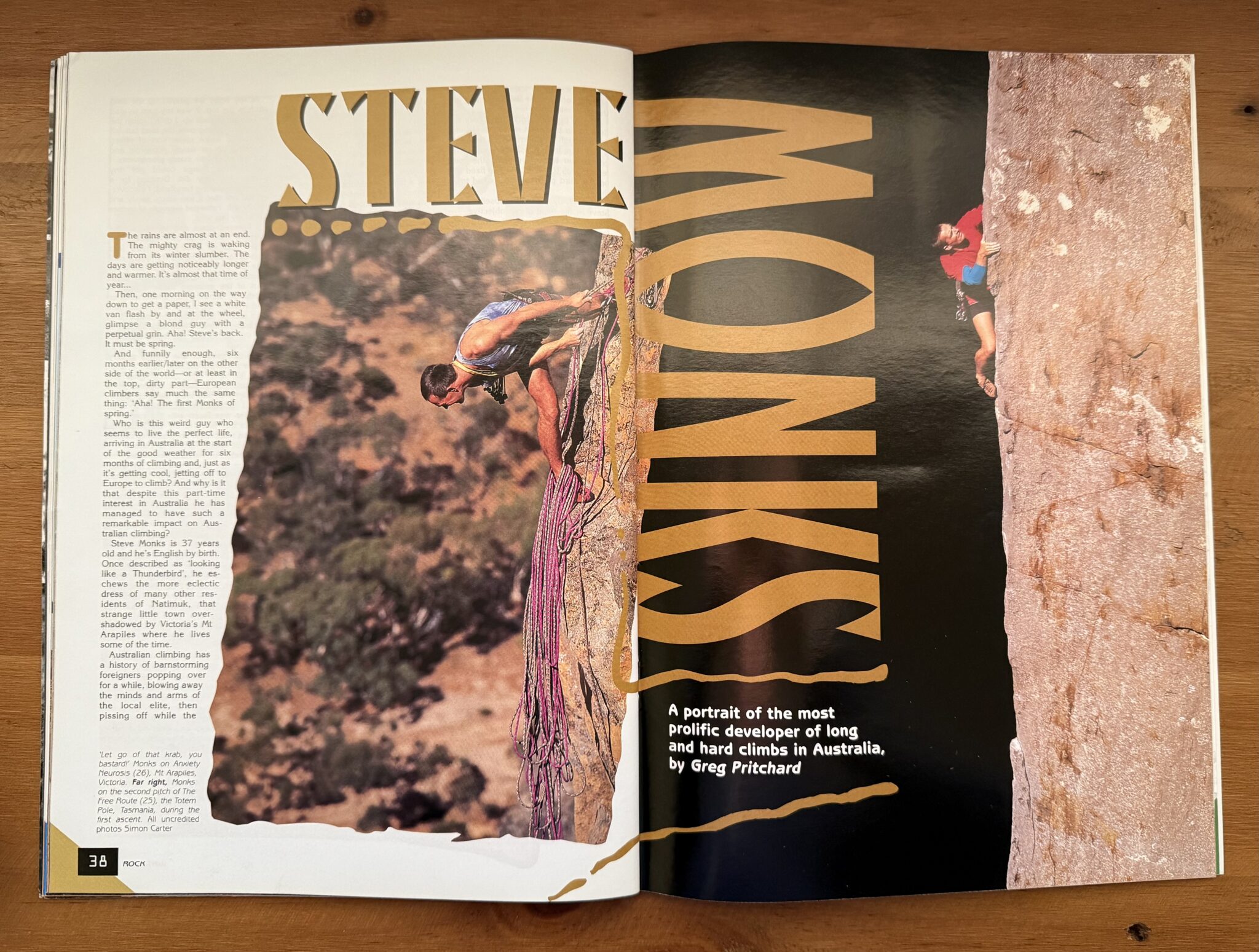
1996 ROCK REVIVAL: Steve Monks
A portrait of Steve Monks, the most prolific developer of long and hard climbs in Australia.
First Published in Rock Magazine in 1996
Written By Greg Pritchard.
This article was originally published in Rock Magazine in 1996. The information, route descriptions, and access details reflect the conditions and ethics of that time. Climbing areas and their access arrangements may have changed significantly since then. Please consult up-to-date local sources, land managers, or climbing access organisations before visiting any of the locations mentioned.
The rains are almost at an end.
The mighty crag is waking from its winter slumber. The days are getting noticeably longer and warmer It’s almost that time of year…
Then, one morning on the way down to get a paper, I see a white van flash by and at the wheel, glimpse a blond guy with a perpetual grin. Aha! Steve’s back.
It must be spring.
And funnily enough, six months earlier/later on the other side of the world-or at least in the top, dirty part-European climbers say much the same thing: ‘Aha! The first Monks of spring.’
Who is this weird guy who seems to live the perfect life, arriving in Australia at the start of the good weather for six months of climbing and, just as it’s getting cool, jetting off to Europe to climb? And why is it that despite this part-time interest in Australia he has managed to have such a remarkable impact on Australian climbing?
Steve Monks is 37 years old and he’s English by birth.
Once described as ‘looking like a Thunderbird’, he eschews the more eclectic dress of many other residents of Natimuk, that strange little town overshadowed by Victoria’s Mt Arapiles where he lives some of the time.
Australian climbing has a history of barnstorming foreigners popping over for a while, blowing away the minds and arms of the local elite, then pissing off while the locals are still picking their jaws up off the sand. Henry Barber, Tobin Soren-son, and Wolfgang Güllich are the most spectacular examples but Stefan Glowacz, Jerry Moffatt, Paul Smith, Andy Pollitt, Patrick Edlinger, and others also come to mind. While Monks has perhaps not redefined the cutting edge (though he has come bloody close) he has lingered longer and in the anti-podean phases of his endless summer has continued to show just what is possible on the tall end of a climbing rope. What is perhaps most remarkable about Monks is that in spite of a climbing pedigree the size of a decent crag he goes about the business of doing such things with a minimum of fuss and fanfare. While others may claim that he is this or that, Monks just grins and shrugs. To quote Oscar Levant: ‘What the world needs is more geniuses with humility. There are so few of us left.’
Simon Mentz, his partner on many climbs, has said that the beauty of Australian climbing is that it is possible for anyone with imagination to leave his or her mark on it. Mind you, it helps a lot if you have the talent to back your imagination. Monks is the living embodiment of this happy combination; he uses his imagination to find climbs that are out of the ordinary, and his skill to get up them.
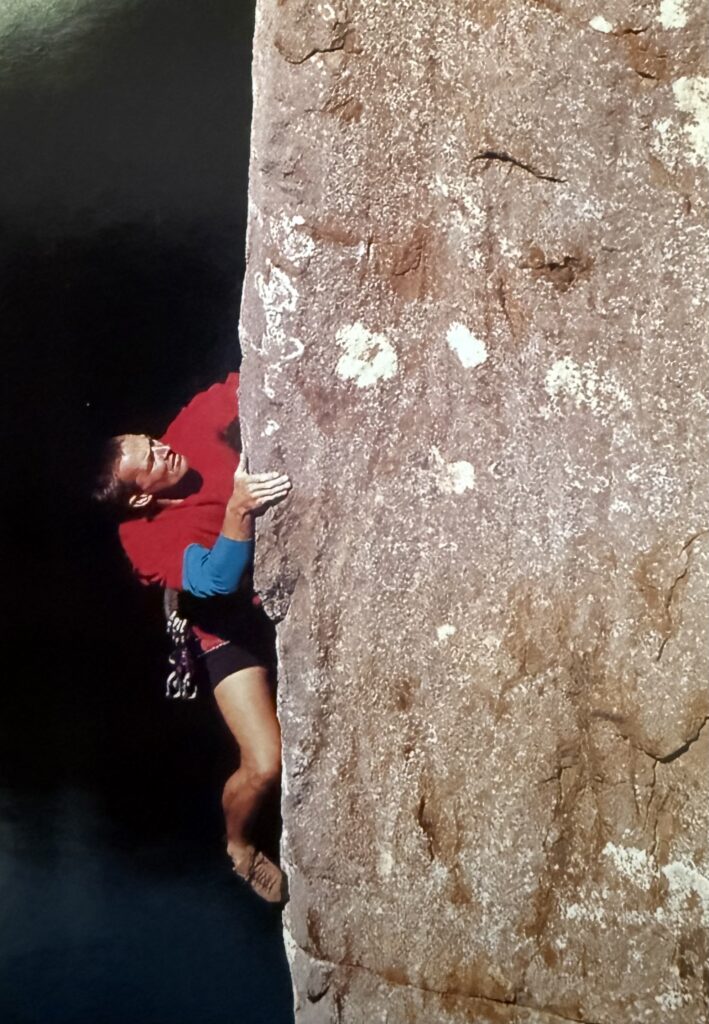
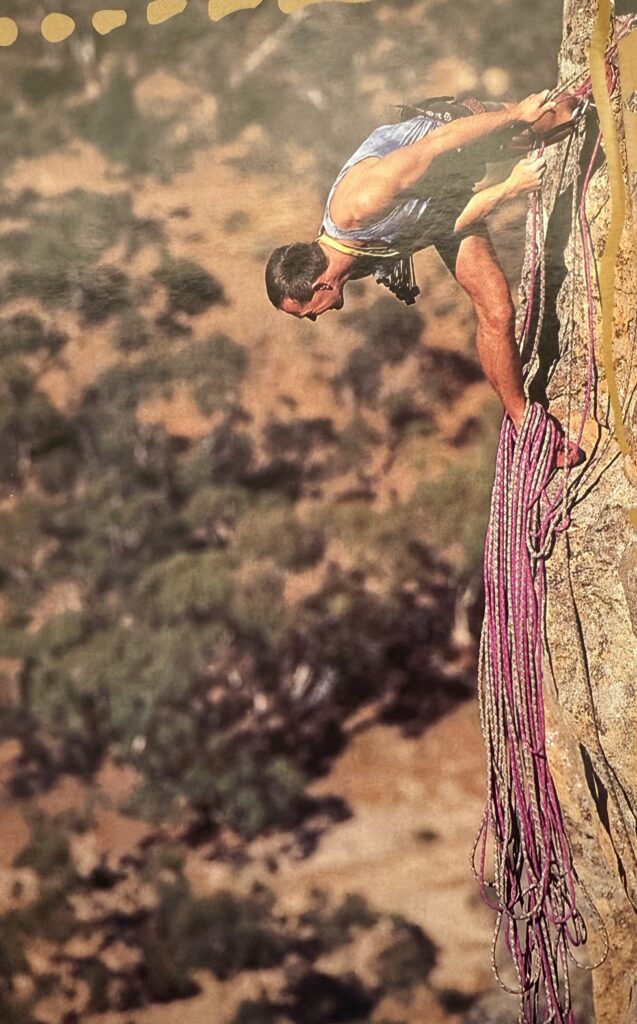
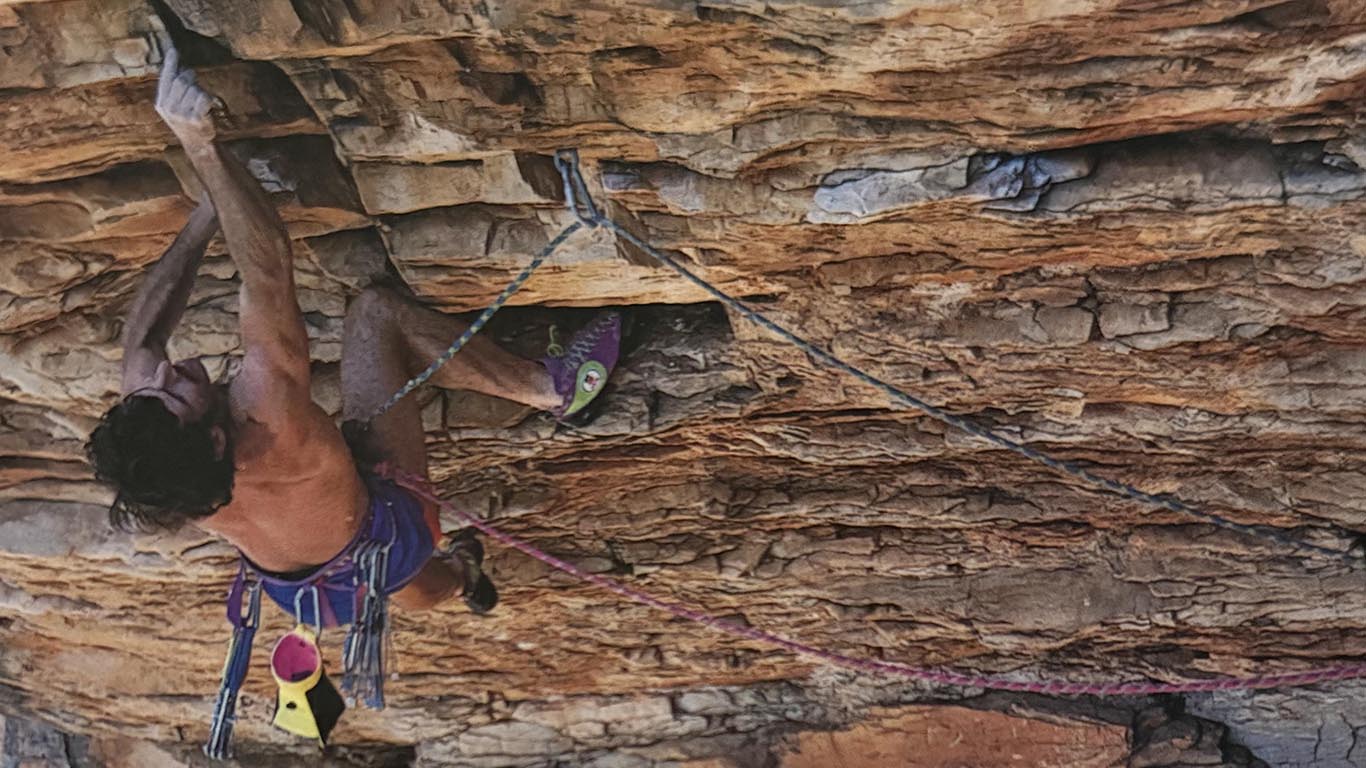
Left: Monks on the second pitch of the Free Route (25), the Totem Pole, Tasmania during the first ascent. Right: “Let go of that krab, you bastard! Monks on Anxiety Neurosis (26) Mt Arapiles Victoria. Images by Simon Carter
Steve Monks was already an integral part of the Bristol climbing scene when he first came to Australia in 1984 after meeting the dynamic duo Kim and Louise (that’s Carrigan and Shepherd for anyone younger than 25) while climbing in the USA and in Europe.
After beginning to climb at the age of 14 while attending Bristol Grammar School he dabbled for a few years before getting the bug; when he got it, he got it with a vengeance. Monks is still nostalgic about this early time in Bristol.
‘For growing up as a youngster climber Bristol was ideal-Avon Gorge was only ten minutes from school… I used to finish school and go and do a route.’ Before he left school he left home and moved in with a girlfriend the sister of a climbing partner. (Some things are the same no matter in what country you live.) After false starts at further study and a stint in London, Monks returned to Bristol to begin the life of a climbing bum. He still preserves a great love for his favourite place in the UK, the cliffs of Pembrokeshire, of which he was a key developer. When asked which climbs were his favourites he decribes the standard six routes allowed by the
traditional ‘desert island climb’ format: ‘I would take the whole area-l’m greedy!’ Said, as always, with a wry smile.
One of Monks’s early partners and, he claims, a sort of mentor for him was Arnie Strapcans. No stranger to readers of Mountain magazine during its heyday, Strapcans gained notoriety after falling into the sea off Gogarth’s Spider’s Web with his belayer, Robert Brown, and their belay. Amazingly, Strap-cans survived the 35 metre fall and made it ashore but was unable to pull his
partner out as the rope was jammed. Brown drowned. Strapcans was featured in Mountain for the last time after his death while soloing in the Alps in 1980. Monks describes Strapcans as a very good climber and an incredibly original thinker; coming from him that is high praise indeed.
In talking of those early days of climbing in the UK Monks gives a clue to his present ability. ‘You didn’t just go rockclimbing; climbing was everything. The rock, the Alps, trips to Norway… Among a swag of new routes to his credit in these early years was a 1978 ascent-with Strapcans-of The West Route at Cheddar Gorge, the first climb in south-west England to be given a grade of E5.
Monks headed for the USA in 1980.
On this first trip he contented himself with that old climbing tradition, the senseless pump. His routes from that period read like a tick-list of North American classics and included Separate Reality, Crimson Cringe and Astroman in Yosemite, and the Wisdom Roof and mythical Naked Edge in Colorado. He spent his apprenticeship on the big walls, often solo, making very notable ascents. These included a free repeat of the West Face of El Capitan and a solo of the regular route on the North-west Face of Half Dome. This entailed on-sighting pitch after pitch of 5.9 (17/18) for six hours, mostly free solo. This 24-pitch route usually takes two days. He also free soloed the Casual Route (interesting use of the word “casual”) on the Diamond Face of Longs Peak in two hours.
He returned to the USA in 1982 and continued his impressive route bagging.
He started with the third one-day ascent of the Nose of El Capitan and went to even greater lengths-a seven-day effort, in fact—to solo the huge aid route The Shield (A4) on El Capitan. While on this route Monks met Kiwi Lydia Bradey, also at home on the big walls, who was doing an adjacent route. Together they went on to do Zenith (A3+) on Half Dome over nine days. Lydia wrote that despite falling snow they ‘were comfortable with a stove, stereo and a bottle of rum’. Whatever happened to austerity? Monks also climbed the A5, Sunkist, on El Capitan.
He eventually finished his studies with a diploma in engineering. The day he put the pen down after his final exam he left for Cho Oyu (8201 metres) in Nepal with Bradey to try the unclimbed East Ridge. They were unsuccessful. From there they came to Australia and Monks proceeded to climb in the company of Kim Carrigan, ticking routes at Arapiles such as London Calling (26) and discovering (yes, I know people had been there before the Grampians. More about that later…
Monks had already decided to make a living from climbing rather than engineering and returned to the UK to get his climbing guide’s ticket. After qualifying he was invited to join the Swiss-based ISM (International School of Mountaineering), a 15-20 member co-op for which he guides four months a year. ISM’s members have included such notable climbers as founder John Harlin, Dougal Haston, Pete Boardman and present head Pat Littlejohn.
In 1985 Monks again pushed the boundaries, capping off (perhaps) his long list of solo achievements with his ascent of the 1938 Route on the North Wall of the Eiger-only the second British solo ascent. When asked why he stopped soloing Monks talks merely of getting ‘more sensible’. It’s a matter of getting less comfortable on routes. It’s a matter of statistics. You just can’t keep pushing limits like that. There are only two ways to become an ex-soloist. The right way is to give it up.
No doubt. Monks’s friendship with several high-profile ex-soloists of the other kind contributed to this lack of comfort with unroped climbing.
Monks continues to climb in the Alps and what he calls the Greater Ranges’, embarking on expeditions to Bhutan’s Kangar Punsum (at 7500 metres one of the world’s highest unclimbed peaks) unsuccessfully in 1986; he was successful in 1987 on Kashmir’s Nun (7400 metres) and Parchimo (6200 metres); and has also had an unsuccessful shot at Ama Dab-lam (6800 metres), a peak to which he hopes to return this year. Last year he guided parties in the Karakoram and the Pamirs, bagging half a dozen unclimbed peaks.
Monks returned to Australia for the 1985-86 summer. On this trip he really set to work at Mt Arapiles and claimed the fourth ascent of Masada (graded 30 at the time) and a repeat of India (29). He also visited Moonarie in the Flinders Ranges. It was on this trip that he became romantically involved with Jane Wilkinson, who was to become his long-term partner and tireless belayer. Wilkinson is one of the unsung heroes (I deplore the term heroine) of Australian climbing accompanying Monks on many of his more outlandish exploits including The Seventh Banana, Ozymandias and the big Tasmanian routes.
After completing his guide’s training in Europe, Monks returned to Australia and became an Australian resident (and, later, Australian citizen). This allowed him to start his unusual life cycle of dividing his time between Australia and Europe.
In Australia Monks is predominantly known as a rockclimber. And his routes continue to set benchmarks for audacity and originality. He admits to having a flair for grand projects’ and says that he has always tried to do such climbs.
According to Wilkinson: ‘Goals are very serious to him and if he has a goal in mind nothing can stop him achieving that. He has an incredible power to use everything the body and mind have to succeed. Once he gets on rock he has this amazing ability for mind over matter and I’ve never met anyone who can do this like Steve can.’ As she points out, Monks has successfully managed to marry the two worlds of climbing-rock- and alpine climbing-and possibly no one else in Australia participates in both activities at the levels he does.
Monks acknowledges a lingering love affair with Victoria’s premier granite area, Mt Buffalo, and in the summer of 1988-89 he blew the minds of most Australian climbers (admittedly not a big task with his free ascent of the mighty, mythical Ozymandias at grade
29. Australia’s longest hard climb, it has pitches of 22, 29, 25, 24, 22, 22, 21 and 18. Simon Mentz says that he still looks at Ozymandias’s corners and thinks, ‘No way!’ This amazing feat has never been repeated. It is surprising that foreign climbers will come to Australia and throw themselves at Punks in the Gym (32) for years but none has leaped in to grab this prestigious second ascent even though Monks is of the opinion that one day Ozymandias will be done regularly. (I’d like to see that!) Not waiting for such a person to come along he has upped the ante still further with his ‘sensationally exposed’ free variation to Ozymandias Direct at 28, described in the new Mt Buffalo guidebook as being ‘one of the most outrageous pitches in the country’.
Jane Wilkinson’s adventure on Ozymandias is also worth recounting. Not only did she belay Monks on the free attempts but she did the route in a day after having Jumared only once before (on the previous day) and that was to do a knot change going down into Hard Rain. She says it was the hardest day’s climbing she has ever done and that she was well and truly out of her comfort zone. ‘We had a little fire on the way down and two pieces of toast, and another piece on Big Grassy Ledge. Ozymandias on three pieces of toast-was well and truly wasted’
Monks has returned annually to Mt Buffalo and added routes such as Rough Justice (28) with its 50 metre face-climbing crux and has freed classics such as Defender of the Faith (23). However, it is not just Mt Buffalo with which he is besotted. On his first trip to Australia in 1984 he realised the potential of Natimuk’s other backyard crags, the sprawling Grampians. Although close by, the Grampians crags with their fresh smell of gums and the baying of koalas are a million miles in kind from the harsh, popular aridness of Mt Arapiles. Monks wrote in the 1987 issue of Rock of the ‘acres of sunny, virgin rock, so unsullied by the probing, chalky fingers of climbing humanity. He set to, systematically picking off the plums of this area. Many of the range’s most substantial crags boast a few Monks routes amongst their finest classics.
He accompanied the motivated X-chromosome team of Nyrie Dodd and Louise Shepherd to Fortress for Dodd’s successful ascent of Passport to Insanity (28). While there, and finding himself unable to cope with a lump of rock so big with only one route on it, he joined in the fun adding Ticket to Retirement (26), unknowingly a very prophetic comment on Dodd’s grand ascent.
Monks was also one of the first climbers fully to appreciate the potential of the now ultra-famous Taipan Wall at Mt Stapylton. Kim Carrigan had more or less freed The Seventh Pillar at 23 and ‘dabbled around the left end of the huge wall’. In 1988 Monks, with Wilkinson, freed the old aid route The Seventh Banana at grade 27 and not long after accompanied Malcolm ‘HB’ Matheson on the first ascent of the amazing Serpentine (then considered 31). Taipan Wall thus emerged as one of the most important cliffs in the country.
In 1995 Monks added the three-star Venom (28) to this grand wall. He has also added the lesser Kaa (24) as well as spending substantial amounts of time on a big project, still unclimbed. Gordon Poultney jokes that every year before Monks leaves the country he goes to the top of this route with a full bladder to remark his claim.
Routes such as Bristol Fashion (27), at Red Sail, have continued to grace the photographic pages of Rock. Perhaps the most impressive of Monks’s Grampians routes are those at Eureka Wall: Pythagoras’ Theorem (26) and Archimedes Principle (26). What
splendid-looking routes! Although we can really thank neither Monks nor photographer Simon Carter for these images-nature itself created these pure works of art—they are visually exciting. However, to Monks must go the kudos for conceiving the routes and for having the ability to do them.
In 1987 Monks spent a few days on the rightmost of the three black streaks on the right of Mt Stapylton’s Wall of Fools, a line of ‘slopy, unpositive edges’ that had already repulsed HB’s ‘meaty digits’. The resultant Innocent Fool (29) joined the collection of the Grampians’ hardest.
Many other crags in these sandstone-strewn hills boast a hard Monks route including Completely Out to Lunch (27) on Out to Lunch Wall; Monkey With a Mission (25), Neurology Wall; Yurtle the Turtle Direct (27), Tortoise Wall; The Good Fight (25) at Mt Staplyton; Old Masters (27), the Asses Ears; and Natural Wastage (25), Lower Taipan Wall.
More recently Monks has discovered Tasmania and can hardly believe that he left the Apple Isle alone for so long. Despite the State’s notorious weather Monks has added a swag of new, on-sight, adventure routes together with either Wilkinson or Mentz.
After a five-day walk in-on which, apart from 12 days’ food, the only climbing gear they carried harnesses, boots, 100 metres of 8.2 millimetre rope, a couple of Friends, a set of Rocks and some ‘draws-they climbed the first route on Precipitous Bluff, the not too imaginatively named Precipitous Arete (23). Knowing what little gear they had, Wilkinson’s words were, ‘Your lead, Bucko’ on all ten pitches. Their 16-hour round trip into and out of Mt Geryon to climb the 450 metre The Shield (23) was equally impressive, especially as they had spent the previous day lost, bashing through horizontal scrub. They finished this route in the moonlight and walked out in the dark.
Monks also followed Ment’s suggestion to visit the Totem Pole and investigate the possibility of making a free ascent of this bizarre, 100 metre sea-stack. Mentz, of course, was keen to join him. In Mentz’s words: ‘If there was a free route on the Totem Pole the one person in Australia who’d do it was Steve and I’d never have forgiven myself if I’d missed out.’ They aided the Original Route on the incredibly thin pillar before returning to add The Free Route (25). Wilkinson and Carter were in on the act.
Monks and Mentz then climbed a new route on the ‘substantial and wet’ South-east Face of Frenchmans Cap, The Natimuk Route (22), a mere 340 metres long.
Not content with these interstate incursions to the south, Monks has crossed the mighty Mud Curtain (the Murray) that holds back the northern barbarians and carried away booty from the inner sanctum of New South Wales climbing, the Blueys. He claimed the second free ascent of Dog Face’s Giant (24) and some routes of similar style for himself. With Adam Darragh and John Ewbank he climbed the 200 metre long, scary choss-route Carnivore Corner (24) on Carne Wall in the Grose valley, Then, with Darragh, he pulled off the coveted first free ascent of Echo Point’s old aid route Echo Crack, a project on which wonder-youth Garth Miller had been working. The route has a new direct start, pitches of 22, 23, 21, 25, 21 and 22, and was described by Monks as ‘a bit loose and wet and need[ing] a determined approach’.
This year Monks returned to the Blue Mountains and Dog Face with Mentz to free the mighty Titan. This went with 26 and 25,MO pitches of 22, (erroneously referred to as 25,M1 in Rock no 26). [Rock does not recognise the grade ‘MO. Under the Australian mechanical grading system even a single fall/rest without pulling the rope and beginning the pitch again) counts as a point of aid and attracts the grade M1. After all, free grades do not begin at ‘grade O. Editor] This climb has ‘fun’ written all over it; fun such as: ‘falls from holds breaking off, runners in sandy rock, lobs, pulling on loose blocks, blocks whizzing past the belay…’ Great stuff! The ‘aid’ grade came about from a fall by Monks on the last pitch, which they had not cleaned off the rock Monks has been active in establishing the Green Belays, better known by the ironic title of the CIA (Climbing Instructors’ Association), an accreditation organisation for climbing instructors. He says his involvement is partly a result of his European training.
In Switzerland guiding is very traditional, very respected. With the CIA I would like to build the idea of a professional body of climbing instructors who consider themselves as worthwhile.’ In managing the CIA the tenacity Monks shows on rock has
surfaced in other ways. Inside sources (tall ones) say that although the CIA is supposed to be a democracy Monks’s stubbornness in sticking to what he believes in has a way of ‘wearing you down’ and “bulldozing discussion’. Monks’s dedication to these beliefs and his energy in the day-to-day tedium of management have had much to do with the survival of this organisation.
Monks has developed a reputation as someone who stands against the brute force and arrogance of sport climbers.
At his age, and with his penchant for adventure climbing, sport-climbing zealots could easily consider Monks as someone who should be lying in the ground waiting for future generations to discover his bones and stick them into a museum. But he is surprisingly uncritical of modern practices: ‘It is easy for older climbers to be scathing of the younger generation and this probably applies to every wave of climbing. Because sport climbing needs less experience because you eliminate a whole side of things you have to learn— basically, protection-this has led to the top participants being younger,’ He continues, When you interview teenagers it is like talking to footballers. You’re not going to get mature answers When pushed to pigeon-hole himself, to identify himself with a particular New Wave’, Monks singles out the period before Kim Carrigan moved to Switzerland to work for Mammut, the mid. 1980’s. I’m climbing as hard now as I ever did but not in comparison to the world around me.’
As for his attraction to adventure routes, Monks thinks this is partly a result of his British and Alpine experience. ‘Britain still has high value placed on boid routes. Gritstone has kept that alive and the enshrining of the seriousness of routes into the gradin. system has an effect of maintaining bold routes. The majority of climbers are wimps but they are aware of, respect, value and aspire to bold routes even if they don’t do them.’
Monks gained notoriety in the UK during the mid-1980s for his high-profile ‘no bolts for Pembroke’ stand But in Australia he has not been so vocal on this issue, saying that he accepts the local ethic wholeheartedly. ‘Australia has never had a tradition of bold routes and this has a lot to do with the ethic. In the UK you do not use bolts at certain areas whereas in Australia you use them when you need them.’ What Monks thinks is really good about the Australian climbing scene but is lacking in the UK is the great interaction between older and younger climbers. He hopes that he is a part of this dynamic.
Despite his long list of successes, the tireless and always enthusiastic Monks continues to climb prolifically. He says that during the last few years he has been enjoying Mt Arapiles more and more but that his heart is really still in new’ routes and, increasingly, in adventure routes. When asked whether the effort needed to establish some of his bigger routes destroys the enjoyment, he laughs: ‘No! I have fun! Climbing’s always fun.’ And this seems to have been his attitude since he was fourteen. Wilkinson agrees: ‘He’s not a closet anything; climbing is his only passion. During his latest sojourn in Australia Monks has been as busy as usual. As well as running numerous CIA courses he has found time to climb at Mt Buffalo, at the Blueys and to visit the new Victorian glamour sea-cliff of Tongue Point.
He also went to Bungonia to complete an old project of John Fantini’s at grade twenty-six.
But as 1 write the nights are getting longer and colder. Natimuk climbers who can’t escape are laying in supplies of firewood and preserves to cope with the long winter. Very soon Monks will be off to Europe for his working stint there, having fun guiding people in the Alps and, as always, doing what he loves most-climbing.
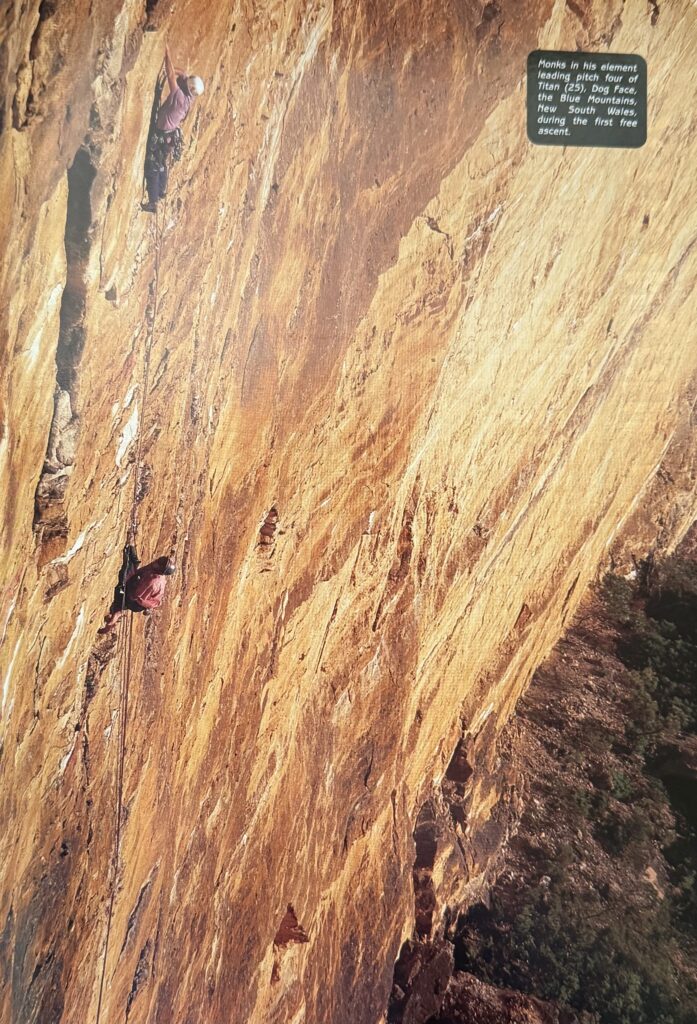
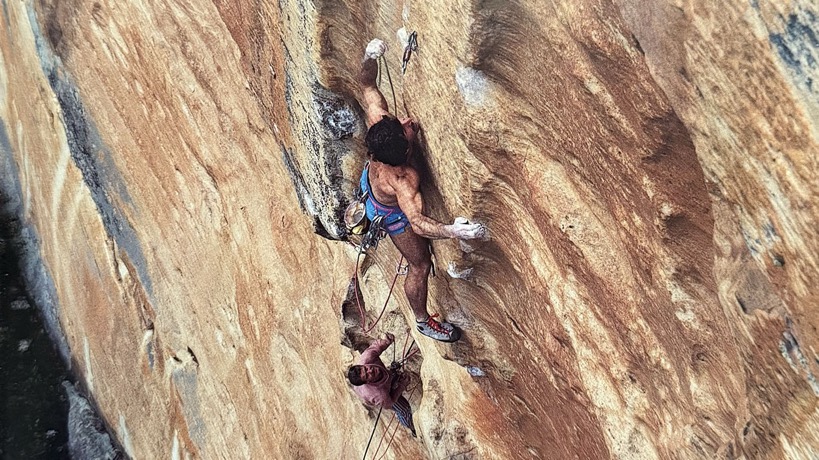
Monks in his element leading pitch four of Titan (25), Dog Face, the Blue Mountains, New South Wales,
during the first free ascent. Image by Simon Carter. Rock Magazine 1996 (issue 27)
Climbing Chronology
1973
Begins climbing at age 14, mainly in the Avon Gorge in Bristol and at the other crags and sea-cliffs in the southwest of the UK.
1977
First alpine season in Chamonix including ascents of the South Ridge of Aiguille Moir de Peuterey and the Vaucher Route on the Aiguille de Paine.
1978
First new routes at Avon in Cheddar Gorge and on the South Wales sea-cliffs including a free ascent of The West Route at Cheddar with Arnie Strapcans -the first route to be graded E5 in the south-west of the UK. Alpine routes include the American Direct on the West Face of the Dru. A winter trip to Norway yields five dramatic new ice-fall routes in the Hardangerfyord area, the best being the 260 metre Saggafoss (grade V).
1979
First British ascent of the Supercouloir on Mt Blanc de Tacul with Strapcans and a solo ascent of the Swiss Route on Les Courtes.
1980
Climbing partner, mentor and inspirational friend Strapcans dies soloing in the Alps. Travels to the USA making early repeats of routes such as Separate Reality, Crimson Cringe and Astro-man in Yosemite Valley, and the Wis-Roof and the Naked Edge in Colorado. Big-wall routes include a free repeat of the West Face of El Capitan and solos of the Regular Route on the Morth-west Face of Half Dome (in six hours, mostly free solo and the Casual Route on the Diamond Face of Longs Peak (two hours, all free solo
1981
First Himalayan trip. Successful second ascent of the East Ridge of Mun (7400 metres) in Kashmir.
1982
An attempt on the unclimbed North Face of the Devils Thumb in Alaska More big-wall routes in Yosemite Valley including the third one-day ascent of The Nose and a solo of The Shield (seven days) on El Capitan as well as the third ascent of Zenith on Half Dome (with Lydia Bradey).
1983
A good winter season in the UK with ascents of routes such as Galactic Hitchhiker (Scottish grade 6) on Ben Nevis and the Devil’s Appendix in North Wales.
New rock routes on the Pembrokeshire sea-cliffs.
1984
Unsuccessful attempt on the unclimbed East Ridge of Cho Oyu (8201 metres) in Nepal. First visit to Australia and New Zealand climbing routes such as a repeat of London Calling (26) at Mt Arapiles and a second ascent of Rattus Balfourous on the Balfour Face of Mt Tasman. Visits the Grampians for the first time.
1985
A summer in Europe with early repeats of routes such as Strawberries (E7) at Tremadog and The Prow (E7) at Ravens Tor. Alpine routes include the second ascent of Martin Scheel’s Amarcorde (VIAA grade IX) in the Raticon Mountains and the second British solo ascent of the Morth Face of the Eiger (1938 Route). New routes in the autumn include Gorilla Action (E) at Pembroke and the four-pitch Lionheart (E6) at Cheddar Gorge.
1985-86
Second trip to Australia. Fourth ascent of Masada (then 30) and India (29). Breaks a leg at Moonarie.
1986
Begins training to become a UIAGM guide in the UK. New routes at Pem-broke include the Bubbly Bosun and Crimes of Passion (both E6). Alpine routes include the Walker Spur on the Grandes Jorasses. In September goes on an unsuccessful attempt on the still unclimbed Kangar Punsum (7500 metres) in Bhutan.
1987
Winter climbing in Scotland includes a new route in Coire Schnecter during winter guide’s test! New rock routes include Coronary Country (E7) at Sharpnose and Black Magic (E5) at Pentire. Climbs Innocent Fool (29) at Mt Stapylton, Victoria.
1988-89
Frees the mighty Ozymandias on Mt Buffalo Gorge’s North Wall at grade 29. Frees The Seventh Banana (27) on Taipan Wall, Mt Stapylton.
1990
Establishes Old Masters (27) at the Asses Ears in the Grampians. First free ascent of Defender of the Faith (23) on the Morth Wall of Mt Buffalo’s Gorge.
1991
Starts work on Eureka Wall in the Grampians to produce Archimedes’ Principle 26) and
1992
Climbs Rough Justice (28) on Mt Buffalo Gorge’s North Wall.
1993-94
Climbs Precipitous Arete (23), the first route on the 350 metre Precipitous Bluff in Tasmania’s South-west. Also climbs the 450 metre route The Shield (24) on Mt Geryon, Tasmania, First continuous free ascent of Bungonia Gorge’s Siblings of the Sun (26) with Malcolm Matheson.
1994-95
Puts up The Free Route (25) on Tasmania’s Totem Pole and The Natimuk Route (22) on Frenchmans Cap with Simon Mentz.
1995
Guided trips to the Karakoram (Pakistan) and the Pamirs (Russia) getting punters successfully up SIx peaks. Frees Echo Crack (25) at Echo Point in the Blue Mountains with Adam Darragh. Puts up Venom (28) on Taipan Wall.
1995-96
Climbs Ozymandias Direct Free Variant (28) on the North Wall of Mt Buffalo Gorge. Frees Titan at 26,M1 (one fall) on Katoomba’s Dog Face with Darragh and Mentz. Frees an old Fantini route at Bungonia Gorge at grade twenty-six.
Other articles from ROCK MAG: