Climber Accounts Highlight Tensions Around Ranger Interactions at Mt Arapiles/Dyurrite
Climber Accounts Highlight Tensions Around Ranger Interactions at Mt Arapiles/Dyurrite
Editor’s Note – 08/05/26
This article was originally published on 11 April 2026 and was written to document concerns and experiences shared by climbers relating to interactions that occurred over the Easter long weekend at Dyurrite/Mt Arapiles. The piece was written by me as Editor and published under the Vertical Life byline due to the inclusion of perspectives and contributions from multiple individuals involved.
Since publication, the article has generated strong reactions and, in some cases, has been interpreted as commentary on race or culture. That was never the intention of the piece.
Vertical Life recognises the deep cultural significance of Dyurrite to Traditional Owners and acknowledges the important work being undertaken by Barengi Gadjin Land Council in partnership with the broader Arapiles working groups on Country. We also recognise that conversations surrounding access, land management, cultural heritage, and climbing are complex and deeply personal for many people.
As Editor, I also want to make clear that my own interactions with BGLC rangers and staff have consistently been positive, respectful, and welcoming. The concerns outlined in this article were included because multiple climbers described situations where they felt distracted, pressured, or uncomfortable while actively climbing, not as criticism of Indigenous people or culture.
I have personally extended multiple invitations for BGLC representatives to share their perspectives, experiences, and cultural knowledge directly with the climbing community through the magazine whenever and however they choose to engage.
In response to community feedback, we have updated aspects of the original article and are continuing work on broader coverage exploring the communication, education, and access challenges impacting different perspectives across this debate.
We believe respectful dialogue, clearer communication, and continued collaboration between climbers, Traditional Owners, Parks Victoria, and land managers will be essential moving forward.
— Claire Williams
Editor, Vertical Life
The broader access debate at Dyurrite/Mt Arapiles has become increasingly complex in recent years, involving climbing access, cultural heritage protection, land management responsibilities, and differing perspectives across the climbing and Traditional Owner communities. This article focuses primarily on accounts shared by climbers present during the Easter period.
Mount Arapiles has long held a near-mythical status in the climbing world. Each year, climbers travel vast distances to stand beneath its walls. Drawn by its history, quality, and reputation as one of the most significant climbing destinations globally.
Over the Easter long weekend, that draw was clear. Climbers arrived from across Australia alongside international visitors. For many, Arapiles was the primary reason for visiting the region. One climber described undertaking a 28-hour round trip, with the majority of their travel budget spent locally in Natimuk and Horsham.
But for a number of those visitors, the weekend did not unfold as expected.
Instead, multiple climbers reported confrontations with rangers believed to be from the Barengi Gadjin Land Council (BGLC) — interactions that disrupted climbs, altered plans, and, in several cases, created situations where some climbers felt increased pressure while climbing.
Confrontations While Climbing
A consistent theme across multiple accounts is the timing of these interactions. Climbers were not approached at the base of climbs, in car parks, or in campgrounds — places where conversations can happen safely. Instead, several report being engaged mid-climb, or while actively belaying.
In one incident on Easter Friday, a climber was partway up the first pitch of Hurricane Lamp Cracks when their belayer noticed movement behind them. Turning around, they saw a group of what appeared to be four to five BGLC representatives standing nearby, watching.
After a brief exchange, the belayer asked whether the area was off-limits.
The response was direct: yes — the belayer immediately called up to their partner — who was already around 20 metres off the ground — and told them to descend.
The belayer recounts:
“The time was about 10:40am or so. I was belaying the first pitch of Hurricane Lamp Cracks… I heard movement behind me that didn’t get any closer, so I assumed another group of climbers was approaching. When I heard movement again that wasn’t getting closer, I looked back to see 4–5 of the rangers standing there watching.
I gave them a wave and said hi… then I said, ‘This area isn’t off limits is it?’ And one person responded ‘Yes it is.’
Me: ‘Oh shit.’ I called up for my leader to stop… and then called up to my leader that she needed to descend.”
For the climber on the wall, they reported that this made them feel distracted and uncomfortable while climbing: “My partner called out that I had to come down, and when I turned around all I could see was people there near him… But yes, I felt very at risk down climbing off. I was about 20m up at that point.”
After returning to the car park and rechecking signage — which they had already read earlier that morning — the pair concluded they had not been climbing in a restricted or culturally sensitive area. They attempted to return and seek clarification, but the group had already left.
That raises an important question: how well do these rangers understand the boundaries of the areas they are tasked with protecting?
In this case, climbers felt pressured to descend from height — in a way that they felt increased risk — despite not being in an area subject to a “keep off” request.
Signage Installed Mid-Climb
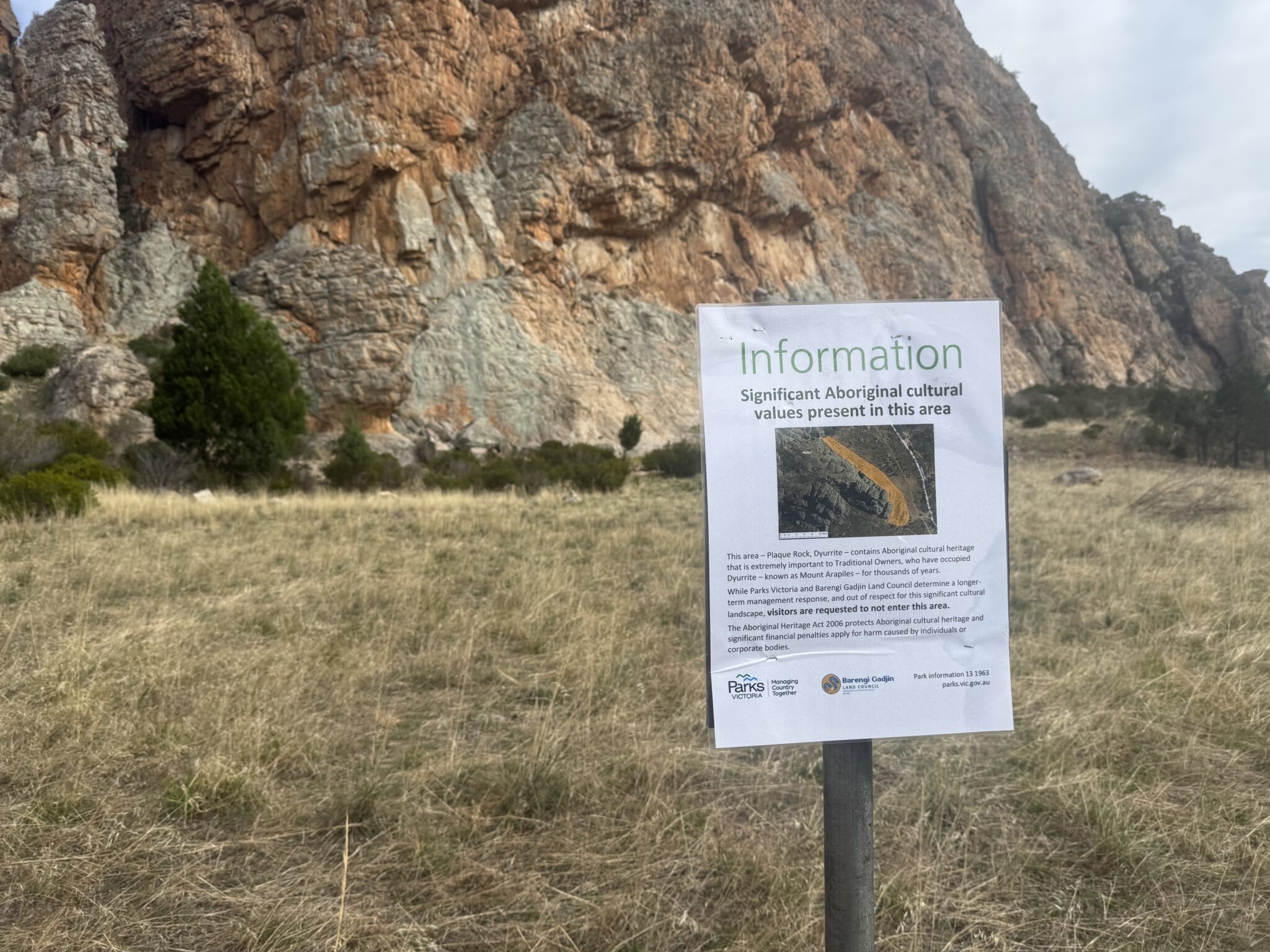
At Tiger Wall, another climber described arriving to find no signage indicating restrictions before beginning their route. While their partner was on the wall, a person believed to be a ranger walked up, placed a metal “keep off” sign between belayers, and began photographing the climbers.
The timing of this interaction created confusion. The climber later reflected that the situation made it appear as though they had knowingly ignored restrictions, when the sign had not been present when they started climbing.
The same party reported a second interaction the following day, again involving a ranger taking photos while they were climbing. Although the ranger left when asked, the climber said the experience had a direct impact:
“My partner was pretty upset, even though it was an easy climb, he had to get lowered off on his last piece as he just couldn’t focus, so I had to take over”
A Pattern of Disruption
Other climbers described a broader pattern across the weekend.
People believed to be rangers were seen driving slowly through the carparks taking down number plates, observing climbers and vehicles, and spending extended periods around popular climbing areas. Some climbers reported being watched from the base of climbs or from nearby bushland, while others described verbal comments directed toward climbers on routes.
In one instance, climbers reported being told that infringements could be issued, despite current “please keep off” requests not being legally enforceable restrictions.
Another climber described the overall experience:
“Highly distracting and adrenaline-inducing to what’s already a dangerous sport.”
Impact on Climbing Experience
Across all accounts, the central concern is not simply access — but the potential for safety risk while climbing.
Climbers described losing focus while leading, being pressured to descend mid-route, and making decisions under stress. In some cases, climbers abandoned routes they had planned and prepared for; in others, they ended their climbing days early.
Climbing relies heavily on mental composure. Focus, calm decision-making, and situational awareness are fundamental to managing risk. Disruptions at height — particularly those involving uncertainty or perceived pressure — can increase the likelihood of mistakes.
As one climber put it:
“If you take the mental part away from climbing, we’d all just play golf.”
Trips Cut Short, Plans Changed
For many, the impact extended beyond individual climbs.
Climbers who had travelled long distances reported abandoning objectives, changing plans, and reconsidering future visits. Some chose to leave early or skip additional climbing destinations on their return journey due to uncertainty around access and the nature of interactions over the weekend.
Given the volume of interstate and international visitors, these decisions carry broader implications for the region — where climbers traditionally contribute to local businesses through accommodation, food, and services.
Communication Breakdown
Many climbers emphasised that they had made genuine efforts to respect known “keep off” requests and avoid culturally sensitive areas. Several also noted positive and respectful interactions with Indigenous visitors at Arapiles.
However, there was a consistent sense that communication leading into the weekend had been inadequate.
Climbers reported:
- Unclear online information especially regarding previous climbing ban roll back announcements
- Signage appearing after climbing had already begun
- No centralised or easily accessible updates in campgrounds
- No clear explanation of why specific areas were sensitive
One climber summarised:
“People travelled a very long way with one understanding, and then were confronted mid-climb as part of an ‘education’ process.”
Accountability and the Path Forward
The events of the Easter long weekend raise important questions about how access management is being implemented on the ground.
While the protection of culturally significant areas is widely acknowledged as important, the accounts from Arapiles point to a critical issue:
Several climbers felt that interactions occurring while they were actively climbing created confusion, distraction, and additional pressure while on route.
In the Hurricane Lamp Cracks incident, climbers felt pressured to descend from height despite not being in a restricted area. That outcome highlights the need for clear understanding, consistent communication, and careful judgement in how and when interactions occur.
At a minimum, climbers say this requires:
- Accurate, up-to-date information before peak periods
- Clear and consistent signage
- Engagement that takes into account the realities and pressures of climbing while on route and climber safety
Mount Arapiles remains a place of shared significance — culturally, historically, and globally within the climbing community and the indigenous community..
For those who travelled far to be there over Easter, the expectation was simple: clarity, respect, and the ability to climb safely. The accounts from the weekend suggest that, in several cases, those expectations were not always met – highlighting the need for clearer communication, consistent processes, and ongoing dialogue moving forward.
The challenges surrounding access management at Dyurrite/Mt Arapiles involve balancing climbing access, cultural heritage protection, public communication, and on-ground enforcement responsibilities — often in highly complex circumstances. It’s important to note that the BGLC rangers have only been in their roles at Mt Arapiles for a few months and may not yet have received sufficient training on how to engage with the public around these issues. Throughout February and March, climber interactions were largely positive, with rangers described as friendly and approachable. The shift in behaviour over the Easter period may not reflect their usual approach.
Further training would likely be beneficial—both in helping rangers better understand the boundaries of exclusion zones and in supporting clear, respectful communication with the climbing community.
Climbing Victoria have contacted Parks Victoria raising these concerns on how things can be approached better in the future.d the boundaries of exclusion zones and in supporting clear, respectful communication with the climbing community.
More Climbing Access Articles:
A Boundary Line at Bundaleer: Grampians Climbing Access
Climbers Push Back on Arapiles Bans, Citing Economic Ruin
Review of DJSIR Data & Analytics’ Study
2021 Economic Assessment of Rock Climbing at the Grampians National Park and Mount Arapiles
President of ACAV arrested over stolen Parks Victoria cameras in the Grampians
From Conflict to Collaboration: Parks Victoria’s Vision for Arapiles