When Parks Victoria announced proposed climbing bans at Mount Arapiles in November 2024, the changes were released without a formal Regulatory Impact Statement (RIS)—a process normally required when government decisions are likely to have significant economic, social or community consequences.
The absence of a RIS meant the economic implications of the proposed closures were never properly assessed before the management changes were made public. That omission has now become a central concern in the ongoing dispute surrounding climbing access at Dyurrite / Mount Arapiles.
Following backlash from the climbing community during the initial consultation period, the Victorian Department of Jobs, Skills and Regions (DJSIR) prepared an economic impact assessment examining the proposed climb site closures. This analysis is detailed in a document titled Mt Arapiles climb site closures: regional economic impacts.
Concerns raised by the climbing community about the accuracy of this analysis led Climbing Victoria to engage Frontier Economics to conduct an independent peer review of DJSIR’s findings.
Frontier Economics was asked to assess whether:
- the assumptions made by DJSIR in its regional economic impact assessment were reasonable;
- the methodology aligned with best or common practice; and
- the methodology had been correctly applied.
Context: Earlier Economic Warnings Were Ignored
Concerns about the economic value of climbing at Mount Arapiles and the Grampians are not new.
In January 2021, Hywel Rowlands produced an extensive Economic Assessment of Rock Climbing at the Grampians National Park and Mount Arapiles on behalf of the Victorian Climbing Club. The report detailed the substantial contribution climbers make to regional economies and warned that access restrictions would result in measurable financial losses. His work provided clear analysis that demonstrated the need for a formal RIS, yet this was not addressed prior to the current escalation.
This year, Rowlands completed an independent peer review of the DJSIR study. He is hopeful that this work will not be ignored this time. His analysis identified methodological flaws and data gaps—many of which are also echoed in Frontier Economics’ findings.
Frontier Economics reached a clear conclusion:
“In our opinion these weaknesses in the methodology and its application are likely to result in a significant underestimate of the regional economic impact of the proposed climbing site closures. For this reason, without adjustments to the methodology and its application, the estimated impacts are not an appropriate basis for considering the opportunity costs in terms of the regional economic impacts associated with the proposed climbing site closures.”
Key Issues Identified
- Oversimplifying climber behaviour
The assessment “solves for the average climber,” overlooking different climber types, spending patterns and destination choices. Closures may disproportionately affect climbers with higher-than-average spending. - Over-reliance on theCrag.com data
Data was not cross-checked with independent sources. Frontier notes this may “lead to systemic underestimation of climbing in areas proposed to be closed,” particularly as the dataset was collected during periods of voluntary avoidance. - Unsubstantiated substitution assumptions
DJSIR assumes roughly half of impacted climbers will simply relocate to other sites at Arapiles. Frontier states this assumption “lacks justification,” especially for international visitors or climbers travelling for specific routes. - No employment or multiplier analysis
The assessment “does not quantify the expected impact to jobs and employment in the region,” nor does it apply standard economic multipliers, understating total losses. - Second-order impacts excluded
Declines in beginner participation, guiding work, volunteer engagement and workforce attraction were not considered, meaning the analysis “cannot cover the true extent of the consequences.” - Unjustified growth assumptions
Linear long-term growth is assumed regardless of closure scenarios, ignoring how reduced access could weaken future visitation. - Key uncertainties not tested
No sensitivity testing was conducted for scenarios where higher-spending climbers may cease visiting Arapiles altogether.
Recommendation: A Proper Impact Assessment
Frontier Economics recommends that Parks Victoria undertake a Regulatory Impact Statement for the Dyurrite Cultural Landscape Management Plan, incorporating a full cost–benefit analysis of economic, social, and environmental impacts before any further decisions on climbing management are made.
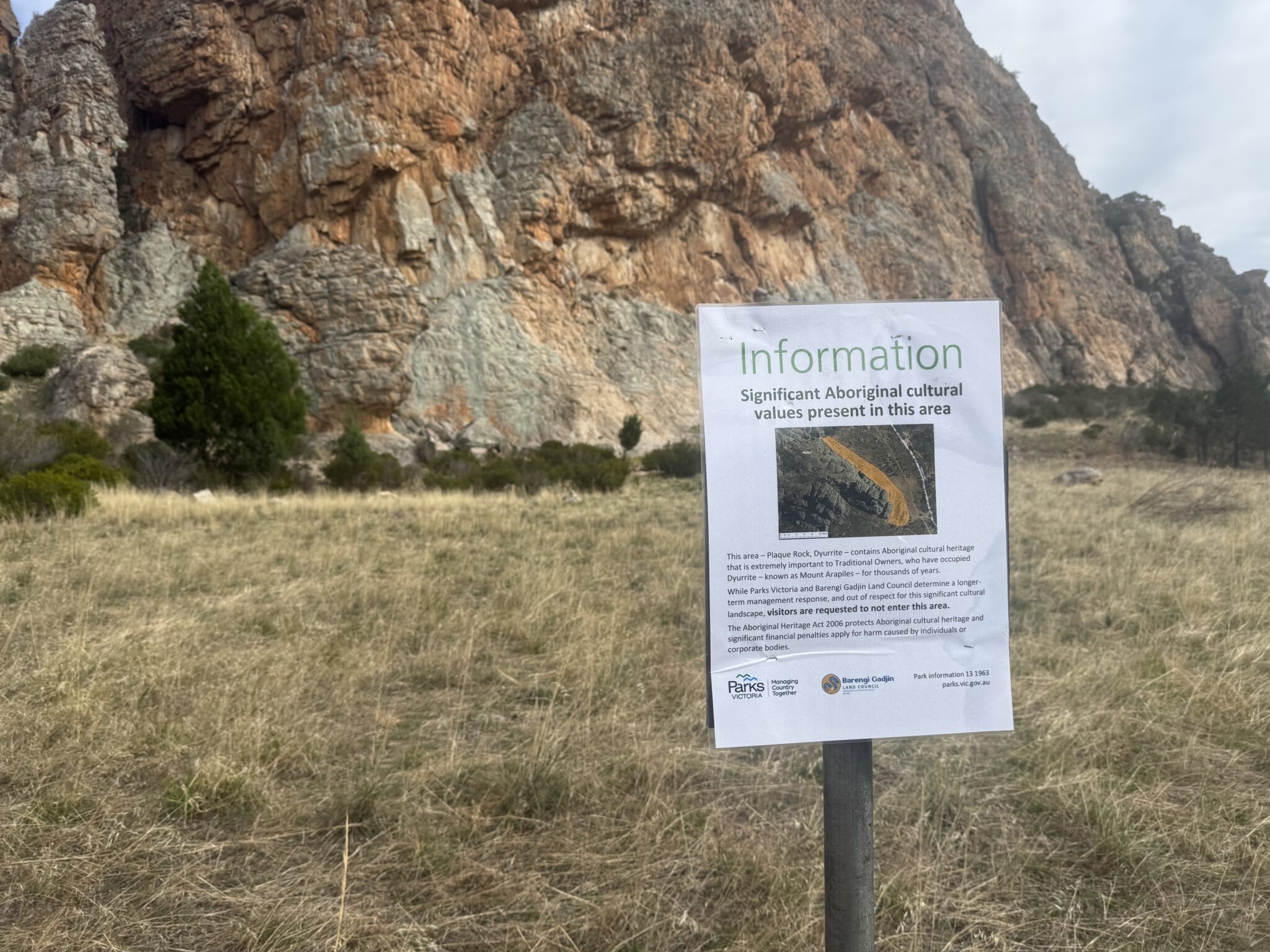
Another major factor missing from the economic assessment is the damage already caused by earlier restrictions, including the 2019 Grampians climbing bans, which removed access to the Victoria Range and key beginner areas such as Summerday Valley. Later that year, requests to avoid sites including Declaration Crag and Tiger Wall immediately affected guided groups, clubs, and educational programs.
Tiger Wall—long regarded as one of Mount Arapiles’ most impressive multipitch cliff lines—became off limits, prompting many climbers to travel elsewhere once one of the area’s major drawcards was lost.
In late 2024, Parks Victoria released a new draft management plan proposing further closures across culturally significant and historically important areas. These include beginner classics such as Tiptoe Ridge, as well as internationally recognised routes including Punks in the Gym (the world’s first grade 32) and Kachoong (21). Mitre Rock and Pilot Error Cliffs—frequently used for guide training, SES rescue simulations, Australian Defence Force activities, and introductory courses—are also affected.
For a more detailed list of proposed closures, see Save the Grampians
The announcement had an immediate economic impact. Many international visitors now mistakenly believe the entire Mount Arapiles cliff is closed, suppressing tourism and visitation. The loss of certainty has already had tangible consequences for locally based businesses tied directly to climbing at Arapiles.
Glenn Tempest, director of Open Spaces Publishing and co-author of the Arapiles Selected Climbs guidebook, said the proposed 2024 closures made it impossible to continue operating.
“The 2024 proposed Arapiles climbing bans by Parks Victoria meant that Open Spaces Publishing no longer had the business certainty to proceed with future editions of the popular Arapiles Selected Climbs guidebook. As a local Natimuk business, and combined with the massive rockclimbing and bushwalking closures in the nearby Grampians National Park, we made the difficult decision to close Open Spaces Publishing.”
Tempest said the amended management plan introduced further instability.
“One other thing that really worried me was that in the amended plan, the BGLC had the power to close any part of the park, whenever and without any consultation. This does not provide certainty for ongoing businesses.”
The closure of Open Spaces Publishing represents not only the loss of a long-standing local business, but also the removal of a key resource supporting safe access, visitor education, and sustainable climbing practices—impacts not captured in DJSIR’s modelling.
Outdoors Victoria is the recognised peak body for the outdoor recreation sector in Victoria, representing guiding companies, outdoor education providers, not-for-profit camp operators, and schools. Established in 2013, it acts as an umbrella organisation supporting thousands of outdoor professionals and volunteers and works with government, Parks Victoria, and Traditional Owner groups on access and land-use issues.
According to Outdoors Victoria, the climbing restrictions at Dyurrite / Mount Arapiles have resulted in approximately 3,500 school students each year no longer visiting the area for outdoor education programs. In addition, nine university and training organisation campuses have ceased using the site, impacting the training of future climbing guides and outdoor professionals.
Bill Lovell, owner of the Natimuk Hotel, reports a noticeable decline in overseas visitors and frequent calls from confused climbers asking whether Mount Arapiles is open.
Louise Shepherd—long-time Arapiles guide and founder of Friends of Arapiles—said bookings dropped immediately following the announcement.
“Volunteer numbers have also fallen… What has remained consistent is the widespread confusion and misinformation surrounding the closures—many climbers still believe the entire cliff, or the vast majority of routes, are shut down.”
Accommodation providers report similar issues.
“We get a lot of questions from people far away who assume more is shut than open. That affects everyone in Natimuk who relies on climbers—guides, schools, small businesses. Even if school groups don’t stay with us, the guides who work with them do.”
Kevin Lindorff, owner of the Natimuk Café, said the regional hospitality sector has been slow to recover since COVID, and that ongoing uncertainty around climbing access at Mount Arapiles has added another layer of risk for potential investors in Natimuk. The café has been for sale for an extended period.
“The ‘bounce back’ of the hospitality sector, post Covid, particularly in regional areas, has been sluggish. It is only now starting to get back to some semblance of what it was.
So, I wouldn’t say that the slow movement of cafes and restaurants for sale in this region over the last few years can be attributed solely to climbing bans. Nonetheless, particularly for a place like Natimuk where climbing-related business is such an important component of the local economy, the uncertainty of what climbs might re-open and what will remain closed at Djurrite, and the potential effect that any such decisions might have on climbing through-traffic, has certainly dampened the willingness of people to take a risk and invest.”
Twelve months after the closures were announced, Parks Victoria reverted to earlier informal “please keep off” requests. By then, economic damage, uncertainty and community stress had already taken hold—deepening divisions, straining relationships and leaving long-term impacts on a community that has historically played a key role in caring for the landscape.
The experience at Mount Arapiles highlights the broader consequences of making land-management decisions without fully understanding their economic and social impacts. As Frontier Economics and community voices have shown, closures—even temporary or proposed—can ripple through local businesses, education programs, and volunteer networks, creating uncertainty that lingers long after the formal restrictions are lifted.
For the climbing community, local economy, and future generations of outdoor professionals, the lesson is clear: meaningful consultation, robust economic analysis, and transparent decision-making are essential before implementing access changes. Without them, the costs can extend far beyond the cliffs themselves, affecting the livelihoods, mental health, education, and cultural engagement of an entire region.
Other related articles:
Review of DJSIR Data & Analytics’ Study
2021 Economic Assessment of Rock Climbing at the Grampians National Park and Mount Arapiles
President of ACAV arrested over stolen Parks Victoria cameras in the Grampians
Reflections from Climbing Victoria
From Conflict to Collaboration: Parks Victoria’s Vision for Arapiles