Hywel Rowlands MSc I.Eng AMICE
January 2021
Author Note
The assessment was undertaken on behalf of the Victorian Climbing Club (VCC). The VCC would like to thank all who provided information through the climber survey and through interviews. A particular thank you to Goshen Watts for the inclusion of economic questions in the climber survey, Simon Dale from theCrag who provided historical climbing logging data and James McIntosh for his rigorous peer review.
Abstract
The economic value of rock climbing is increasingly recognised internationally and in Victoria reduced access may result in the loss of millions of dollars to regional communities. This paper estimates the economic benefit of rock climbing at two prominent Australian rock climbing destinations in Victoria, Australia. It is estimated that in 2018 there were 51,452 and 49,145 climbing person days at Mount Arapiles (Dyurrite) and the Grampians (Gariwerd) respectively. In the short term there has been an estimated 36% decline in climbing person days in the Grampians in 2019 whilst there has been an increase in climbing at Mount Arapiles.
The estimated direct and indirect rock climbing tourism benefits to regional communities in 2018 are $12.3 million for Mount Arapiles and $11.9 million for the Grampians.
Climbing access changes may also impact the Victorian employment sector with an estimated 290 individuals seriously considering a move, moving, or having moved. The IT and professional sectors may be impacted the most across Victoria, however changes may be more greatly felt in regional areas in the health, business and education sectors.
43% of respondents indicating that they or someone they knew had been affected by mental health issues relating to the climbing prohibitions. Mental health has a substantial impact at the personal, social and economic levels which are not estimated in this paper.
Keywords: Rock Climbing; Economic Benefits; Tourism; Regional Labor; Arapiles; Grampians; Gariwerd; Dyurrite.
Author: Hywel Rowlands is an experienced transport and land use strategist and researcher. His international experience includes the collection and collation of city and regional wide data as a logistical foundation in shaping cities and managing the way we travel.
Understanding the economic benefits of rock climbing to regional Victoria provides an opportunity to advocate for access and conservation in areas that are greatly valued by the climbing community. Prior to the development of this paper only anecdotal evidence existed in terms of the economic benefits of rock climbing in regional Australian communities. In other countries and in particular the USA, communities near climbing areas are becoming acutely aware of the positive impact that climbing is having on regional economies. For example, in New River Gorge West Virginia climber benefits amount to US$12.1 million annually (Maples et al 2018) and in Nantahala-Pisgah West Carolina the annual benefits are US$14 million (Maples & Bradley 2017).
Further to the economic benefits there are the physical and mental health benefits that are increasingly recognised including the use of climbing in helping to treat depression, stress, anxiety and trauma, (Lambert 2017). Mental health has a substantial impact at the personal, social and economic levels (Australian Government 2009).
Climbing, once a fringe sport, is increasing in popularity and climbing demographics have undeniably changed as a result. Climbers in Australia are largely professional and skilled members of the economy with a very high frequency of visitation to regional areas of Victoria. The most important stated aspects of outdoor climbing enjoyed by survey respondents are spending time in nature and the physical and mental challenge of climbing.
This paper estimates rock climbing visitations at Mount Arapiles (Dyurrite) and in the Grampians (Gariwerd) in western Victoria with a focus on 2018 prior to rock climbing prohibitions and COVID19. Thereafter the paper estimates direct and indirect benefits and examines the potential economic implications of changes in climbing access.
Methodology
The core approach of the study is to utilise historical climbing data that has been logged on theCrag website and thereafter factor this data with a sample gathered through the inclusion of questions in a recent climber survey to estimate the number of climbing person days per year.
The online questionnaire survey also gathered information that would deduce an average spend per climbing day. Combined, these provide an estimate of direct economic benefits to communities surrounding Mount Arapiles and the Grampians. Indirect economic benefits are estimated through extrapolating available secondary economic tourism data available in the region.
theCrag web site is a collaborative open resource that allows climbers to record their climbing activity and input new or historical routes into the database. theCrag has provided data on the number of unique individuals using the database each year and the number of logged person climbing days per year in the Grampians and at Mount Arapiles for the purpose of this economic assessment.
Questionnaire Survey
The online climber questionnaire survey which took place in December 2020/January 2021 provided information on a representative sample of rock climbers. The survey was closed on the 8 th January 2021. The survey permitted the capture of data on origin, spend, climbing activity and the perceptions of climbers with regard to climbing prohibitions implemented in the Grampians and at Mount Arapiles. This paper focuses on data captured in the questionnaire survey that has an economic implication.
Data Cleaning
All data was screened for any oddities such as unrealistic spending or duplicate responses. 5 responses were rejected in total. Some responses did not respond to all questions.
Excluded responses:
- Respondents that only completed the initial 6 questions were removed from the data.
- Respondents that represented the spend of a large organised group were removed.
Statistical Sample
In 2018 and 2019, there were approximately 1000 unique climbers a year who logged their climbing days in Victoria on theCrag. The questionnaire survey indicated that only 43.6 % of respondents logged their activity on theCrag. This suggests that there were around 2,300 individuals climbing outdoors in Victoria in 2018 and 2019 whether they were from overseas, interstate or Victorian. This provides our best estimate of the active outdoor climbing community in Victoria prior to COVID19. Using a 95% confidence level at a confidence interval of 5%, 329 surveys completed by outdoor climbers were required for a statistical sample. Over 500 questionnaires were received and 496 were suitable for analysis with 473 of the sample indicating that they climbed outdoors often.
Climbing Visitations
The number of climbing days per person per year for 2018 represents climbing activity for the year prior to climbing prohibitions in The Grampians and at Mount Arapiles, and prior to COVID19 lockdowns. The foundation to this estimate is data from theCrag for 2018, however not all climbers log their climbing ascents and days. Furthermore, a number of pilot interview surveys identified that logging behaviour amongst climbers varies notably in terms of the date accuracy (e.g. climbing over a weekend is logged on a single date) and the proportion of climbing days logged. Factors were required to take account of the logging behaviour and to take account of climbers that did not use theCrag.
Base Climbing Person Days Per Year
Days of climbing logged on theCrag in 2018 at The Grampians and at Mount Arapiles are 3069 and 3019 climbing days respectively. The questionnaire survey asked three questions:
- Do you log your climbing activity on theCrag.com?
How particular are you about logging the correct ascent dates?
What proportion (percentage) of your days climbing do you log?
The initial question provides the study with the proportion of people who are not represented in the figures on theCrag and the base figures can be factored accordingly. With 43.6% of respondents logging their climbing, a factor of 2.3 estimates the outdoor climbing population.
The second question relates to logging behaviour, whether those that logged their climbing day logged accurately to each day or grouped these climbing achievements over multiple days on a single day when the climbing is logged. The resulting factor is 2.3 aggregated from 3 possible responses, that a proportion of climbers log accurately (49%), a proportion would log a weekend of climbing on a single date (30%), and a proportion are not particular about when they log their climbing days (21%).
The final question relates to the proportion of climbing days that are logged. Some climbers do not habitually log all their climbing days, or forget to log, or only log new climbs and not repeats. The mean percentage value in each response range was used and weighted by the number of responses to achieve a representative aggregate factor. The resulting factor for this logging behaviour is almost 2.7.
The factors are accumulative, accordingly 2.3×2.3×2.7 resulting in an overall factor of 14.1 (note there is a rounding error). The factor of 14.1 is applied to theCrag data to estimate the number of person climbing days per year.
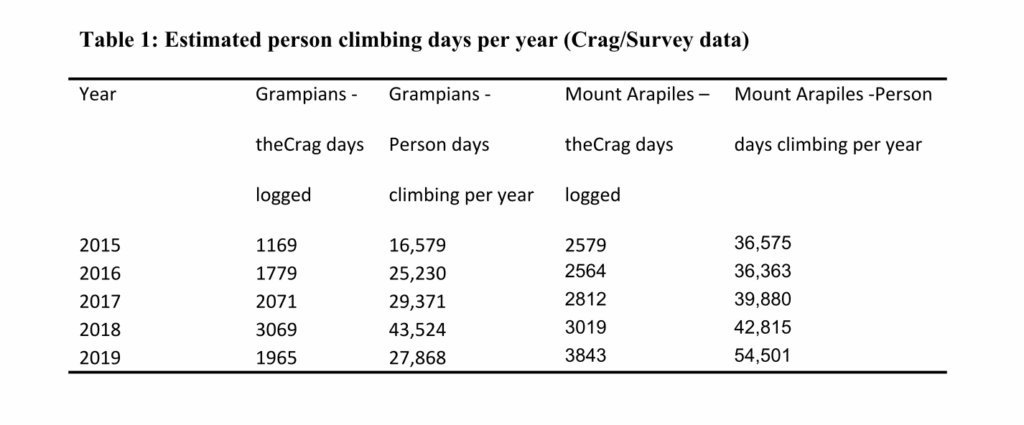
The results are illustrated in the table below for years 2015 to 2019 and these represent the base person climbing days per year. A 36% decline in climbing in the Grampians is noted based on theCrag data in 2019 whilst there is an increase in climbing at Mount Arapiles. In the short term the 2019 logging data shows a partial shift in climbers from the Grampians to Mount Arapiles.
Guided or training groups present additional days of climbing and the total number of person climbing days are estimated in the next section.
Total Person Climbing Days Per Year
In additional to the base climbing days derived from theCrag and survey, additional climbing not captured by the surveys would include school groups and rescue training groups.
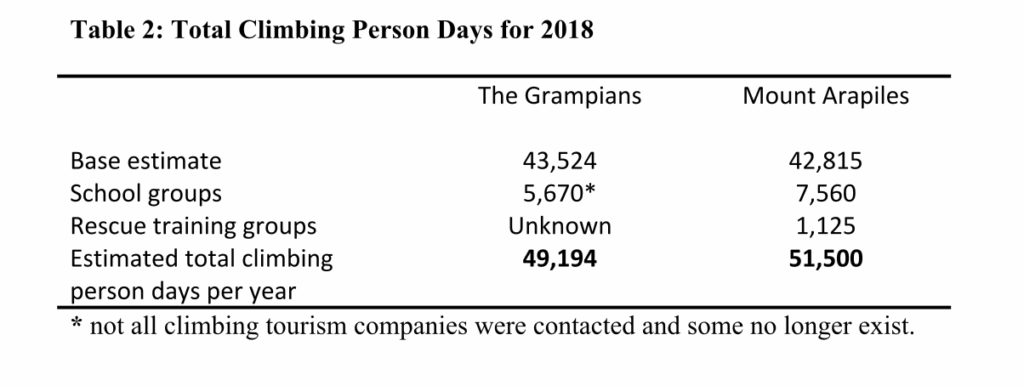
The following summarises the additional climbing days and provides the estimated total climbing days in 2018.
Additional Mount Arapiles climbing days are based on consultation with stakeholders:
- 80 annual school groups at Mount Arapiles. School groups are generally 20-30 pupils plus 2 teachers, on average 27 persons. 10 groups would have trips of a week, the vast majority of trips are 3 days.
- 15 annual rescue training groups at Mount Arapiles generally comprising of 15 persons on average including instructors over a 5-day period. Vehicle activity relating to these groups would be recorded in the traffic data.
Additional Grampians climbing days are based on consultation with stakeholders: - 60 annual school groups of 20-30 pupils plus 2 teachers, averaging 27 persons.
- The number of rescue training groups that undertake exercises is unknown.
Validation of Climbing Person Days
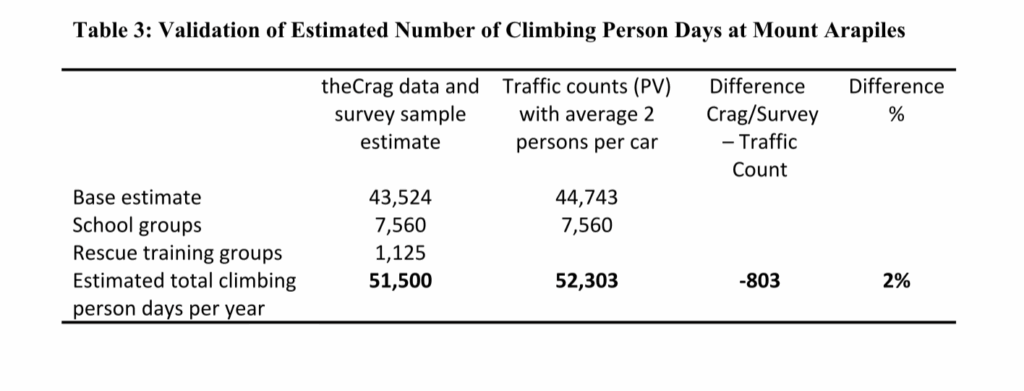
The data available to validate ‘climbing days per person per year’ is limited. Parks Victoria stated in a Ministerial Briefing Report that the number of visiting climbers to the Grampians is 80,000 annually (Parks Victoria 2019). How this figure was reached is unknown and cannot be deemed reliable for validation.
Traffic Counts at Mount Arapiles provide the most reliable source of data, particularly due to the contained nature of Mount Arapiles. The Terms of Reference for the Mount Arapiles – Tooan State Park Advisory Group contains an estimate of 78,300 total annual daily visits by climbers representing 90% of total visitations in 2018 (Parks Victoria 2019). Through interviewing members of the Advisory Group, it is understood that these figures use a car occupancy multiplication of 3.5 persons per car which is considered extremely high.
Sample car occupancy surveys undertaken at The Pines, The Upper and Lower Gums on the 10th , 12th and the 17th January revealed an average car occupancy of 1.8 persons per vehicle.
This paper will assume a car occupancy of 2 persons per car as organised club/student trips have
been limited and organise groups usually enable a greater degree of carpooling. It is noted through observations that given camping equipment, food and climbing equipment, very few vehicles would have capacity for more than 3 occupants.
Visitor Expenditures
Individual Climbers
This section examines average spend per day based on the origin of each individual that responded to the questionnaire survey. The spend on other items whilst in regional Victoria such as climbing equipment or clothing has not been captured by the survey and accordingly spending figures are considered conservative.
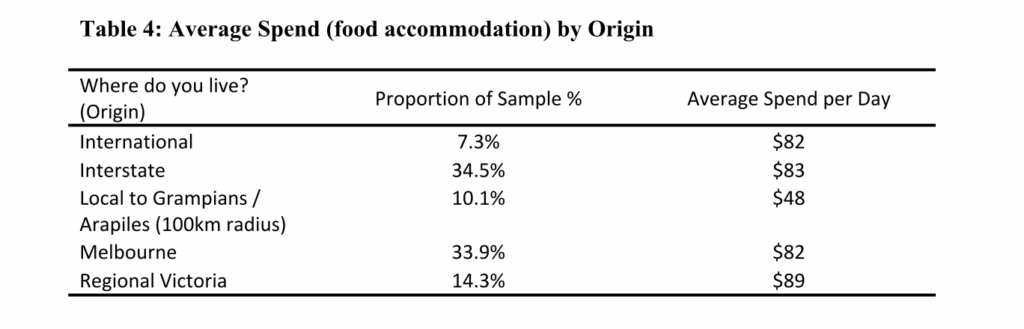
Average spend per day was relatively similar with the exception of climbers local to the study area. It is estimated that the annual spend for climbers visiting Mount Arapiles is $3,416,437, and for The Grampians is $3,473,012.
The following table summarises travel spend per day of climbing. The travel spend per trip is divided by the length of each individual trip and then averaged by origin. Assumptions were made with regard to the proportion of the travel expense that would be spent across regional Victoria. The daily average regional travel spend per person based on their origin is to be used as part of the direct economic benefit estimation. The average travel spend per trip reflected the relative distance from origin to destination.
The average spend per trip differs greatly by origin. It is evident that international and interstate climbers place a high value on climbing in western Victoria based on their travel spend. From the average regional travel spend per day by origin, it is estimated that climbers visiting Mount Arapiles will spend $2,442,857 on travel in regional Victoria, and climbers visiting The Grampians will spend $2,483,310 on travel in regional Victoria.

School Groups
School groups are typically groups of 20-30 pupils together a couple of teachers. The main local expenditure for Victorian school groups is the procurement of climbing guides. A Victorian school group will typically spend around $3,200 on climbing guides for a 3-day period. South Australian school groups generally bring their own outdoor/climbing guides.
Around 80 school groups visit Mount Arapiles each year and require guiding services. Most will stay for a 3-day period whilst 10 groups will stay a week and generally increase their guiding requirements. At Mount Arapiles school groups will spend an estimated $332,000 annually on climbing guiding services.
It is estimated in 2018 that around 60 school groups visited The Grampians although information was not received from all local tourism operators during the timeframe of the study and some operators no longer exist. It is estimated that school groups would have provided direct economic benefits of over $250,000 annually through the procurement of climbing guide services and likely considerably more on discretionary spending within the Halls Gap environment.
Training and Rescue Groups
These groups provide a significant income stream for hotels/motels, restaurants and publicans and each group of around 15 individuals will provide a direct economic benefit to the region of $15,000 per visit. Based on interviews in Natimuk, at Mount Arapiles around 15 groups visit each year providing an estimated $225,000 income boost to the local economy.
Figures were not obtained for the number and spend of training and rescue groups in the Grampians.
Direct Benefits
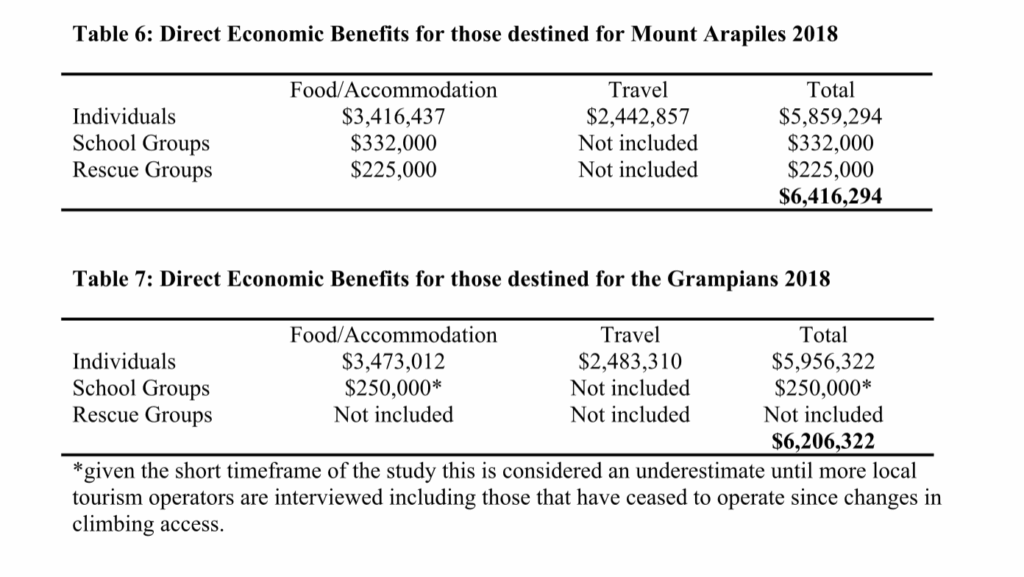
Direct benefits are estimated, for 2018, based on how much is spent on food, accommodation, travel and guiding services.
This section outlines the direct benefits collated from both individuals (including individual on clubs and university trip) and organised groups (schools and emergency training). Direct benefits are just the beginning of the compounding multiplying affects that provide further economic benefits for local communities including indirect and induced benefits.
The direct economic benefit of rock climbing at Mount Arapiles is estimated at $6.4 million dollars and in The Grampians is estimated at $6.2 million dollars as summarised in the tables below.
Indirect Benefits
The indirect benefits occur where the businesses that receive the direct benefits then spend their money to support their business operations. These would include the support services that allow a motel to operate or the purchase of fruit, vegetables and coffee to run a café.
The Grampians Regional Tourism Summary estimates the direct economic benefits of tourism for financial year 2018/2019 were $160 million and the resulting indirect benefits were estimated to be $151 million (TEVE 2020). The resulting factor from direct to indirect in this case is 0.944. The Regional Victoria Tourism Summary estimates direct benefits of $4,916 million and indirect benefits of $4,510 million for financial year 2018/2019 giving a factor of 0.917 (TEVE 2020). The resulting factors year on year for both these documents is very consistent. It is considered that the flow on benefits from climbing tourism should not be any different from any other recreational tourism.
Based on the more conservative lower factor of 0.917, the study estimates that the indirect benefit of rock climbing in 2018 for Mount Arapiles was $5.88 million and The Grampians was $5.69 million.
Other Benefits
This section identifies further areas of economic benefit that may present scope for future research on the benefits of rock climbing in Victoria.
Employment Sector
Rock climbing is an attraction and given the frequency of many climbing visitors, it should be no surprise that some will choose to relocate to the region for better access to recreation opportunities. Labour attraction and retention are critical issues for regional areas in Victoria. As a result of climbing access changes in western Victoria, the following table is a representative estimate of changes in the employment sector and potential future changes based on responses to the questionnaire survey.
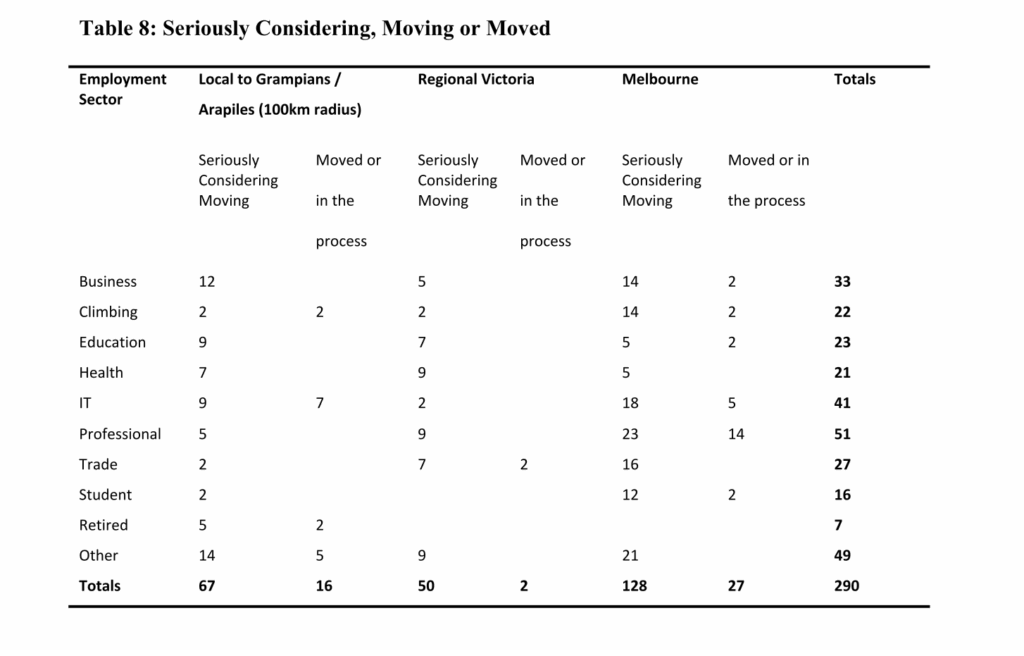
Across Victoria it is estimated that as a result of climbing restrictions 45 individuals have already moved or are in the process of moving and a further 245 are seriously considering moving. The potential employment sector changes are most notable in the IT sector, in the professional sector (e.g. engineers and scientists), and in the business sector (e.g. manufacturing and financial).
Whilst the potential changes in the employment market are higher in Melbourne, the impact may be more significantly felt in regional Victoria in the business, health and education sectors.
Induced Benefits
Those employed in the industries that receive direct and/or indirect benefits then spend their income in the regional community on goods and services including housing. This study does not have an economic modelling resource and the induced benefit have not been estimated.
Mental and Physical Benefits
‘Why do people rock climb?’ was a question posed in the questionnaire survey and respondents were asked to rate from 1-5, 1 being very important. The responses reflect the importance of multifaceted aspects of outdoor climbing:
- 72% of climbers indicated that the physical and mental challenge was very important.
- Less than 40% indicated that physical fitness was very important.
- 70% of climbers indicated that time in nature was very important.
- Less than 40% indicated social time with friends was very important.
- 56% of climbers indicated that climbing was very important to managing their mental wellbeing and/or to manage stress.
Responses to the following questions are a notable concern:
- Have you, or a climber you know personally, been affected by a mental health issue relating to the climbing bans, or has reached out to mental health care services? Over 43% indicated yes.
- How has the impact of these climbing bans made you FEEL? Over 50% responded feeling depressed, 47% indicated all 5 stages of grief, almost 40% indicated angry and 10% indicated guilty.
Increasingly research highlights the importance of health and wellbeing to the economy. This paper is not well placed to explore the economic benefits of improved health through outdoor rock climbing activities. The survey does however identify an area in which further research could be developed and that there should be concern in terms of the impact of climbing prohibitions on the health and wellbeing of the community.
Growth in Rock Climbing
The growth of outdoor climbing was investigated as part of this paper in order to estimate the
potential future economic benefit of rock climbing, however suitable data does not exist.
Ministerial Briefing Report – MBR038732 obtained under a Freedom of Information request
indicated climber growth of 8,000 visiting climber in 2003 to 80,000 in 2018 in the Grampians
Economic Assessment of Rock Climbing at the Grampians and Mount Arapiles 17
(Parks Victoria 2019). However, the investigation as part of this paper on outdoor climbing growth is inconclusive and is summarised below. There is some evidence of growth in outdoor climbing but the data is far from reliable as follows:
- The number of unique individuals logging their climbing in theCrag has risen from 572 in 2015 to 1053 in 2019, this could represent an element of outdoor climbing growth but equally a growth in individuals adopting the open-source platform, there is no way to discern.
- In the past 10 years the number of rock climbing gyms have continued to increase and it is estimated that there are ‘over 300,000 Australians climbing at indoor sport climbing gyms around the country’ however there is no data on how many may climb outdoors (Australian Olympic Committee 2021).
- Figures on guidebook sales in the Grampians have been consistent at around 500-600 guidebooks a year, this may present an element of outdoor climbing growth as year on year more people own a guidebook, however this is far from reliable and this figure may also represent to a degree the number of international tourists (Monteith 2019).
- It is understood from the Mount Arapiles – Tooan State Park Advisory Group from their conversations with Parks Victoria that traffic data at Mount Arapiles has been stable over recent years, however, this data has not been published.
Conclusion
The estimated direct economic benefit of rock climbing tourism in western Victoria is just the beginning with compounding and multiplying affects that include indirect and induced benefits.
It is evident that international and interstate climbers place a high value on climbing in western
Victoria based on their travel spend. Those who have moved to live in the communities local to
Mount Arapiles and the Grampians perhaps place the greatest value given that they have
relocated their lives to western Victoria.
Overall, there are clear and very positive economic benefits to regional Victoria from rock climbing tourism. This tourism not only provides income and employment but also draws experienced and skilled individuals to the region. Labour attraction and retention are critical issues for regional areas in Victoria. The resulting diverse communities give rise to unique businesses such as roped access which support other industries in the region such as the wind farms. The volunteers (climbers) in the CFA and SES together with volunteers that plant trees and build paths in our valued parks are not even quantified.
This paper has collected a significant and representative set of data upon which the level of outdoor climbing visitation has been quantified and the economic benefits estimated.
Importantly the visitation estimates derived through theCrag figures and the questionnaire survey
have been validated against traffic count information which provides a good degree of confidence in the analysis. Prior to the development of this paper only anecdotal evidence existed in terms of the economic benefits of rock climbing in regional Australian communities.
As time permits and potential data improves the economic benefits of rock climbing can be expanded with greater certainty and in greater depth.
Limitations
- The study represents an estimation of direct economic benefits, the economic activity created through the purchase of food, accommodation and travel. This estimation is considered conservative as it has not gathered information on other goods such as clothing and equipment.
- Indirect economic benefits are derived from a factor based on direct and indirect tourism benefits published on factsheets produced by the Tourism, Events and Visitor Economy (TEVE) Research Unit on behalf of the Victorian Government (TEVE 2020).
- Economic benefits are estimated based on the last trip made by each respondent to the
questionnaire survey. Given access and COVID19 restrictions, spend by interstate and international climbers are likely to be at 2018 prices or earlier. Spend by Victorian climbers are more likely to be based on 2020 prices and whilst CPI has increased petrol/travel prices have undoubtedly decreased. No CPI adjustments have been applied and the minor error that may exist is considered negligible to the broader economic perspective. - The number of much older climbers may be under represented in the questionnaire sample given that the questionnaire was advertised through social media. Given that they are not engaged on social media it would be highly unlikely that they would be using theCrag website to log their climbing days. The implications are that there is likely to be a small proportion of additional days climbed and a resulting additional economic benefit.
References
ACT Natimuk (2019). ACT Natimuk Annual Report. 12/1/21. http://actnatimuk.com/wpcontent/uploads/2020/06/ACT-Natimuk-Annual-Report-2019.pdf
Australian Government (2009). The magnitude of the problem. The Department of Health website updated 2009.
Australian Olympic Committee (2021). Sport Climbing. 12/1/21.
https://www.olympics.com.au/sports/sport-climbing/
Lambert K (2019). Out on a Ledge: The Mental Health Benefits of Climbing.
https://www.climbing.com/people/out-on-a-ledge-the-mental-health-benefits-of-
climbing/
Maples & Bradley (2017). Economic Impact of Rock Climbing in the Nantahala and
Pisgah National Forests. Kentucky.
Maples et al (2018). Climbing out of Coal Country: The Economic Impact of Rock
Climbing in the New River Gorge Region. Virginia
Monteith N. (2019). 80,000 Climbers a Year? Yere, Nah.
https://savegrampiansclimbing.org/2019/04/12/letter-from-the-minister-facts-and-
fictions/
Parks Victoria (2019). Mount Arapiles-Tooan State Park Advisory Group – TOR
Parks Victoria (2019). Ministerial Briefing Report MBR038732. Matthew Jackson
TEVE Research Unit (2020). Grampians Regional Tourism Summary. Melbourne
TEVE Research Unit (2020). Regional Victoria Tourism Summary. Melbourne
Other article to read:
Review of DJSIR Data & Analytics’ Study
President of ACAV arrested over stolen Parks Victoria cameras in the Grampians
From Conflict to Collaboration: Parks Victoria’s Vision for Arapiles